
Carnett’s sign
Tells abdominal wall pain apart from pain arising inside the abdomen.
Surgery · Clinical signs and scores
Carnett’s Sign (For distinguishing between abdominal wall pain and abdominal organ pain)
Introduction
The Carnett’s Sign is a clinical examination sign used to distinguish between abdominal wall pain (Pain arising from the abdominal musculature) and pain arising from within the abdomen (Visceral pain from abdominal/pelvic organs).
The Carnett’s Sign Technique
- Patient lies supine
- Surgeon/Clinician identifies the point of maximal abdominal tenderness
- Patient tenses their abdominal wall
- Patient crosses their arms over the chest
- Lifts head off table
- Lifts their shoulders off the table
- May also lift both legs off table simultaneously
Illustration of Carnett’s Sign
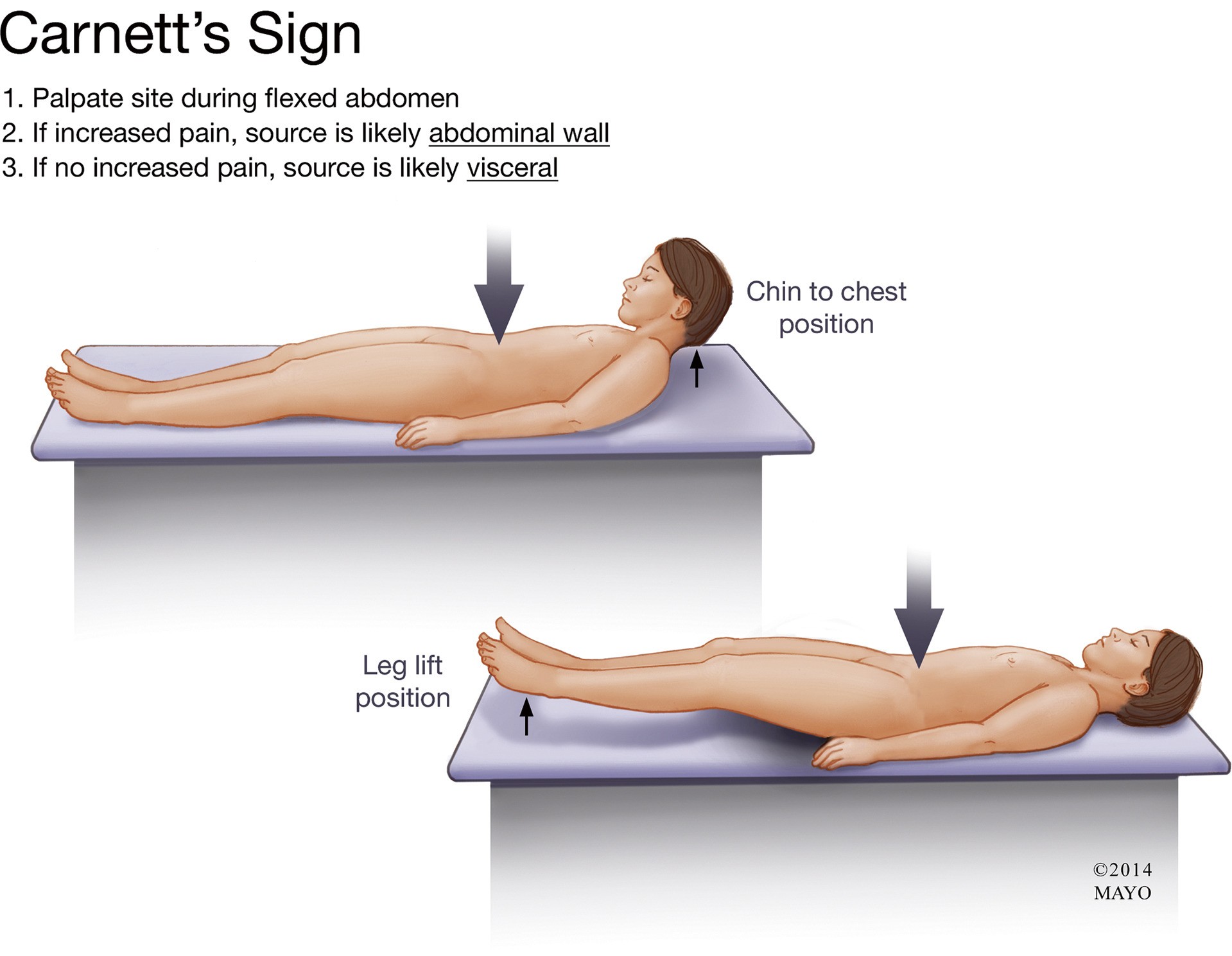
Interpreting Carnett’s Sign
- The Carnett Sign is Positive if: The Pain has not decreased and remains constant. This indicates that the pain is originating from the Abdominal Wall. This indicates nerve entrapment, hernias, or myositis as the likely case of the abdominal pain.
- The Carnett’s Sign is Negative if: The pain has decreased. This indicates that the source of the pain originates from abdominal organs. In other words, the pain is intra-abdominal.
When should you look for the Carnett’s Sign?
The best use of this examination is after you have evaluated the patient and performed an ultrasound but cannot pin-point the likely cause of the abdominal pain. It can also be performed when the patient has been examined, but the laboratory results are not deranged in any way. An interesting case study can be found below, which elaborates this further: