3. Open injuries (wounds)
High yield
Breach of skin or mucosa by a mechanical agent; three damage zones; types by agent and contamination.
Exam Prep · State examSurgery · Emergency and traumaSurgery · General surgery
1. Definition
- Wound (vulnus) → breach of the integrity of skin or mucosa, with or without damage to deeper tissues, caused by a mechanical agent
- Cardinal signs:
- Pain
- Bleeding
- Gaping → separation of the edges by elastic tissue retraction
- Loss of function
2. Parts of a wound
- Edges
- Walls
- Floor (blind wound) or channel
- Entry and exit openings (through-and-through wound)
3. Pathological processes in the wound
Zones of damage
- Wound defect (channel) → destroyed tissue, blood clot, foreign bodies, bacteria
- Zone of primary traumatic necrosis → tissue killed directly by the agent
- Zone of molecular concussion → damaged but viable tissue; becomes secondary necrosis with poor perfusion, oedema or infection
- Width of zones 2 and 3 → greatest in gunshot, crushed and contused wounds; minimal in incised wounds
Microbial contamination
- Every accidental wound → primarily contaminated
- Bacteria stay on the surface for the first 6–8 h, then invade the tissue
- Golden period → 6–8 h; primary closure possible after debridement
- Face and scalp → up to 24 h because of the rich blood supply
- Infection threshold → > 10^5 organisms per gram of tissue
- Secondary contamination → later, from dressings, hands, hospital
Healing processes
- Haemostasis
- Inflammation → cleansing of the wound, days 1–4
- Proliferation → granulation tissue, epithelialisation
- Remodelling (maturation) → scar
- Healing by primary or secondary intention → see Question 8
4. Classification
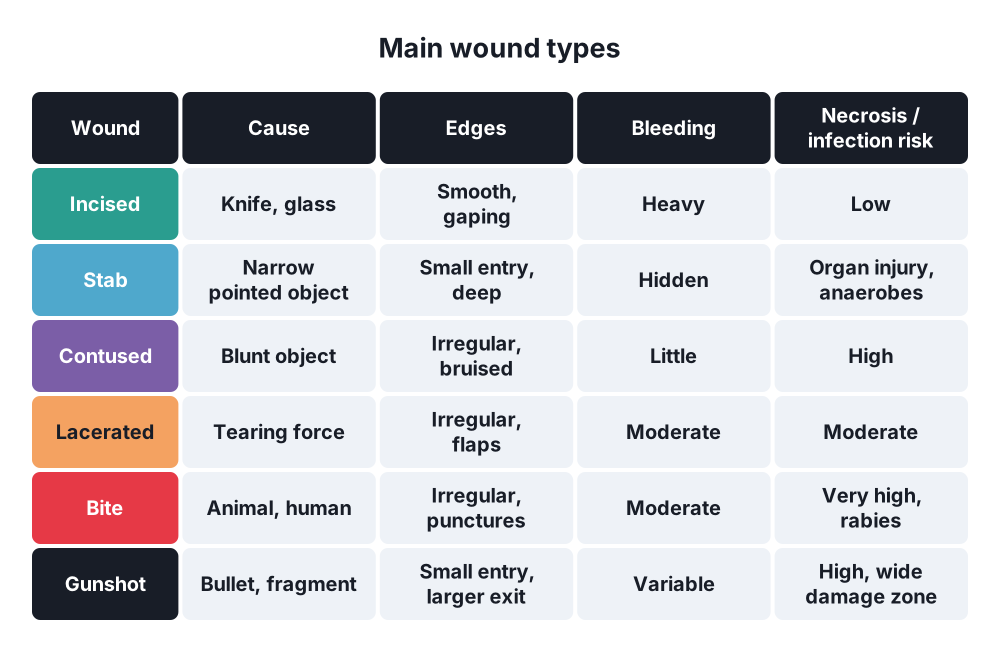
By agent (type of wound)
- Incised (vulnus scissum) → knife, glass; smooth edges, gaping, heavy bleeding, minimal necrosis, heals well
- Stab (vulnus punctum) → narrow, deep; small entry, risk of hidden organ injury and anaerobic infection
- Cut-stab (vulnus caesum) → axe, heavy sharp object; deep, with bone injury
- Contused (vulnus contusum) → blunt object; irregular edges, wide necrosis zone, little bleeding
- Lacerated (vulnus laceratum) → tearing force; irregular edges, flaps
- Crushed (vulnus conquassatum) → severe crushing; most tissue necrosis
- Bite (vulnus morsum) → animal or human; heavy oral flora, high infection risk, rabies risk
- Scalp (avulsion, degloving) → skin peeled off the deeper tissues
- Poisoned (vulnus venenatum) → snake or insect venom, chemicals
- Gunshot (vulnus sclopetarium) → bullet or fragment
- Low velocity (< 600 m/s) → damage along the track
- High velocity (> 600 m/s) → temporary cavity, damage far beyond the track
- Entry small; exit larger and irregular
- Mixed → combined features
By course of the channel
- Blind → no exit
- Through-and-through (perforating) → entry and exit
- Tangential → grazes the surface
By relation to a body cavity
- Non-penetrating
- Penetrating → into the peritoneal, pleural, cranial or joint cavity
By origin
- Surgical (intentional) → aseptic conditions
- Accidental → always contaminated
By surgical contamination class
- Clean → infection risk 1–2%; no viscus opened (hernia repair)
- Clean-contaminated → < 10%; viscus opened under control (cholecystectomy)
- Contaminated → 15–20%; spillage from bowel, fresh traumatic wound
- Dirty → > 30%; pus, perforated viscus, old traumatic wound
By time
- Fresh → < 6–8 h
- Old → > 6–8 h, colonised
- Infected → clinical signs of infection
5. Clinical and surgical significance
- Examine for depth, foreign bodies, nerve, tendon and vessel damage
- Every wound → tetanus prophylaxis according to immunisation status
- Bite wounds → rabies assessment; not closed primarily, except on the face
- Penetrating abdominal or chest wound → assess for organ injury before closure
- Treatment → primary surgical treatment of the wound (Question 9)
Show as a list
Wounds
- Signs
- Pain
- Bleeding
- Gaping
- Loss of function
- Zones
- Wound defect
- Primary necrosis
- Molecular concussion
- Types by agent
- Incised
- Stab
- Contused
- Lacerated
- Bite
- Gunshot
- Channel
- Blind
- Through-and-through
- Tangential
- Contamination class
- Clean
- Clean-contaminated
- Contaminated
- Dirty