9. Wound treatment and primary surgical treatment
High yield
Primary surgical treatment turns a contaminated wound into a clean one; closure is primary, delayed primary or secondary.
Exam Prep · State examSurgery · General surgerySurgery · Operative techniques
1. Indications
- Primary surgical treatment (PST, primary surgical debridement) → first operation on an accidental wound
- Purpose:
- Convert a contaminated wound into a surgically clean wound
- Remove dead tissue (primary necrosis), foreign bodies and bacteria
- Stop bleeding
- Restore damaged structures
- Create conditions for primary healing
- Done in the first 6–8 h (early PST)
- Delayed PST → 24–48 h, with antibiotics
- Late PST → > 48 h, infected wound; drainage, no closure
- Every deep, contaminated, contused or gunshot wound
2. Contraindications
- Shock → resuscitate first
- Superficial abrasions and small clean incised wounds → simple cleaning and closure
- Small through-and-through bullet wounds with no organ, vessel or bone damage
- Established infection → open and drain, no excision with closure
3. Preparation and positioning
- Assess the patient first → Advanced Trauma Life Support (ATLS) priorities
- Check distal pulses, sensation, movement before anaesthesia
- Tetanus prophylaxis → toxoid and/or human tetanus immunoglobulin according to immunisation status
- Antibiotics → contaminated, bite and old wounds
- X-ray → foreign bodies, fractures
- Anaesthesia → local infiltration, regional block or general
- Clean the skin around the wound, shave if needed; antiseptic from the wound edge outwards
4. Steps
- Irrigate the wound with large volumes of saline under pressure
- Explore the whole depth of the wound; extend the incision if needed (dissection)
- Excise non-viable skin edges, 1–2 mm (face: minimal or none)
- Excise dead fat, fascia and muscle
- Muscle viability → 4 C's: colour, consistency, contractility, capillary bleeding
- Remove foreign bodies and clots
- Achieve haemostasis
- Repair vessels, nerves, tendons when the wound is clean (or tag for later repair)
- Irrigate again; change gloves and instruments
- Decide on closure: primary suture or leave open
- Drain if dead space remains
- Dressing, immobilisation, elevation
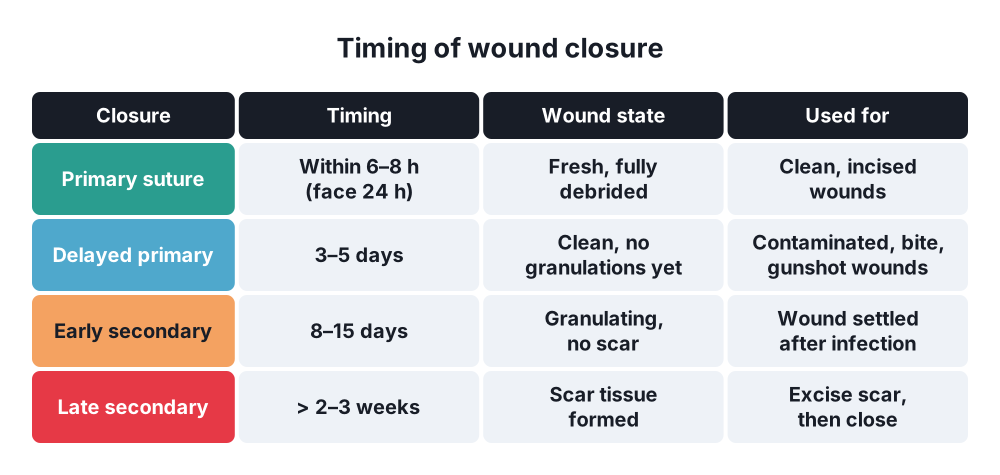
5. Closure of the wound
A. Primary suture
- Immediately after PST, within 6–8 h
- Face and scalp → up to 24 h
- Indications:
- Fresh wound, < 6–8 h
- Complete debridement possible
- Good blood supply, no tension
- Patient can be observed
- Contraindications:
- Wound > 8–12 h old
- Heavy contamination, soil
- Gunshot wounds, war wounds
- Bite wounds (except the face)
- Crushed tissue, incomplete debridement
- Signs of infection
B. Delayed primary suture
- 3–5 days after PST
- Wound clean, no granulation tissue yet, no signs of infection
- Contaminated, bite, gunshot wounds
C. Early secondary suture
- 8–15 days, on a granulating wound without scar
- Edges mobilised without excision
D. Late secondary suture
- After 2–3 weeks, scar tissue present
- Excise the scar and granulations, then close
E. Other methods
- Skin grafts → split-thickness, full-thickness
- Local flaps
- Negative pressure wound therapy
6. Suturing a treated wound
- Skin sutures:
- Simple interrupted → most common
- Vertical mattress (Donati) → everts edges
- Horizontal mattress
- Intradermal (subcuticular) → best cosmetic result
- Materials → non-absorbable monofilament for skin (nylon, polypropylene); absorbable for deep layers
- Alternatives → staples, adhesive strips, tissue adhesive
- Rules:
- Close dead space in layers
- No tension on the edges
- Equal bites on both sides, edges slightly everted
- Suture removal:
- Face → 3–5 days
- Scalp → 7–10 days
- Trunk → 7–10 days
- Limbs → 10–14 days
- Over joints, back, feet → 14 days
7. Complications
- Wound infection → remove sutures, open and drain
- Haematoma, seroma
- Wound dehiscence
- Tetanus, gas gangrene → in untreated, contaminated wounds
- Missed foreign body, missed nerve or tendon injury
- Hypertrophic scar, keloid
Show as a list
Primary surgical treatment
- Purpose
- Clean wound
- Remove dead tissue
- Haemostasis
- Timing
- Early: 6–8 h
- Delayed: 24–48 h
- Late: > 48 h
- Steps
- Irrigation
- Excision
- Haemostasis
- Repair structures
- Closure
- Primary suture
- Delayed primary
- Early secondary
- Late secondary
- Prophylaxis
- Tetanus
- Antibiotics