
What is the Jarisch-Herxheimer reaction
High yield
Self-limiting fever, rigors and hypotension within 24 h of antibiotics for spirochaetes; mimics sepsis and septic shock.
Exam Prep · Viva and oral examsSurgery · Emergency and trauma
1. Definition
- Jarisch-Herxheimer reaction (JHR) → acute, transient inflammatory reaction within 24 h of starting antibiotics for a spirochaetal infection
- Self-limiting → resolves in 12–24 h, often without targeted treatment
- Diagnosis → clinical
- Named after Adolf Jarisch (Austrian dermatologist, late 1800s) and Karl Herxheimer (German dermatologist, early 1900s)
- First seen as worsening of syphilitic skin lesions after mercury treatment
2. Why it is asked in the viva
- Classic oral exam question → "a patient becomes febrile and hypotensive a few hours after the first dose of penicillin"
- Examiner wants the differential diagnosis of sepsis and septic shock
- Second differential → antibiotic allergy (anaphylaxis)
- Reason → severe JHR looks like sepsis or distributive shock, but needs no change of antibiotics
- Model answer:
- Name it → Jarisch-Herxheimer reaction
- Link it → spirochaetal infection, first antibiotic dose
- Time it → onset within hours, gone in 24 h
- Separate it → from sepsis and from drug allergy
- Manage it → supportive care, continue antibiotics
3. Aetiology
Infections
- Syphilis → most common, and the first in which JHR was described
- Lyme disease
- Leptospirosis
- Relapsing fever → louse-borne and tick-borne
- Also reported → other bacterial, fungal and protozoal infections; babesiosis
Antibiotics
- Most often → penicillins, tetracyclines, erythromycin
- Also → cephalosporins, ciprofloxacin, levofloxacin, clarithromycin, azithromycin, meropenem
- Can follow antibiotics given for another infection (e.g. gonorrhoea) when a spirochaetal infection is undiagnosed
4. Incidence
Syphilis
- Seronegative primary → 55%
- Seropositive primary → 95%
- Secondary → 95%
- Latent → does not occur
- Late → rare, except general paresis of the insane (GPI) → 75%
- Pregnancy → up to 40%
Other spirochaetes
- Lyme disease → 7–30%
- Leptospirosis → about 9%
- Tick-borne relapsing fever → 39%
- Louse-borne relapsing fever → 37–100%, depends on the antibiotic
5. Pathophysiology
- Antibiotic kills spirochaetes rapidly
- Lysis releases lipoproteins and endotoxin-like substances
- Cytokine release → interleukin 6 (IL-6), interleukin 8 (IL-8), tumour necrosis factor alpha (TNF-α)
- Acute systemic inflammatory response → fever, myalgia, flushing, rash, nausea
- Onset → within 2 h of the antibiotic
- Severity → proportional to the spirochaete load
6. Clinical picture
Symptoms
- Fever, chills, rigors
- Headache, malaise, myalgia, weakness
- Nausea, vomiting
- Sore throat → early picture may look viral
Signs
- Tachycardia, hyperventilation, flushing
- Hypotension
- Transient early hypertension
- Worsening of existing skin lesions
Severe form (sepsis mimic)
- Systemic inflammatory response → tachycardia, tachypnoea, hypotension
- Picture of sepsis or distributive shock
- Organ dysfunction → myocardial failure, pulmonary oedema, liver or kidney impairment
- Neurological → meningitis, seizures, cerebral oedema
By stage of syphilis
- Primary → oedema around the chancre, chancre ulceration
- Secondary → more marked rash
- GPI → worse psychosis, seizures, focal deficits
- Tabes dorsalis → more lightning pains, constipation, urinary retention
7. Diagnosis
- Clinical → timing after the first antibiotic dose plus a known or suspected spirochaetal infection
Laboratory
- Lymphopenia
- Polymorphonuclear leucocytosis
- Raised erythrocyte sedimentation rate (ESR)
- Syphilis serology → if risk factors and no known diagnosis
- Unexpected JHR-like reaction after antibiotics → search for a spirochaetal infection, especially syphilis
8. Differential diagnosis
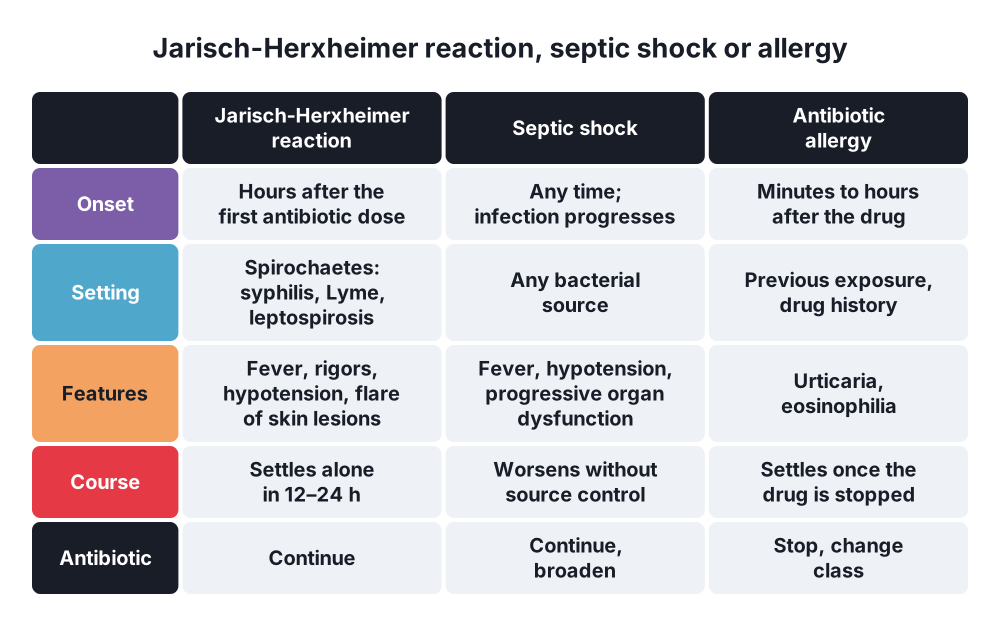
A. Sepsis and septic shock
- Main differential, and the reason JHR is examined
- Both → fever, rigors, tachycardia, tachypnoea, hypotension, organ dysfunction
- Points towards JHR:
- Starts within hours of the first antibiotic dose
- Known or suspected spirochaetal infection
- Settles by itself within 12–24 h
- Points towards sepsis:
- Worsening despite treatment
- Persisting or progressing end-organ dysfunction
- Unstable patient or organ dysfunction → assess for bacteraemia and sepsis; never assume JHR
B. Antibiotic hypersensitivity
- Common misdiagnosis → patient wrongly labelled penicillin allergic
- Allergy → generalised urticaria, eosinophilia, anti-penicillin antibodies
- Check the drug history
C. Hoigné syndrome
- Reaction to intramuscular procaine penicillin
- Immediately after injection → acute delirium, fear, perceptual disturbance
- Resolves within 30 min
D. Others
- Progression of the underlying infection
- Viral syndrome
- Viral exanthem, erythema multiforme → rash
9. Treatment
Mild
- Supportive care and observation
- Antipyretics → paracetamol or aspirin
- Continue the antibiotic → mild JHR is not a reason to stop
- Admission → only if risk factors: advanced syphilis, pregnancy
Severe
- Continuous monitoring of observations and end-organ function
- Hypotension → intravenous crystalloids, vasopressors if needed
- Severe leptospirosis → inotropes and temporary dialysis in case reports
- Corticosteroids → adjuvant in neurosyphilis; case reports only, no trial evidence
Prevention
- No reliably effective method
- Anti-TNF-α antibodies before treatment → reduced fever, pulse and blood pressure rise in a randomised trial
- Antipyretics → do not prevent it
- Warn the patient before treating a spirochaetal infection
Pregnancy
- Continuous foetal monitoring → contractions, variable decelerations
- Prefer agents with lower JHR risk where possible
10. Complications
- Most cases → no lasting harm
- Severe → hypotension with end-organ dysfunction or failure
- Neurosyphilis → seizures, focal deficits; transient psychosis in GPI
- Cardiovascular syphilis → heart failure, aortic aneurysm rupture, acute pulmonary hypertension
- Laryngeal gumma → oedema, may need tracheotomy
- Pregnancy → uterine irritability, preterm contractions
11. Prognosis
- Excellent in most → recovery in 12–24 h with supportive care
- Severe cases → depends on organ involvement and comorbidities
- JHR in syphilis → does not predict the response to treatment
Show as a list
Jarisch-Herxheimer reaction
- Cause
- Syphilis
- Lyme disease
- Leptospirosis
- Relapsing fever
- Mechanism
- Spirochaete lysis
- IL-6, IL-8, TNF-α
- Clinical
- Within 24 h
- Fever, rigors
- Hypotension
- Skin lesions worse
- Differentials
- Sepsis, septic shock
- Drug allergy
- Hoigné syndrome
- Management
- Supportive
- Continue antibiotics
- Fluids, vasopressors
Source
- Wood JM, Sbar E. Jarisch-Herxheimer Reaction. [Updated 2025 Jul 7]. In: StatPearls [Internet]. Treasure Island (FL): StatPearls Publishing; 2026 Jan-
- Read the full article → NCBI Bookshelf, NBK557820