31. Thyrotoxicosis
High yield
Excess circulating thyroid hormone; Graves' disease, toxic multinodular goitre and toxic nodule, treated by drugs, radioiodine or thyroidectomy.
Exam Prep · State examSurgery · General surgery
1. Definition
- Thyrotoxicosis → clinical syndrome of excess circulating thyroid hormones
- Hyperthyroidism → excess synthesis or secretion of hormone by the thyroid itself
- Thyrotoxicosis without hyperthyroidism → thyroiditis, factitious intake
- Overt → suppressed thyroid-stimulating hormone (TSH), raised free thyroxine (T4) or triiodothyronine (T3)
- Subclinical → suppressed TSH, normal free T4 and T3; risk of atrial fibrillation and osteoporosis
2. Epidemiology
- United Kingdom → 27 in 1000 women, 3 in 1000 men
- Graves' disease → 4 times more common in women, age 20–40 years
3. Aetiology and risk factors
- Graves' disease, toxic multinodular goitre, solitary toxic nodule → over 95% of cases
Thyrotoxicosis with hyperthyroidism
- Graves' disease → most common cause
- Toxic multinodular goitre (Plummer's disease) → elderly, iodine-deficient areas
- Solitary toxic nodule (adenoma)
- Iodine-induced → Jod-Basedow phenomenon in a nodular gland
- Rare → TSH-secreting pituitary adenoma, hydatidiform mole, choriocarcinoma, struma ovarii, metastatic follicular carcinoma
Thyrotoxicosis without hyperthyroidism
- Thyroiditis → de Quervain's (subacute), postpartum, silent, early Hashimoto's
- Drug-induced → amiodarone, interferon
- Factitious → excess levothyroxine
Triggers of Graves' disease
- Smoking, stress, iodine, radiation
- Genes → HLA-DR3, CTLA-4; 80% concordance in identical twins
4. Pathogenesis
Graves' disease
- TSH receptor antibodies (TRAb) bind and stimulate the TSH receptor
- Diffuse hyperplasia and hypertrophy of follicles → diffuse vascular goitre
- Excess T4 and T3 secretion → raised metabolic rate, sensitivity to catecholamines
- Same antibodies act on orbital fibroblasts → inflammation, oedema, fibrosis → orbitopathy
Toxic nodular disease
- Activating mutations of the TSH receptor gene → autonomous nodules
- Nodules work independent of TSH → TSH suppressed, rest of the gland switched off
- Not autoimmune → no remission with drugs
Thyroiditis
- Destruction of follicles → release of stored hormone → transient thyrotoxicosis, low uptake on scan
5. Classification
- By cause → Graves', toxic multinodular goitre, toxic nodule, thyroiditis, drug-induced, factitious
- By severity → overt, subclinical
- Amiodarone-induced:
- Type 1 → iodine-induced excess synthesis in an abnormal gland
- Type 2 → destructive thyroiditis in a normal gland; responds to steroids
6. Clinical picture
Symptoms
- Weight loss with increased appetite
- Heat intolerance, sweating
- Palpitations, dyspnoea
- Anxiety, irritability, tremor, fatigue
- Diarrhoea
- Oligomenorrhoea
- Elderly → few symptoms; atrial fibrillation or heart failure alone
Signs
- Tachycardia, atrial fibrillation
- Fine tremor, warm moist skin, hyperreflexia, proximal myopathy
- Lid lag, lid retraction → sympathetic overactivity, any cause
- Goitre:
- Diffuse with bruit or thrill → Graves'
- Nodular → toxic multinodular goitre
- Single nodule → toxic nodule
Graves'-specific signs
- Ophthalmopathy → exophthalmos, chemosis, lid retraction, periorbital oedema, ophthalmoplegia, diplopia, corneal ulcers; usually bilateral
- Pretibial myxoedema (dermopathy)
- Thyroid acropachy → finger clubbing
- Vitiligo, alopecia, other autoimmune disease
7. Diagnosis
Laboratory
- TSH → suppressed (except pituitary adenoma)
- Free T4 and T3 → raised
- TRAb → raised in 90% of Graves' disease; specificity 99%
- Anti-thyroid peroxidase (TPO) antibodies → autoimmune thyroid disease, thyroiditis
- Full blood count and liver function tests → baseline before antithyroid drugs
Imaging
- Ultrasound → increased vascularity in Graves', reduced in thyroiditis; nodules
- Scintigraphy (technetium-99m or iodine-123):
- Diffuse increased uptake → Graves' disease
- Patchy uptake → toxic multinodular goitre
- Single hot focus, rest suppressed → toxic nodule
- Low uptake → thyroiditis, iodine excess, factitious
- Toxic nodule → no fine-needle aspiration cytology (FNAC); hot nodules are rarely malignant and cytology is unhelpful (Thy3f)
- CT or MRI of the orbits → orbitopathy
8. Differential diagnosis
- Anxiety disorder
- Phaeochromocytoma
- Menopause
- Diabetes mellitus, malignancy → weight loss
- Sympathomimetic drugs, cocaine
9. Treatment
Conservative
- Beta-blockers (propranolol 40–120 mg/day) → tachycardia, tremor; also reduce T4 to T3 conversion
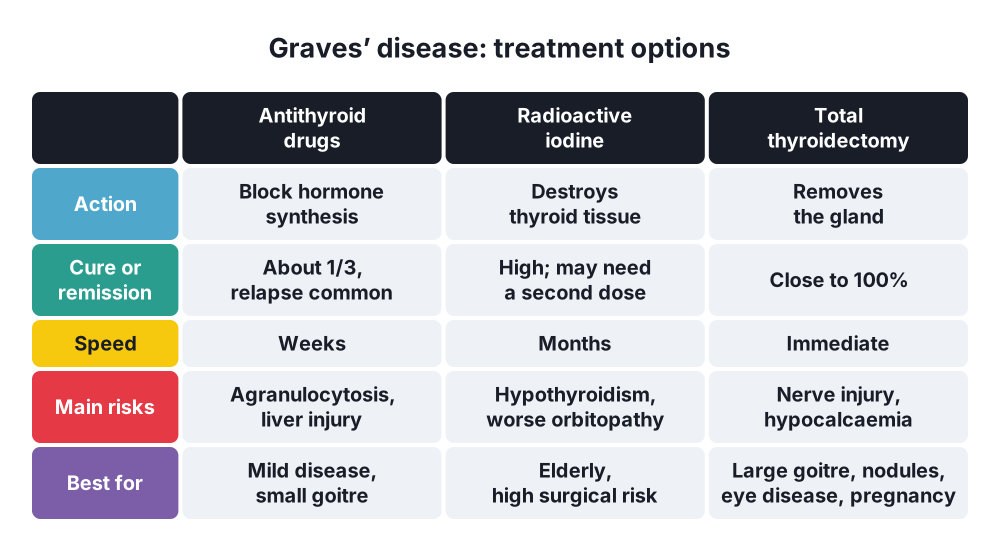
- Antithyroid drugs:
- Carbimazole → first choice in the United Kingdom
- Propylthiouracil → first trimester of pregnancy, thyroid storm; blocks T4 to T3 conversion; risk of liver failure
- Regimens → dose titration, or block and replace (carbimazole 40 mg + levothyroxine after 4–6 weeks)
- Euthyroid in 4–8 weeks; continued 12–18 months for remission
- Relapse after stopping → about 60%; higher in men, smokers, large goitre, high TRAb
- Side effects → rash, arthralgia, agranulocytosis
- Radioactive iodine (RAI, iodine-131):
- Given as a drink; works in up to 4 months
- Relapse → 15–20%
- Contraindicated → pregnancy, breastfeeding, pregnancy planned within 6 months, close contact with young children
- Severe eye disease → avoid; worsens in 15%; mild stable disease → give with steroid cover
- Late hypothyroidism common
- Toxic nodular disease → drugs only to prepare for RAI or surgery
- Subclinical disease → treat if ≥ 65 years, cardiac risk, osteoporosis risk, symptoms
Surgical
- Indications:
- Large goitre with compression
- Suspicious or malignant nodule
- Severe or active ophthalmopathy
- Pregnancy, breastfeeding, planned pregnancy
- Children
- Failure, relapse, side effects or poor compliance with drugs
- Need for rapid control
- Operations:
- Graves' disease → total thyroidectomy; cure in all; replaced subtotal thyroidectomy
- Toxic multinodular goitre → total thyroidectomy
- Solitary toxic nodule → lobectomy on the side of the nodule
- Preoperative preparation:
- Euthyroid with antithyroid drugs → avoids thyroid storm
- Beta-blocker for tachycardia
- Lugol's iodine 0.3 mL 3 times daily for 10 days in Graves' disease → less vascular gland (Wolff-Chaikoff effect)
- No iodine in toxic nodular goitre → may worsen thyrotoxicosis (Jod-Basedow)
- Vocal cord check, calcium and vitamin D
- After total thyroidectomy → lifelong levothyroxine
Pregnancy
- Graves' → 1 in 500 pregnancies
- Propylthiouracil in the first trimester, carbimazole after
- RAI contraindicated; surgery in the second trimester if needed
- TRAb cross the placenta → foetal and neonatal thyrotoxicosis
10. Complications
Of the disease
- Atrial fibrillation, cardiac failure
- Osteoporosis, muscle wasting
- Loss of vision → corneal ulceration, optic nerve compression
- Thyroid storm:
- Triggers → surgery, trauma, infection, iodinated contrast, RAI, stopping drugs
- Fever, marked tachycardia, arrhythmia, heart failure, vomiting, diarrhoea, agitation, coma
- Treatment → beta-blocker, propylthiouracil, potassium iodide (1 h after the thionamide), hydrocortisone, cooling, intensive care
Of thyroidectomy in Graves' disease
- Bleeding → 1%
- Hypoparathyroidism → temporary in up to 30%; permanent in up to 5–10% (0.6–6% in high-volume centres)
- Recurrent laryngeal nerve injury → 1–2%; bilateral about 1 in 500
- External branch of the superior laryngeal nerve → loss of high pitch
- Hypothyroidism → expected after total thyroidectomy
Show as a list
Thyrotoxicosis
- Causes
- Graves' disease
- Toxic multinodular goitre
- Toxic nodule
- Thyroiditis
- Amiodarone
- Clinical
- Weight loss, tremor
- Atrial fibrillation
- Ophthalmopathy
- Pretibial myxoedema
- Diagnosis
- Low TSH
- High free T4, T3
- TRAb
- Scintigraphy
- Treatment
- Beta-blockers
- Carbimazole
- Radioiodine
- Thyroidectomy
- Complications
- Thyroid storm
- Agranulocytosis
- Nerve, parathyroids