32. Thyroid carcinoma
High yield
Papillary, follicular, medullary and anaplastic carcinoma; ultrasound and FNA, thyroidectomy, neck dissection and radioiodine.
Exam Prep · State examSurgery · Surgical oncologySurgery · General surgery
1. Definition
- Thyroid carcinoma → malignant tumour of the thyroid gland
- Arises from follicular cells → differentiated (papillary, follicular, oncocytic), poorly differentiated, anaplastic
- Arises from parafollicular C cells → medullary carcinoma
2. Epidemiology
- Most common endocrine malignancy
- Female predominance → about 3:1
- Thyroid nodules → palpable in 5%; on ultrasound in up to 50% by age 50 years
- Malignant nodules → rare, about 4 per 100 000 per year
- Solitary thyroid nodule → most common thyroid disorder; colloid nodule most often
3. Aetiology and risk factors
- Ionising radiation in childhood → papillary carcinoma (Chernobyl, Hiroshima, head and neck radiotherapy)
- Family history of differentiated thyroid cancer
- Hereditary syndromes:
- Familial adenomatous polyposis, Gardner's syndrome → papillary
- Cowden syndrome → follicular
- Carney complex → papillary, follicular
- Multiple endocrine neoplasia type 2 (MEN2) → medullary (RET mutation)
- Iodine deficiency → follicular
- Long-standing goitre → anaplastic
- Hashimoto's thyroiditis → thyroid lymphoma
4. Pathogenesis
- Papillary → BRAF V600E mutation, RET/PTC rearrangement
- Follicular → RAS mutation, PAX8-PPARγ rearrangement
- Medullary → RET proto-oncogene mutation; sporadic 75%, hereditary 25%
- Anaplastic → dedifferentiation of a differentiated tumour, TP53 mutation
5. Classification
A. Papillary carcinoma (PTC)
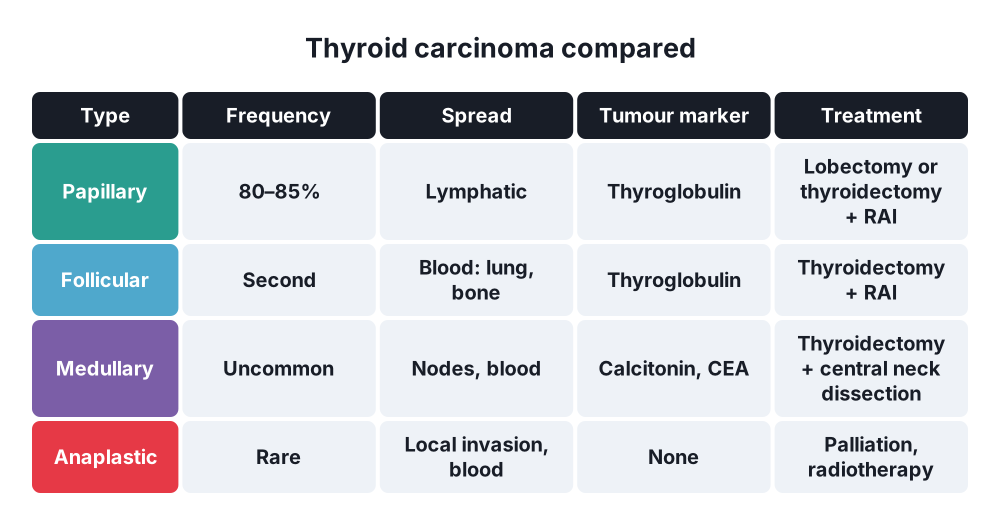
- Most common → about 80–85%
- Young adults, women
- Spread → lymphatic to central and lateral neck nodes; microscopic nodal disease in up to 80%
- Distant metastases → 3–5%, lung and bone
- Papillary microcarcinoma → ≤ 1 cm
- Histology → papillae, Orphan Annie (clear) nuclei, nuclear grooves, pseudoinclusions, psammoma bodies
- Multifocal, often bilateral
- Aggressive variants (< 1%) → tall cell, hobnail, diffuse sclerosing, columnar
B. Follicular carcinoma (FTC)
- Second most common
- Older adults, female to male 3:1, iodine-deficient areas
- Spread → haematogenous to lung and bone; nodes in < 10%
- Diagnosis → capsular or vascular invasion on histology; cannot be made on FNA
- Minimally invasive → capsular invasion only; excellent prognosis
- Widely invasive → through the capsule into the gland and vessels; haematogenous metastases
C. Oncocytic carcinoma
- Formerly Hürthle cell carcinoma
- ≥ 75% oncocytic cells
- Less radioiodine-avid
D. Medullary carcinoma (MTC)
- From parafollicular C cells → secretes calcitonin and carcinoembryonic antigen (CEA)
- Sporadic → unifocal, age 40–60 years
- Hereditary → bilateral, multifocal; MEN2A, MEN2B, familial medullary carcinoma
- MEN2A → MTC, phaeochromocytoma, hyperparathyroidism
- MEN2B → MTC, phaeochromocytoma, mucosal neuromas, marfanoid habitus
- Does not take up iodine → no role for RAI
E. Anaplastic carcinoma (ATC)
- Older women, rapidly growing hard mass over weeks
- Hoarseness, dysphagia, stridor
- Most aggressive → median survival about 5 months
- All are stage IV
F. Others
- Thyroid lymphoma → diffuse B-cell non-Hodgkin's or mucosa-associated lymphoid tissue (MALT) lymphoma; background of Hashimoto's thyroiditis; rapid growth; core biopsy; chemotherapy and radiotherapy
- Metastases to the thyroid → kidney, lung, breast, melanoma
Staging
- Tumour, node, metastasis (TNM) system, American Joint Committee on Cancer (AJCC) 8th edition
- Differentiated cancer → age 55 years is the cut-off
- Under 55 years → stage I without distant metastases, stage II with them
6. Clinical picture
Symptoms
- Painless thyroid nodule → most common presentation
- Rapid growth
- Hoarseness → recurrent laryngeal nerve invasion
- Dysphagia, dyspnoea, cough, haemoptysis
- Diarrhoea, flushing → medullary carcinoma (calcitonin)
- Bone pain → metastases
Signs
- Hard, irregular, fixed nodule
- Solitary nodule in a man, a child or an elderly patient → higher cancer risk
- Rapid growth of a long-standing nodule
- Cervical lymphadenopathy
- Vocal cord palsy
- Horner's syndrome → extensive spread
7. Diagnosis
Laboratory
- TSH → usually normal
- Calcitonin and CEA → medullary carcinoma
- RET mutation testing → all medullary carcinomas and their families
- Plasma metanephrines before surgery in medullary carcinoma → exclude phaeochromocytoma
- Thyroglobulin → tumour marker after total thyroidectomy, not for diagnosis
Imaging
- Ultrasound of the thyroid and neck nodes:
- Suspicious → hypoechoic, solid, taller than wide, irregular margins, microcalcifications, extrathyroidal extension
- United Kingdom → British Thyroid Association U1–U5 grading: U1 normal, U2 benign, U3 equivocal, U4 suspicious, U5 malignant
- United States → thyroid imaging reporting and data system (TI-RADS)
- FNA for U3–U5
- FNA cytology, United Kingdom Thy system (risk of malignancy):
- Thy1 → non-diagnostic; repeat
- Thy2 → benign colloid nodule; 0–3%
- Thy3a → atypia; 5–15%
- Thy3f → follicular lesion; 15–30%; diagnostic lobectomy
- Thy4 → suspicious of malignancy; 60–75%
- Thy5 → malignant; 97–100%
- Bethesda system (6 categories) → used outside the United Kingdom; same steps from non-diagnostic to malignant
- Follicular adenoma or carcinoma → separated only on histology after excision
- Molecular testing → indeterminate cytology (Bethesda 3 and 4)
- CT of neck and chest → locally advanced disease, retrosternal extension
- Laryngoscopy → vocal cord function before surgery
- Core biopsy → lymphoma, anaplastic carcinoma
8. Differential diagnosis
- Benign colloid nodule, multinodular goitre
- Follicular adenoma
- Thyroid cyst
- Thyroiditis → Hashimoto's, Riedel's
- Parathyroid tumour
- Lymphadenopathy of other origin
9. Treatment
Surgical
- Differentiated carcinoma:
- Lobectomy with isthmus → minimum operation; diagnostic for Thy3f; curative for papillary < 1 cm and minimally invasive follicular carcinoma
- Lobectomy also acceptable → low-risk papillary 1–4 cm, no nodes, no extrathyroidal extension (current guidelines)
- Total thyroidectomy → > 4 cm, extrathyroidal extension, nodal or distant metastases, previous neck radiation, familial disease, bilateral tumours
- Completion thyroidectomy → after lobectomy shows high-risk papillary or widely invasive follicular carcinoma
- Microcarcinoma < 1 cm, low risk → lobectomy or active surveillance
- Neck nodes:
- Clinically involved central nodes → central compartment (level VI) dissection
- Involved lateral nodes → central and lateral (levels II–V) neck dissection
- Prophylactic central dissection → selected high-risk tumours (T3, T4)
- Medullary carcinoma → total thyroidectomy with central neck dissection; lateral dissection for involved nodes
- Prophylactic thyroidectomy in RET carriers → timing set by the mutation; in the first year of life in MEN2B
- Anaplastic carcinoma → resection if localised; tracheostomy for the airway only if needed
Conservative and adjuvant
- Radioactive iodine (RAI) → ablation of remnant and metastases after total thyroidectomy in intermediate and high-risk differentiated cancer
- Uptake needs a high TSH → stop liothyronine (T3) for 2 weeks, or give recombinant human TSH (rhTSH) without stopping hormone
- TSH suppression with levothyroxine:
- Low to intermediate risk → TSH 0.1–0.5 mU/L
- High risk → TSH < 0.1 mU/L
- External beam radiotherapy → unresectable or anaplastic disease
- Targeted therapy → tyrosine kinase inhibitors for RAI-refractory and medullary disease; dabrafenib + trametinib for BRAF V600E anaplastic carcinoma
- Follow-up → thyroglobulin, anti-thyroglobulin antibodies, neck ultrasound
10. Complications
- Recurrent laryngeal nerve injury
- Hypoparathyroidism → hypocalcaemia
- Haematoma, airway compression
- Superior laryngeal nerve injury → voice fatigue, loss of high pitch
- Local recurrence, distant metastases
- RAI → sialadenitis, dry mouth, secondary malignancy
11. Prognosis
- Papillary → 10-year survival > 90%
- Follicular → slightly worse than papillary
- Medullary → depends on stage and calcitonin doubling time
- Anaplastic → very poor
Show as a list
Thyroid carcinoma
- Follicular cell
- Papillary
- Follicular
- Oncocytic
- Anaplastic
- C cell
- Medullary
- MEN2, RET
- Risk factors
- Childhood radiation
- Family history
- Diagnosis
- Ultrasound
- FNA, Bethesda
- Calcitonin
- Treatment
- Lobectomy
- Total thyroidectomy
- Neck dissection
- Radioiodine
- TSH suppression