4. Thermal burns
High yield
Heat injury graded by depth and extent; burn disease runs through shock, toxaemia, septicotoxaemia and convalescence.
Exam Prep · State examSurgery · Emergency and traumaSurgery · General surgery
1. Definition
- Thermal burn → tissue damage from heat: flame, hot liquid (scald), steam, hot object (contact), flash
- Protein coagulation starts above 44 °C; damage rises with temperature and time of exposure
- Burn disease → general reaction of the body to an extensive burn
2. Aetiology and risk factors
- Children → scalds
- Adults → flame
- Epilepsy, alcohol, elderly, house fires
3. Pathogenesis
Local: zones of injury (Jackson)
- Zone of coagulation → dead tissue, must be debrided
- Zone of stasis → impaired blood flow; may survive or die (cooling, fluids, no infection save it)
- Zone of hyperaemia → minimal injury, recovers in 7–10 days
General
- Increased capillary permeability → loss of plasma into tissues and from the wound
- Hypovolaemia, haemoconcentration → burn shock
- Hypermetabolism, catabolism
- Immunosuppression → infection, sepsis
- Burn shock develops when burns are > 15% total body surface area (TBSA) in adults, > 10% in children and the elderly
4. Classification
Depth (local burns)
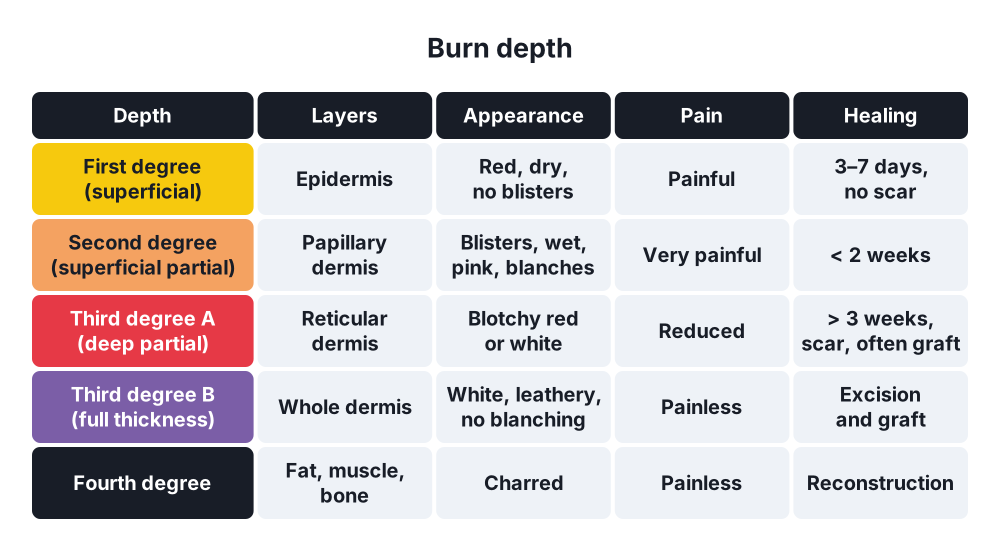
- First degree (superficial, epidermal) → erythema, pain, no blisters; heals in 3–7 days without scar
- Second degree (superficial partial thickness) → epidermis and papillary dermis; blisters, wet pink base, blanches, very painful; heals in < 2 weeks
- Third degree A (deep partial thickness) → reticular dermis; blotchy red or white, reduced sensation; heals in > 3 weeks with scarring, often needs grafting
- Third degree B (full thickness) → whole dermis; white, leathery or charred eschar, painless, no blanching; needs excision and grafting
- Fourth degree → subcutaneous fat, muscle, bone; charring
- Partial thickness → heals from surviving skin appendages (hair follicles, sweat glands)
- Depth may progress over the first 48–72 h
Extent
- Rule of nines (adults):
- Head and neck → 9%
- Each upper limb → 9%
- Front of trunk → 18%
- Back of trunk → 18%
- Each lower limb → 18%
- Perineum → 1%
- Palm method → patient's palm with fingers ≈ 1% TBSA
- Lund and Browder chart → most accurate; corrects for age (larger head in children)
- First-degree burns → not counted in TBSA
Severity
- Minor → partial thickness < 10% TBSA in adults, < 5% in children or elderly, full thickness < 2%
- Major → larger area, special areas (face, hands, feet, perineum, major joints), inhalation injury, electrical or chemical burns
- Baux score → age + % TBSA; add 17 for inhalation injury (revised Baux)
5. Clinical picture: stages of burn disease
- Burn shock → first 48–72 h; hypovolaemia, oliguria, haemoconcentration, thirst, restlessness
- Acute burn toxaemia → days 3–10; absorption of toxic products from the wound; fever, tachycardia, confusion, anaemia
- Septicotoxaemia → from week 2 until wounds close; wound infection, sepsis, wasting (burn cachexia)
- Convalescence → wounds healed; scars, contractures
6. Diagnosis
- History → agent, time, enclosed space (inhalation risk)
- Signs of inhalation injury:
- Burns to face, singed nasal hair
- Soot in the mouth, carbonaceous sputum
- Hoarse voice, stridor
- Fire in an enclosed space
- Carboxyhaemoglobin (COHb) level, arterial blood gas
- Full blood count, haematocrit, urea, electrolytes, creatine kinase
- Bronchoscopy → confirms airway injury
7. Treatment
First aid
- Stop the burning process; remove clothing and jewellery
- Cool with running tap water for 20 min (useful within 3 h); no ice
- Cover with cling film or a clean dressing
- Keep the patient warm
General treatment
- Primary survey (ABCDE):
- Airway → early intubation in inhalation injury before oedema closes the airway
- Breathing → 100% oxygen for carbon monoxide poisoning
- Circumferential chest burn → escharotomy to allow ventilation
- Fluid resuscitation → burns > 15% TBSA in adults, > 10% in children
- Parkland formula → 4 mL × body weight (kg) × % TBSA of Hartmann's (Ringer's lactate) in 24 h
- Half in the first 8 h from the time of the burn
- Half in the next 16 h
- Current guidance (Advanced Burn Life Support) → start at 2 mL × kg × % TBSA in adults
- Titrate to urine output → 0.5 mL/kg/h in adults, 1 mL/kg/h in children
- Analgesia → intravenous opioids
- Tetanus prophylaxis
- Early enteral nutrition → high protein and calorie
- Stress ulcer prophylaxis → prevents Curling's ulcer
- Venous thromboembolism prophylaxis
- No routine prophylactic systemic antibiotics → treat proven infection only
Local treatment
- Clean, debride loose skin and large or tense blisters
- Superficial burns → non-adherent dressing, moisturiser
- Partial and full thickness → topical antimicrobials (silver sulfadiazine, silver dressings)
- Closed method → dressings; open method → exposure (face, perineum)
- Escharotomy → circumferential full-thickness burn of a limb or chest; incise the eschar to release constriction
- Early tangential excision and split-thickness skin grafting → within 3–5 days for deep burns
- Large burns → temporary cover with allograft, xenograft or skin substitutes
- Physiotherapy, splinting, pressure garments → prevent contractures and hypertrophic scars
Referral to a burns centre
- Partial thickness > 10% TBSA
- Face, hands, feet, genitalia, perineum, major joints
- Full-thickness burns at any age
- Electrical, chemical and inhalation injuries
- Burns with major trauma or serious comorbidity
8. Complications
- Hypovolaemic shock, acute kidney injury
- Respiratory failure, acute respiratory distress syndrome (ARDS)
- Wound infection, sepsis (Pseudomonas, Staphylococcus aureus)
- Curling's ulcer → stress ulcer of the stomach or duodenum
- Compartment syndrome
- Hypertrophic scars, keloids, contractures
- Marjolin's ulcer → squamous cell carcinoma in a chronic burn scar
9. Prognosis
- Depends on age, % TBSA, depth, inhalation injury
- Revised Baux score > 140 → survival unlikely
Show as a list
Thermal burns
- Depth
- First degree
- Second degree
- Third degree A
- Third degree B
- Fourth degree
- Extent
- Rule of nines
- Palm 1%
- Lund and Browder
- Burn disease
- Burn shock
- Acute toxaemia
- Septicotoxaemia
- Convalescence
- General treatment
- ABCDE, airway
- Parkland formula
- Urine output
- Nutrition
- Local treatment
- Cooling 20 min
- Dressings
- Escharotomy
- Excision and grafting