19. Tetanus
High yield
Clostridium tetani toxin blocks inhibitory neurones, causing trismus, rigidity and spasms; prevented by toxoid and immunoglobulin.
Exam Prep · State examSurgery · General surgerySurgery · Emergency and trauma
1. Definition
- Tetanus → acute toxin-mediated disease with muscle rigidity and painful spasms, caused by Clostridium tetani
- Not transmitted from person to person
- No lasting immunity after the disease → vaccinate after recovery
2. Epidemiology
- Rare where vaccination is routine; neonatal tetanus in low-income countries
- Mortality → 10–50% (higher in neonates and the elderly)
3. Aetiology and risk factors
- Clostridium tetani → Gram-positive, anaerobic, spore-forming rod; drumstick appearance
- Spores → soil, dust, animal faeces; very resistant to heat and disinfectants
- Tetanus-prone wounds:
- Deep puncture wounds → nails, thorns, splinters
- Soil or manure contamination
- Devitalised tissue, crush injury, foreign bodies
- Burns, frostbite
- Wounds treated > 6 h after injury
- Open fractures, gunshot wounds
- Injecting drug use, umbilical stump, septic abortion
- Unvaccinated or incompletely vaccinated patients
4. Pathogenesis
- Spores enter the wound
- Anaerobic conditions (dead tissue, foreign body) → spores germinate into vegetative bacteria
- Bacteria produce tetanospasmin (neurotoxin) and tetanolysin
- Toxin enters motor nerve endings → retrograde axonal transport to the spinal cord and brainstem
- Toxin blocks release of inhibitory neurotransmitters (GABA and glycine) from inhibitory interneurones
- Uninhibited motor neurones → rigidity and spasms
- Sympathetic overactivity → autonomic instability
- Binding of toxin to neurones → irreversible; recovery needs new nerve terminals (4–6 weeks)
- Incubation period → 3–21 days (average 7–10)
- Short incubation (< 7 days) and short onset period (< 48 h) → severe disease, poor prognosis
5. Classification
- Generalised → most common (80%); descending spread
- Localised → rigidity near the wound; may become generalised
- Cephalic → head wounds, otitis; cranial nerve palsies (facial nerve)
- Neonatal → infected umbilical stump; inability to suck
6. Clinical picture
Prodrome
- Restlessness, irritability, headache
- Pulling pain and twitching around the wound
Rigidity (descending order)
- Trismus (lockjaw) → masseter spasm; first sign in most patients
- Risus sardonicus → sardonic smile from facial muscle spasm
- Neck stiffness, dysphagia
- Rigid abdominal wall (board-like)
- Opisthotonus → arched back from paravertebral muscle spasm
- Rigid limbs → arms flexed, legs extended
Spasms
- Painful generalised tonic spasms, triggered by noise, light, touch
- Patient fully conscious during spasms
- Laryngeal and diaphragmatic spasm → asphyxia
- Spasms may cause fractures (vertebral), muscle rupture
Autonomic dysfunction
- Labile hypertension and hypotension, tachycardia, arrhythmias
- Sweating, hyperpyrexia
- Cardiac arrest
7. Diagnosis
- Clinical diagnosis → no specific laboratory test
- Wound culture → positive in only 30%; negative does not exclude
- Spatula test → touching the posterior pharynx causes reflex masseter spasm (bites the spatula)
- Creatine kinase may be raised
8. Differential diagnosis
- Dental abscess, peritonsillar abscess → trismus
- Strychnine poisoning
- Dystonic reaction to drugs (metoclopramide, haloperidol)
- Meningitis, encephalitis
- Hypocalcaemic tetany
- Rabies
- Neuroleptic malignant syndrome
9. Treatment
Wound
- Surgical debridement of the wound → remove the source of toxin
- Leave the wound open
Neutralise unbound toxin
- Human tetanus immunoglobulin (HTIG) → 3000–6000 IU intramuscularly (some use 500 IU)
- Antitoxin binds only circulating toxin, not toxin already in neurones
Kill bacteria
- Metronidazole → drug of choice; 500 mg intravenously every 8 h for 7–10 days
- Penicillin → alternative
Control spasms
- Quiet, dark room; minimal handling
- Benzodiazepines → diazepam, midazolam
- Magnesium sulphate → spasms and autonomic instability
- Neuromuscular blockade with ventilation → severe cases
- Baclofen (intrathecal)
Supportive care in the intensive care unit
- Early tracheostomy → airway protection, prolonged ventilation
- Autonomic control → magnesium, labetalol, morphine
- Nutrition via nasogastric tube or gastrostomy
- Fluids, thromboprophylaxis, prevention of pressure ulcers
- Active immunisation with tetanus toxoid at a different site → disease does not give immunity
10. Prevention
Active immunisation
- Tetanus toxoid → primary course in childhood, boosters
- Full immunity → 5 doses in life
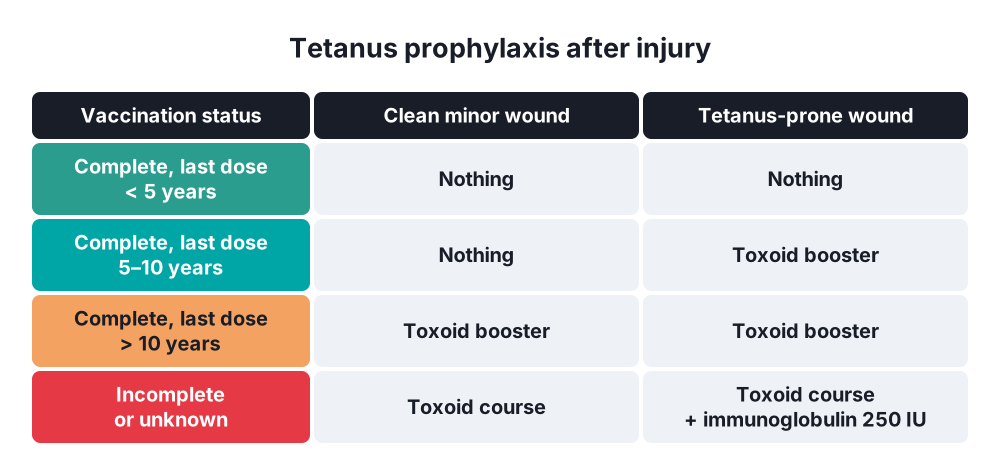
Prophylaxis after injury
- Wound care and debridement in every case
- Clean minor wound:
- Vaccination complete → no vaccine needed (booster if > 10 years since last dose)
- Incomplete or unknown → toxoid
- Tetanus-prone wound:
- Vaccination complete, last dose < 5 years → nothing more
- Vaccination complete, last dose > 5 years → toxoid booster
- Incomplete or unknown → toxoid + human tetanus immunoglobulin 250 IU (500 IU if > 24 h or heavy contamination)
- Toxoid and immunoglobulin → different sites, different syringes
11. Complications
- Asphyxia, aspiration pneumonia
- Autonomic crises, cardiac arrest
- Vertebral fractures
- Rhabdomyolysis, renal failure
- Complications of prolonged ventilation
Show as a list
Tetanus
- Cause
- Clostridium tetani
- Tetanospasmin
- Mechanism
- Retrograde transport
- Blocks GABA, glycine
- Forms
- Generalised
- Localised
- Cephalic
- Neonatal
- Signs
- Trismus
- Risus sardonicus
- Opisthotonus
- Spasms, conscious
- Treatment
- Debridement
- Immunoglobulin
- Metronidazole
- Benzodiazepines, ICU
- Prevention
- Toxoid
- Immunoglobulin