84. Terminal ileitis, small bowel tumours and Crohn's disease
High yield
Crohn's disease is transmural and patchy; surgery treats complications and saves bowel. Small bowel tumours are rare.
Exam Prep · State examSurgery · General surgerySurgery · ColorectalSurgery · Surgical oncology
1. Definition
- Terminal ileitis → inflammation of the terminal ileum; causes include Crohn's disease, Yersinia, tuberculosis, backwash ileitis (UC), lymphoma, NSAIDs, Behçet's disease
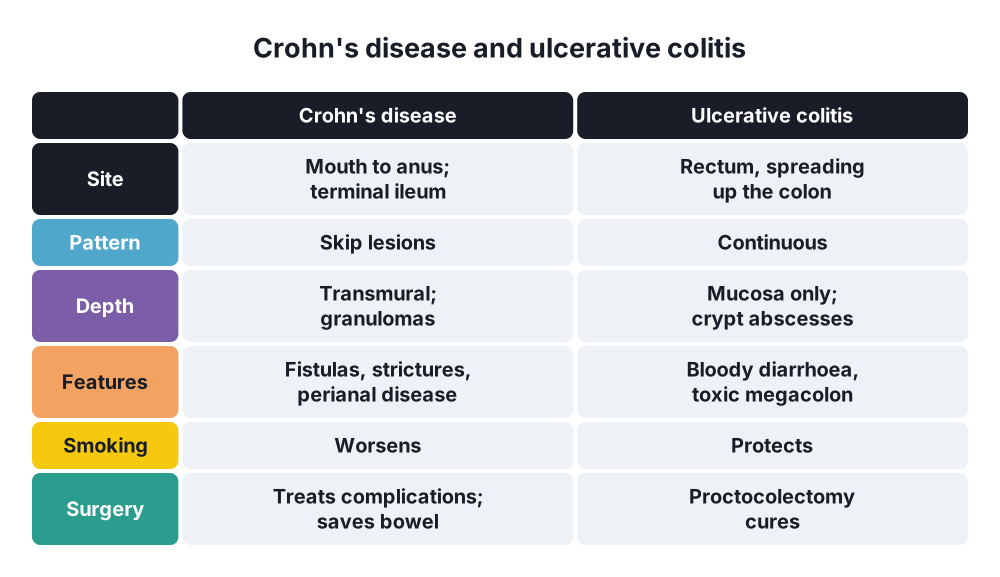
- Crohn's disease → chronic, relapsing, transmural granulomatous inflammation that can affect any part of the gut from mouth to anus, with skip lesions; most often the terminal ileum and caecum
- Small bowel tumours → benign (adenoma, lipoma, leiomyoma, hamartoma, haemangioma) or malignant (neuroendocrine tumour, adenocarcinoma, lymphoma, GIST, metastases)
2. Epidemiology
Crohn's disease
- Incidence 5–20 per 100,000 a year in Europe and North America; rising in Asia
- Peak 15–30 years, smaller peak at 50–70
- Slightly more in women; Ashkenazi Jews; northern Europe; urban areas
- Smokers have twice the risk (opposite of UC)
- Distribution:
- Ileocaecal (ileocolic) about 40–50%
- Small bowel only about 30%
- Colon only about 20–25%
- Perianal disease in about 30%
- About 70–80% need surgery at some time; 30–50% need a second operation within 10 years (rates now falling with biologics)
Small bowel tumours
- Small bowel is 75% of the gut length and 90% of its surface, but has only 3–6% of GI tumours and about 2% of GI cancers
- Neuroendocrine tumours (ileum) and adenocarcinoma (duodenum) are the most common malignancies; then lymphoma and GIST
- Age 50–70; diagnosis often delayed by months
3. Aetiology and risk factors
Crohn's disease
- Genetic → family history (10–15%), NOD2/CARD15 mutation (ileal, stricturing), ATG16L1, IL23R
- Environment → smoking, Western diet, antibiotics in childhood, NSAIDs, oral contraceptives, appendicectomy (debated)
- Gut microbiota → abnormal immune response to normal bacteria (dysbiosis)
- Immune → Th1 and Th17 response, TNF-alpha, IL-12, IL-23
Other terminal ileitis
- Yersinia enterocolitica (acute, children)
- Ileocaecal tuberculosis (endemic areas, HIV)
- Backwash ileitis (pancolitis in UC), NSAIDs, radiation, ischaemia, lymphoma, Behçet's, typhoid, actinomycosis, amoebiasis
Small bowel tumours
- Crohn's disease → adenocarcinoma in strictured ileum
- Coeliac disease → enteropathy-associated T-cell lymphoma (EATL), adenocarcinoma
- Familial adenomatous polyposis → duodenal and periampullary adenomas and cancer
- Lynch syndrome, Peutz-Jeghers syndrome (hamartomas; intussusception)
- Immunosuppression, HIV → lymphoma, Kaposi's sarcoma
- Neurofibromatosis type 1 → GIST
- MEN1 → duodenal gastrinoma
4. Pathogenesis
Crohn's disease
- Abnormal immune response in the mucosa
- Aphthous ulcers over lymphoid follicles
- Deep linear (fissuring) ulcers + oedematous mucosa → "cobblestone" pattern
- Transmural inflammation → thick wall, non-caseating granulomas (in 50–60%)
- Fat wraps around the bowel → "creeping fat" (fat wrapping)
- Chronic inflammation → fibrosis → strictures (string sign of Kantor)
- Deep fissures pass through the wall → fistulas, abscesses, adhesions to nearby organs
- Three behaviours (Montreal):
- Inflammatory (non-stricturing, non-penetrating)
- Stricturing (fibrotic narrowing → obstruction)
- Penetrating (fistula, abscess, perforation)
- Terminal ileum disease → loss of bile salt and vitamin B12 absorption → diarrhoea, gallstones, oxalate kidney stones, B12 deficiency
Small bowel tumours
- Fewer tumours because of rapid transit, liquid contents, few bacteria, high IgA and lymphoid tissue, alkaline pH, rapid cell turnover
- Neuroendocrine tumours (carcinoid) → from enterochromaffin cells; ileum; often multiple; desmoplastic reaction in the mesentery → kinking, mesenteric ischaemia; spread to nodes and liver → carcinoid syndrome (serotonin bypasses the liver)
- Adenocarcinoma → adenoma-carcinoma sequence; duodenum (most common site); annular, obstructing
- Lymphoma → non-Hodgkin B-cell (MALT, diffuse large B-cell, Burkitt's in the ileocaecal region of children), EATL (coeliac)
- GIST → interstitial cells of Cajal; KIT (CD117) or PDGFRA; jejunum and ileum; bleed into the lumen
- Metastases → melanoma (most common metastasis to the small bowel), breast, lung
5. Classification
Montreal classification of Crohn's disease
- Age (A) → A1 ≤ 16, A2 17–40, A3 > 40
- Location (L) → L1 ileal, L2 colonic, L3 ileocolonic, L4 upper GI (added)
- Behaviour (B) → B1 inflammatory, B2 stricturing, B3 penetrating; p = perianal disease
Severity
- Crohn's Disease Activity Index (CDAI), Harvey-Bradshaw index
Small bowel tumours
- Benign → adenoma (duodenum), lipoma, leiomyoma, haemangioma, hamartoma (Peutz-Jeghers), Brunner's gland adenoma
- Malignant → NET, adenocarcinoma, lymphoma, GIST, sarcoma, metastases
6. Clinical picture
Crohn's disease: symptoms
- Chronic diarrhoea (often without blood in small bowel disease), abdominal pain (RIF, colicky after meals)
- Weight loss, fatigue, fever, malaise
- Children → growth failure, delayed puberty
- Obstruction (strictures) → colicky pain, distension, vomiting
- Fistula symptoms → pneumaturia, faecal discharge from the vagina or skin, diarrhoea (enteroenteric)
- Perianal disease → abscesses, complex fistulas, skin tags, fissures (often atypical, lateral)
- Acute terminal ileitis may present like appendicitis
Crohn's disease: signs
- Thin, pale; RIF tenderness or mass (inflamed loops, abscess)
- Mouth ulcers, perianal skin tags, fistulas
- Extraintestinal manifestations:
- Joints → enteropathic arthritis (large joints), sacroiliitis, ankylosing spondylitis
- Skin → erythema nodosum, pyoderma gangrenosum
- Eyes → episcleritis, uveitis
- Liver → primary sclerosing cholangitis (less than in UC), gallstones
- Kidney → oxalate stones; amyloidosis; VTE; osteoporosis
Small bowel tumours
- Vague and late → intermittent colicky pain, weight loss, anaemia
- Obstruction (adenocarcinoma, intussusception from a polyp or lipoma)
- Occult or overt GI bleeding (GIST, adenoma, metastasis)
- Duodenal tumours → jaundice, gastric outlet obstruction
- Perforation (lymphoma)
- Carcinoid syndrome (only with liver metastases, about 10%) → flushing, diarrhoea, wheeze, right-sided heart disease (tricuspid regurgitation, pulmonary stenosis)
7. Diagnosis
Crohn's disease
- Bloods → FBC (anaemia, raised platelets), CRP, ESR, albumin, ferritin, B12, folate, vitamin D, LFT, U&E
- Faecal calprotectin → raised in active inflammation (separates IBD from IBS)
- Stool cultures, C. difficile toxin (exclude infection)
- Ileocolonoscopy with biopsies → first-line: aphthous ulcers, skip lesions, cobblestoning, rectal sparing, non-caseating granulomas on histology
- MR enterography → small bowel extent, strictures, fistulas, active vs fibrotic disease (no radiation)
- Pelvic MRI → perianal fistulas and abscesses
- CT → acute complications (abscess, perforation, obstruction)
- Intestinal ultrasound → wall thickness, follow-up
- Capsule endoscopy → small bowel disease without stricture (patency capsule first)
- Upper GI endoscopy → upper GI disease
- Barium follow-through (historical) → string sign of Kantor, fistulas, cobblestone
- TB → IGRA, chest X-ray, biopsy culture and PCR (TB mimics Crohn's; do not start biologics before excluding TB)
Small bowel tumours
- CT enterography or MR enterography → mass, wall thickening, obstruction
- Capsule endoscopy → obscure bleeding
- Double-balloon enteroscopy → biopsy, tattoo, polypectomy
- Upper GI endoscopy → duodenal tumours
- NET → 24-hour urine 5-HIAA, chromogranin A, Ga-68 DOTATATE PET-CT, echocardiography (carcinoid heart disease)
- GIST → CT, biopsy (CD117, DOG1)
- Lymphoma → biopsy, PET-CT, bone marrow
- Diagnosis often made at laparotomy for obstruction or bleeding
8. Differential diagnosis
- Acute appendicitis, appendix mass
- Ulcerative colitis (colonic Crohn's)
- Ileocaecal tuberculosis (caseating granulomas, endemic area)
- Yersinia ileitis, infectious colitis (Campylobacter, Salmonella, C. difficile)
- Lymphoma, caecal carcinoma, small bowel tumours
- Irritable bowel syndrome
- Coeliac disease, NSAID enteropathy, radiation enteritis, ischaemic colitis
- Behçet's disease
9. Treatment
Conservative: Crohn's disease
- Stop smoking (halves relapse)
- Induction of remission:
- Corticosteroids → prednisolone (moderate to severe), budesonide (mild to moderate ileocaecal disease)
- Exclusive enteral nutrition → first-line in children
- Biologics → anti-TNF (infliximab, adalimumab), vedolizumab (anti-integrin), ustekinumab, risankizumab (anti-IL-23)
- JAK inhibitors (upadacitinib)
- IV steroids for acute severe disease
- Maintenance of remission:
- Thiopurines (azathioprine, mercaptopurine; check TPMT first) or methotrexate
- Biologics (often combined with a thiopurine)
- Steroids are not for maintenance
- 5-ASA (mesalazine) → little benefit in Crohn's (unlike UC)
- Perianal fistula → seton drainage plus anti-TNF (infliximab); antibiotics (metronidazole, ciprofloxacin)
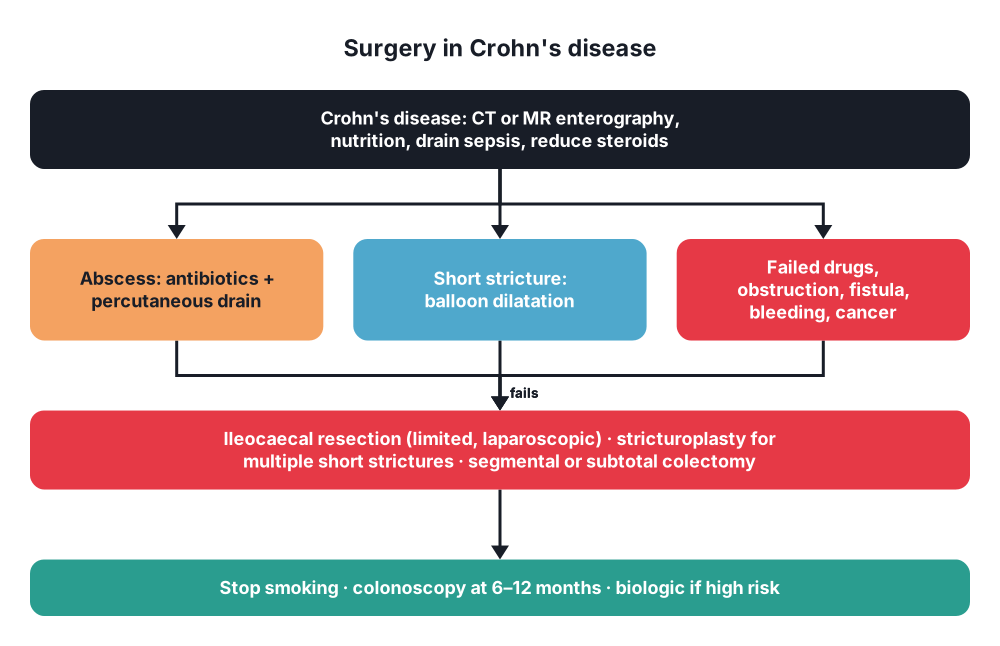
- Abscess → antibiotics + percutaneous drainage, then medical therapy or elective surgery
- Short strictures (under 5 cm, no fistula) → endoscopic balloon dilatation
- Nutrition → B12 injections, iron, vitamin D, calcium; dietitian
- Before surgery → optimise nutrition (enteral or parenteral), reduce steroids (more complications if prednisolone over 20 mg), drain sepsis first
Surgical: Crohn's disease
- Principles:
- Surgery does not cure Crohn's disease; it treats complications and disease not responding to drugs
- Save bowel → resect only macroscopic disease with 2 cm margins; microscopic clear margins do not lower recurrence
- Avoid short bowel syndrome
- Early ileocaecal resection is an alternative to biologics in limited terminal ileal disease (LIRIC trial)
- Indications:
- Failure of medical therapy, steroid dependence, drug side effects
- Obstruction from fibrotic strictures
- Fistulas (enterovesical, enterocutaneous, symptomatic enteroenteric) and abscesses
- Perforation, severe bleeding
- Toxic colitis (colonic Crohn's)
- Dysplasia or cancer
- Growth failure in children
- Operations:
- Ileocaecal resection (limited right hemicolectomy) → most common operation for terminal ileal disease; laparoscopic preferred; side-to-side stapled or Kono-S anastomosis (fewer recurrences)
- Segmental small bowel resection with anastomosis
- Stricturoplasty → for multiple short strictures or previous resections (saves bowel):
- Heineke-Mikulicz → strictures under 10 cm: longitudinal incision, transverse closure
- Finney → strictures 10–25 cm
- Michelassi (side-to-side isoperistaltic) → long strictures
- Not for strictures with fistula, abscess, phlegmon or suspicion of cancer
- Fistula → resect the diseased bowel; repair the healthy organ (bladder, sigmoid) simply
- Colonic Crohn's → segmental colectomy, subtotal colectomy with end ileostomy, or proctocolectomy with end ileostomy (no ileal pouch in Crohn's: high failure)
- Diverting ileostomy → severe perianal disease
- Emergency → resection with stoma if septic, malnourished or on high-dose steroids (avoid anastomosis)
- Postoperative → stop smoking; colonoscopy at 6–12 months (Rutgeerts score); start biologic or thiopurine in high-risk patients (POCER trial)
Treatment: small bowel tumours
- Adenocarcinoma → segmental resection with mesentery and nodes; duodenal → pancreaticoduodenectomy (Whipple) or segmental duodenal resection; adjuvant chemotherapy (FOLFOX or CAPOX) for node-positive disease
- NET → resection with mesenteric lymphadenectomy (nodes often large); palpate the whole small bowel (multiple tumours); cholecystectomy if somatostatin analogues are planned; liver metastases → resection, ablation, somatostatin analogues, PRRT (lutetium-177)
- Octreotide cover before surgery in carcinoid syndrome (prevents carcinoid crisis)
- GIST → segmental resection with clear margins, no lymphadenectomy, avoid rupture; imatinib adjuvant (high risk) or for metastatic disease
- Lymphoma → chemotherapy (R-CHOP); surgery for obstruction, perforation, bleeding or diagnosis
- Benign tumours → endoscopic or surgical resection if symptomatic (bleeding, intussusception)
- Peutz-Jeghers → enteroscopic polypectomy; surgery for intussusception
- Metastases (melanoma) → palliative resection for bleeding or obstruction
10. Complications
Crohn's disease
- Strictures and obstruction
- Fistulas (enteroenteric, enterovesical, enterocutaneous, perianal), abscesses
- Perforation, bleeding, toxic megacolon (colonic)
- Malnutrition, B12 deficiency, anaemia, osteoporosis, growth failure
- Gallstones (loss of bile salts) and oxalate kidney stones
- Short bowel syndrome (after many resections)
- Cancer → small bowel adenocarcinoma, colorectal cancer (long-standing colitis), anal and fistula cancer; lymphoma (thiopurines)
- Drug complications → infections and TB (biologics), bone marrow suppression and pancreatitis (thiopurines)
- Recurrence after resection → endoscopic in 70–90% at 1 year; clinical 20–30% at 1 year; usually at the neoterminal ileum (just above the anastomosis)
- Surgery → anastomotic leak, intra-abdominal abscess, enterocutaneous fistula, adhesions
Small bowel tumours
- Obstruction, intussusception, bleeding, perforation
- Carcinoid syndrome, carcinoid crisis, carcinoid heart disease
- Mesenteric fibrosis and ischaemia (NET)
- Late diagnosis → poor survival for adenocarcinoma (5-year survival about 30%)
Show as a list
Crohn's and small bowel tumours
- Crohn's
- Mouth to anus
- Transmural
- Skip lesions
- Granulomas
- Smoking
- Montreal
- L1 ileal, L2 colon, L3 both
- B1 inflammatory
- B2 stricturing
- B3 penetrating
- Tests
- Calprotectin
- Ileocolonoscopy
- MR enterography
- Pelvic MRI
- Medical
- Steroids: induction
- Thiopurines: maintenance
- Anti-TNF, vedolizumab
- Stop smoking
- Surgery
- Complications only
- Ileocaecal resection
- Stricturoplasty
- Save bowel
- No pouch
- Small bowel tumours
- NET: ileum, 5-HIAA
- Adenocarcinoma: duodenum
- Lymphoma
- GIST: imatinib
- Melanoma metastases