90. Strangulation obstruction and sigmoid volvulus
High yield
Obstruction with lost blood supply needs urgent surgery; sigmoid volvulus is untwisted endoscopically, then resected.
Exam Prep · State examSurgery · General surgerySurgery · Emergency and trauma
1. Definition
- Strangulation obstruction (strangulation ileus) → mechanical obstruction in which the blood supply of the bowel is cut off, as well as its lumen; leads to ischaemia, gangrene and perforation
- Main forms:
- Volvulus → twisting of a bowel loop around the axis of its mesentery, usually 180° or more
- Knotting (nodulation) → two loops wound round each other (ileosigmoid knot)
- Incarceration → bowel trapped in an external or internal hernia, or under a band
- Sigmoid volvulus → twisting of the sigmoid colon around its mesentery; the most common colonic volvulus
- Closed loop → a segment blocked at both ends; it fills with gas and fluid that cannot escape
- General obstruction → question 89; hernias → questions 52–57; gastric volvulus → question 62; midgut volvulus in malrotation → question 85
2. Epidemiology
- About 10% of SBO is strangulated at operation; more with hernias and closed loops
- Colonic volvulus → sigmoid about 60–75%, caecum about 20–30%, transverse colon about 2–3%, splenic flexure under 1%
- Sigmoid volvulus:
- Under 5% of LBO in the USA and Western Europe, but 20–50% in the "volvulus belt" (Eastern Europe and Russia, Africa, the Middle East, India, South America)
- In the West → elderly, often institutionalised, with neurological or psychiatric disease and chronic constipation
- In endemic areas → younger men, high-fibre diet
- Men more than women (about 2–4 : 1)
- 40–60% have had previous episodes
- Ileosigmoid knotting → rare in the West, more common in Africa, Turkey and Asia; mortality 15–70%
- Mortality → about 5–10% for viable sigmoid volvulus, rising to 25–50% with gangrene or perforation
3. Aetiology and risk factors
Causes of strangulation
- Hernias → femoral (highest risk), inguinal (indirect), umbilical and incisional (narrow neck), obturator; internal hernias (after Roux-en-Y gastric bypass, paraduodenal)
- Adhesive bands → a single band traps a loop (closed loop)
- Volvulus → sigmoid, caecum, small bowel (around a band or Meckel's diverticulum), midgut (malrotation)
- Intussusception → the mesentery of the inner tube is squeezed (question 92)
Sigmoid volvulus risk factors
- Long, redundant sigmoid colon on a narrow mesenteric base (the two feet of the loop are close together)
- Chronic constipation, high-fibre diet (bulky stool, heavy loop)
- Age, institutional care, neurological and psychiatric disease (Parkinson's disease, dementia, multiple sclerosis), long-term laxatives, antipsychotics, anticholinergics
- Megacolon → Chagas' disease (South America), Hirschsprung's disease, dolichosigma (question 106)
- Pregnancy (uterus displaces the sigmoid), previous abdominal surgery, high altitude
Caecal volvulus risk factors
- Mobile caecum (failure of fixation of the right colon; in 10–25% of people), previous surgery, pregnancy, distal obstruction
Ileosigmoid knot
- Long, mobile small bowel mesentery + long sigmoid on a narrow pedicle + a large meal on an empty small bowel
4. Pathogenesis
Strangulation sequence
- Compression of the mesentery at the neck of the hernia or the twist
- Veins (thin walls, low pressure) close first → venous congestion: bowel swells, turns dark red, fluid and blood leak into the lumen and peritoneum (bloodstained fluid)
- Rising tissue pressure → arterial inflow stops → ischaemia
- Mucosa dies first (within hours), then the muscle and serosa → gangrene (black, green, no sheen, no peristalsis, no mesenteric pulse)
- Bacteria and toxins cross the damaged wall → sepsis, toxic shock
- Perforation → faecal peritonitis
- The trapped loop loses blood and plasma → hypovolaemic and septic shock together
- Gangrene usually starts within 6 hours of complete arterial occlusion
- Constriction rings at the neck of a hernia or twist are the first places to perforate
Sigmoid volvulus
- The sigmoid loop twists, usually anticlockwise, by 180–720° (a 360° twist causes complete obstruction and strangulation is likely)
- Closed loop → enormous distension of the twisted loop (up to 20–30 cm) → wall ischaemia from tension, then from the twisted vessels
- Proximal colon also distends (incompetent ileocaecal valve allows reflux into the small bowel)
- Twist under 180° → often untwists by itself (recurrent attacks)
Caecal volvulus and bascule
- Axial caecal volvulus → caecum and ascending colon twist (usually clockwise) around the axis; caecum moves to the left upper quadrant
- Caecal bascule → caecum folds upwards and forwards without a twist; no vascular compromise at first
Ileosigmoid knot
- The ileum wraps round the base of the sigmoid → two closed loops, both strangulate fast → gangrene of both in most patients
5. Classification
Strangulation by mechanism
- Volvulus (twisting), knotting, incarceration (hernia, internal hernia, band)
Strangulation by stage of bowel damage
- Venous congestion (reversible) → arterial ischaemia → gangrene → perforation
Colonic volvulus by site
- Sigmoid, caecal (axial or bascule), transverse, splenic flexure
Sigmoid volvulus by course
- Acute fulminant → younger patients; sudden, severe pain, early shock, early gangrene
- Subacute progressive → elderly; slow onset of distension, less pain, gangrene later
- Recurrent (chronic) → repeated attacks that untwist on their own
Ileosigmoid knot (Alver)
- Types I–IV by which loop is active (ileum or sigmoid) and the direction of the wrap
6. Clinical picture
Strangulation
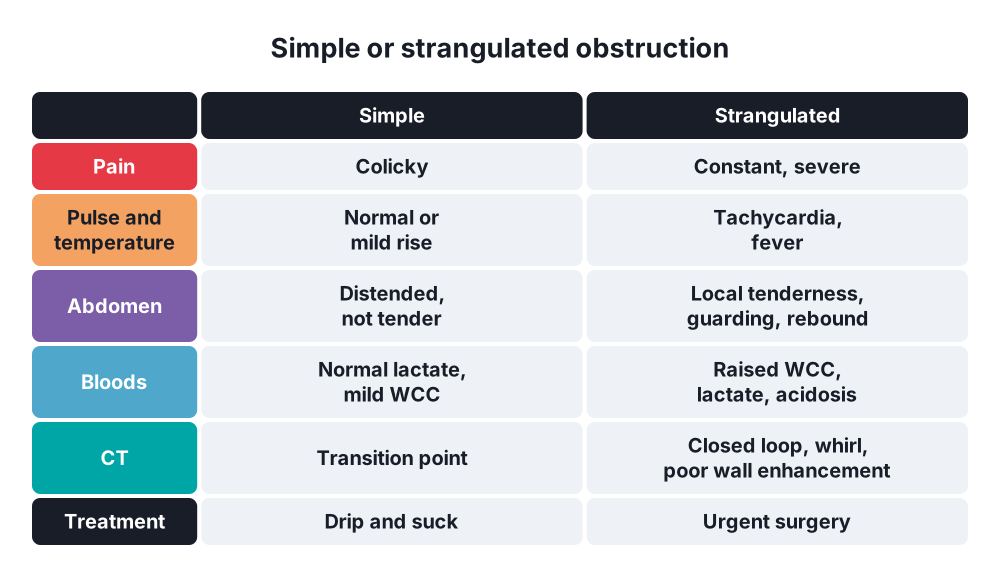
- Signs of obstruction (colic, vomiting, distension, constipation) plus:
- Pain that becomes constant and severe, out of proportion at first
- Tachycardia, fever, signs of shock
- Localised tenderness, guarding, rebound → peritonitis
- Tender, tense, irreducible hernia with no cough impulse, red overlying skin
- Vomiting of blood or bloodstained stool (late)
- Absent bowel sounds (late)
- Elderly, obese and immunosuppressed patients may have few signs
- Richter's hernia → only part of the wall is trapped; strangulation without obstruction
Sigmoid volvulus
- Elderly patient, often from a nursing home, with chronic constipation
- Sudden or gradual colicky lower abdominal pain
- Massive, asymmetrical abdominal distension (often more on the left, then the whole abdomen); tympanic
- Absolute constipation early
- Vomiting late (low obstruction)
- Empty rectum on digital examination
- Previous similar attacks
- Signs of gangrene → constant pain, tenderness, guarding, fever, tachycardia, shock, bloodstained rectal fluid
- Classic old signs (Central European teaching):
- Von Wahl's sign → a fixed, visible and palpable distended loop with tympany over it
- Obukhov Hospital sign → empty, ballooned rectum with a gaping anus
- Tsege-Manteuffel sign → only about 300–500 mL of water can be given as an enema (the twist stops more)
Caecal volvulus
- Central or right-sided colic, vomiting earlier than in sigmoid volvulus, distension in the left upper quadrant or mid-abdomen, empty right iliac fossa
Ileosigmoid knot
- Very sudden, severe pain, repeated vomiting, early shock, moderate distension; plain X-ray shows both sigmoid and small bowel dilatation
7. Diagnosis
Bloods
- WCC, CRP, U&E (dehydration, potassium), lactate and pH (raised lactate and acidosis suggest ischaemia, but a normal lactate does not exclude it), group and crossmatch, clotting
Plain abdominal X-ray
- Sigmoid volvulus:
- Coffee bean sign (bent inner tube) → massively dilated, haustra-free loop rising from the left pelvis towards the right upper quadrant, often over the liver (liver overlap sign)
- Northern exposure sign → the loop rises above the transverse colon
- Three dense lines (walls of the loop) converge in the left iliac fossa
- Erect film → two fluid levels in the loop at different heights
- Diagnostic in about 60–70% of patients
- Caecal volvulus → large dilated caecum in the left upper quadrant or centre (embryo or kidney shape), small bowel dilatation, collapsed distal colon
- Strangulation → no specific signs; free gas under the diaphragm on an erect chest X-ray means perforation
CT abdomen and pelvis with IV contrast
- Investigation of choice when the diagnosis is not certain and to look for ischaemia
- Whirl sign (twisted mesentery and vessels), bird's beak (tapered ends at the twist), closed loop with two transition points, X-marks-the-spot (crossing limbs)
- Ischaemia → poor or absent wall enhancement, wall thickening, target sign, mesenteric oedema and fluid, pneumatosis, portal venous gas, free gas
Water-soluble contrast enema
- If X-ray and CT are not available or not clear → "bird's beak" (ace of spades) where the contrast column tapers at the twist
- Barium is contraindicated if perforation is possible
Endoscopy
- Flexible sigmoidoscopy → diagnostic and therapeutic:
- Shows the spiral twist of mucosa
- Assesses mucosal viability → dusky, black or ulcerated mucosa means ischaemia → surgery
Strangulated hernia
- Clinical diagnosis; CT for obese patients and obturator or internal hernias
8. Differential diagnosis
- Sigmoid volvulus:
- Pseudo-obstruction (Ogilvie's) → dilated colon without a twist; CT or contrast enema
- Obstructing sigmoid or rectal cancer (gradual onset, weight loss, bleeding)
- Caecal volvulus, transverse colon volvulus
- Toxic megacolon (colitis, bloody diarrhoea, fever)
- Faecal impaction, diverticular stricture
- Strangulated obstruction:
- Acute mesenteric ischaemia (embolus, thrombosis)
- Perforated viscus, acute pancreatitis
- Simple obstruction (no constant pain, no peritonism, normal lactate)
- Irreducible hernia → lymphadenitis, femoral aneurysm, saphena varix, hydrocele of the cord, testicular torsion
9. Treatment
Conservative
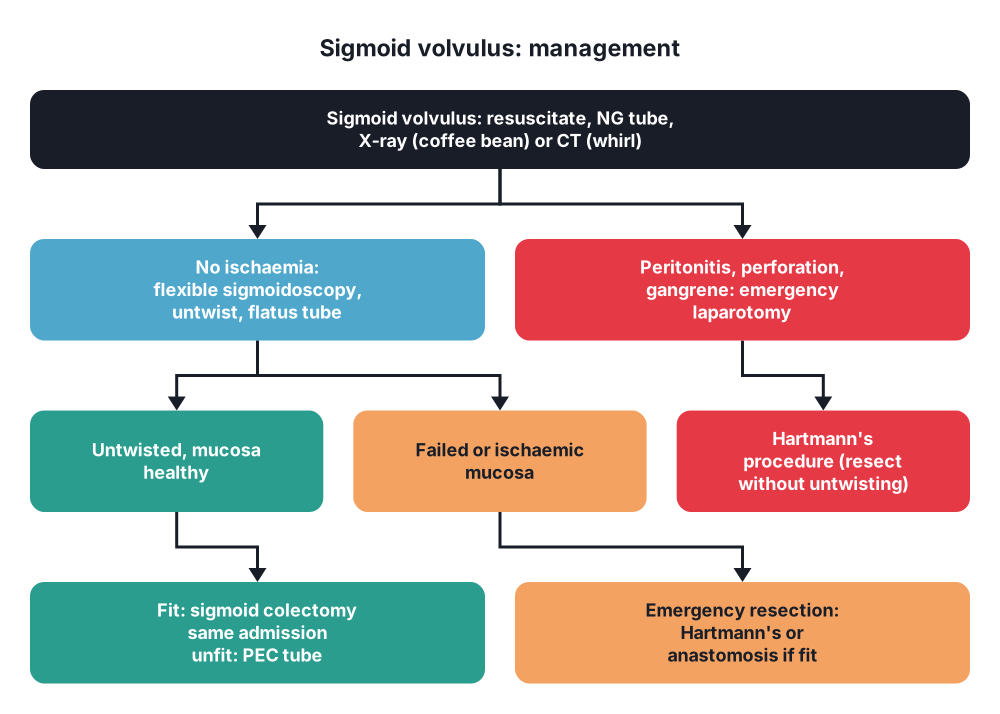
- Resuscitation for all → IV fluids, correct potassium, NG tube, urinary catheter, analgesia, oxygen, broad-spectrum antibiotics if ischaemia is suspected, VTE prophylaxis
- Strangulation → no place for conservative treatment; resuscitate quickly and operate
- Do not try to reduce a hernia that may be strangulated ("taxis" may push dead bowel back; reduction en masse)
- Sigmoid volvulus without signs of ischaemia or perforation:
- Endoscopic decompression and detorsion → flexible sigmoidoscopy (preferred: done under vision, checks the mucosa) or rigid sigmoidoscopy
- The scope is passed gently through the twist → sudden rush of gas and liquid stool, the abdomen softens
- A soft rectal (flatus) tube is left through the twist for 24–72 hours to keep it decompressed and prevent early recurrence
- Success in about 70–90%; mortality about 2–5%
- Blind rectal tube or contrast enema can also untwist the loop, but cannot check the mucosa
- Repeat attempt possible if the first fails and the patient is stable
- Caecal volvulus → endoscopic untwisting usually fails (under 30%) and risks perforation; not recommended
- Caecal bascule without ischaemia → surgery is still usually advised
Surgical
- Strangulation (hernia, band, internal hernia, small bowel volvulus):
- Urgent laparotomy or laparoscopy after short resuscitation (within hours)
- Release the constriction (divide the band, open the hernia neck, untwist)
- Assess viability:
- Viable → pink colour, shine, peristalsis, pulsating mesenteric arteries, bright red bleeding from cut edges
- Doubtful → wrap in warm, moist packs for 10–20 minutes, give 100% oxygen, inject local anaesthetic into the mesentery; re-examine
- Indocyanine green (ICG) fluorescence or Doppler can help
- Non-viable → black or green, no sheen, no peristalsis, no pulse, smell → resect with margins into healthy bowel and anastomose (or stoma if unstable)
- Check constriction rings and the other loop (Maydl's hernia)
- Second-look laparotomy in 24–48 hours if viability is uncertain (decided at the first operation)
- Repair the hernia (mesh only if no contamination; biological or delayed repair if contaminated)
- Sigmoid volvulus: emergency surgery when:
- Signs of peritonitis, perforation or gangrene (clinical or CT)
- Ischaemic mucosa at endoscopy
- Failed endoscopic decompression
- Early recurrence that cannot be decompressed
- Emergency operation for sigmoid volvulus:
- Lithotomy (Lloyd-Davies) position; midline laparotomy
- Gangrenous colon → do not untwist before clamping (releases toxins and bacteria); resect the loop
- Hartmann's procedure (sigmoid colectomy, end colostomy, closed rectal stump) → standard in unstable patients, gangrene, peritonitis, faecal loading
- Resection with primary anastomosis (± on-table colonic lavage, ± defunctioning ileostomy) → stable, younger patients with viable bowel and little contamination
- Decompression of a huge loop with a needle on suction through a taenia may help handling
- Elective surgery after successful decompression:
- Recurrence after decompression alone is 40–60% (up to 90% in some series), with high mortality at each new attack
- Elective sigmoid colectomy with primary anastomosis during the same admission (2–5 days after untwisting, after bowel preparation) is recommended for fit patients; operative mortality about 2–3%; open or laparoscopic
- Unfit patients → percutaneous endoscopic colostomy (PEC: one or two tubes fixing the sigmoid to the wall), endoscopic sigmoidopexy; repeat decompression as needed
- Sigmoidopexy or mesosigmoidoplasty (fixing or shortening the mesentery) → high recurrence; mostly abandoned
- Megacolon (Chagas', Hirschsprung's) → longer resection or subtotal colectomy
- Caecal volvulus → right hemicolectomy with primary anastomosis (viable or not) is the treatment of choice; ileostomy if unstable or gangrenous; caecopexy or caecostomy only in very unfit patients (high recurrence)
- Transverse colon volvulus → transverse colectomy or extended right hemicolectomy
- Ileosigmoid knot → resuscitation and urgent surgery; resect gangrenous ileum (anastomosis) and sigmoid (Hartmann's or primary anastomosis if fit and clean); do not untwist gangrenous loops
10. Complications
Of strangulation and volvulus
- Gangrene, perforation, faecal peritonitis
- Septic shock, multiple organ failure, death
- Bowel stricture after ischaemia (late)
- Short bowel syndrome after large small bowel resection
- Recurrence of sigmoid volvulus after decompression only (40–60%)
Of treatment
- Endoscopic perforation of an ischaemic colon
- Anastomotic leak, wound infection, dehiscence, incisional hernia
- Stoma complications; many elderly patients never have the Hartmann's reversed
- Aspiration pneumonia, VTE, delirium in elderly patients
Prognosis
- Mortality → about 5–10% with viable colon vs up to 50% with gangrene; strangulated SBO mortality rises with each hour of delay
- Elective resection of sigmoid volvulus has low mortality (2–3%) compared with emergency surgery (up to 25%)
Show as a list
Strangulation and sigmoid volvulus
- Strangulation
- Volvulus
- Knotting
- Hernia, band
- Veins close first
- Signs
- Constant pain
- Fever, tachycardia
- Peritonism
- Raised lactate
- Sigmoid volvulus
- Elderly, constipated
- Long loop, narrow base
- Coffee bean
- Bird's beak, whirl
- Treatment
- Resuscitate
- Flexible sigmoidoscopy
- Flatus tube 24-72 h
- Elective colectomy
- Emergency surgery
- Gangrene: Hartmann's
- Failed untwist
- Caecal: right hemicolectomy
- Viability
- Colour, sheen
- Peristalsis
- Mesenteric pulse
- Warm packs, ICG