13. Shock
High yield
Circulatory failure causing inadequate tissue perfusion and oxygenation; hypovolaemic, cardiogenic, obstructive or distributive.
Exam Prep · State examSurgery · Emergency and trauma
1. Definition
- Shock → acute circulatory failure with inadequate tissue perfusion and oxygen delivery, leading to cellular hypoxia
- Not defined by blood pressure alone → hypotension is a late sign
2. Classification
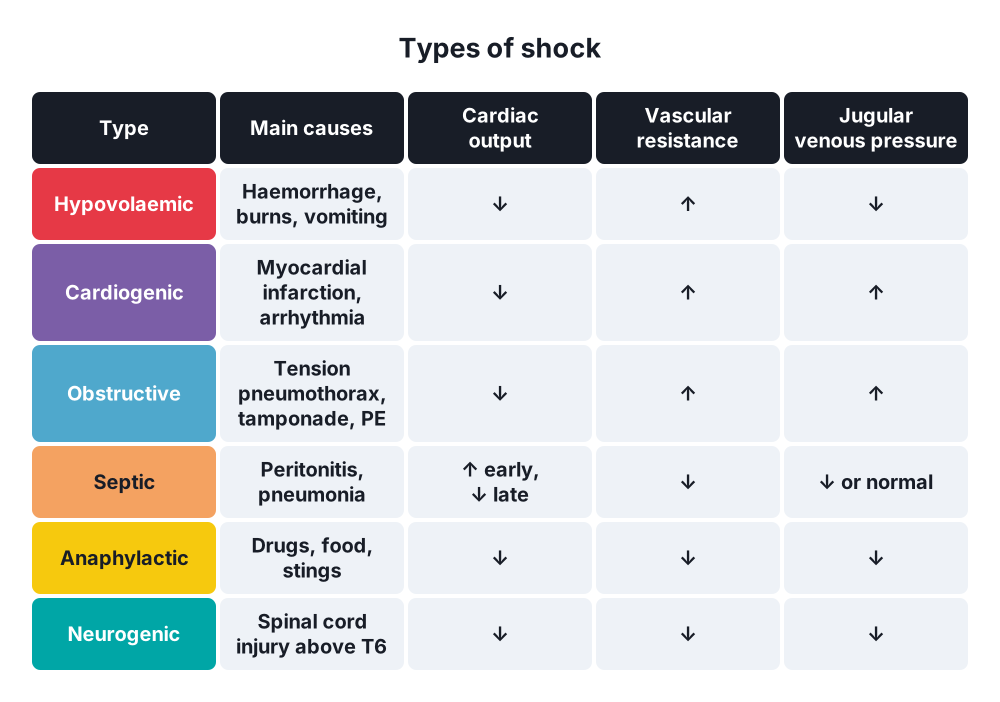
A. Hypovolaemic
- Haemorrhagic → trauma, gastrointestinal bleeding, ruptured aneurysm
- Non-haemorrhagic → burns, vomiting, diarrhoea, bowel obstruction, pancreatitis
- Most common type in surgery
B. Cardiogenic
- Pump failure → myocardial infarction, arrhythmias, cardiomyopathy, valve rupture, myocardial contusion
C. Obstructive
- Obstruction to flow outside the heart:
- Tension pneumothorax
- Cardiac tamponade
- Massive pulmonary embolism (PE)
D. Distributive
- Vasodilatation, maldistribution of flow:
- Septic shock
- Anaphylactic shock
- Neurogenic shock → spinal cord injury above T6; hypotension with bradycardia
E. Endocrine
- Adrenal insufficiency (Addisonian crisis), hypothyroidism
3. Pathogenesis
Compensated shock
- Fall in cardiac output or vascular tone
- Baroreceptor reflex → sympathetic activation, catecholamines
- Tachycardia, vasoconstriction → skin, gut, kidney
- Centralisation of the circulation → blood redirected to brain and heart
- Renin-angiotensin-aldosterone, antidiuretic hormone → retain water and sodium
- Fluid shift from interstitium into vessels
Decompensated shock
- Cellular hypoxia → anaerobic metabolism → lactic acidosis
- Failure of the sodium-potassium pump → cell swelling
- Capillary leak, microcirculatory stasis, sludging
- Disseminated intravascular coagulation (DIC)
- Systemic inflammatory response syndrome (SIRS)
Irreversible shock
- Cell death, multi-organ dysfunction syndrome (MODS)
- Shock organs:
- Lung → acute respiratory distress syndrome (ARDS)
- Kidney → acute tubular necrosis
- Gut → bacterial translocation
- Liver → ischaemic hepatitis
- Heart → depression of contractility
- Brain → confusion, coma
4. Clinical picture
- Tachycardia → earliest sign
- Tachypnoea
- Cold, pale, clammy skin; delayed capillary refill > 2 s
- Narrow pulse pressure
- Oliguria → < 0.5 mL/kg/h
- Anxiety → confusion → coma
- Hypotension → late, after loss of > 30% blood volume
- Septic shock → warm, flushed skin early (warm shock)
- Neurogenic shock → bradycardia, warm dry skin
- Obstructive and cardiogenic → raised jugular venous pressure
- Shock index → heart rate ÷ systolic blood pressure; > 1 suggests significant shock
5. Diagnosis
Laboratory
- Lactate → > 2 mmol/L abnormal; > 4 mmol/L severe
- Arterial blood gas → metabolic acidosis, base deficit
- Full blood count, coagulation, crossmatch
- Urea, creatinine, electrolytes, liver function
- Troponin, blood cultures
Monitoring and imaging
- Electrocardiogram (ECG), continuous monitoring
- Urinary catheter → hourly urine output
- Central venous pressure, arterial line
- Focused assessment with sonography for trauma (FAST), echocardiography
- Chest X-ray, CT when stable
6. Treatment
General principles
- ABCDE approach; high-flow oxygen
- Treat the cause → stop bleeding, drain the pericardium, decompress the pneumothorax, control the septic source
- 2 large-bore intravenous cannulas
- Targets → mean arterial pressure ≥ 65 mmHg, urine output ≥ 0.5 mL/kg/h, falling lactate
Hypovolaemic
- Haemorrhage control → pressure, tourniquet, surgery, angioembolisation
- Permissive hypotension in bleeding trauma → systolic about 80–90 mmHg until bleeding controlled (not in head injury)
- Early blood products (1:1:1) rather than large crystalloid volumes
- Tranexamic acid within 3 h
- Non-haemorrhagic → crystalloids
Cardiogenic
- Cautious fluids
- Inotropes → dobutamine
- Coronary revascularisation
- Mechanical support → intra-aortic balloon pump
Obstructive
- Tension pneumothorax → needle decompression, then chest drain
- Tamponade → pericardiocentesis or thoracotomy
- Massive PE → thrombolysis
Septic
- Sepsis bundle within 1 h:
- Measure lactate
- Blood cultures before antibiotics
- Broad-spectrum antibiotics
- Crystalloid 30 mL/kg for hypotension or lactate ≥ 4 mmol/L
- Vasopressors (noradrenaline) if MAP < 65 mmHg after fluids
- Source control → drain, debride, resect
Anaphylactic
- Adrenaline 0.5 mg intramuscularly (0.5 mL of 1:1000), repeat after 5 min
- Fluids, oxygen; antihistamines and steroids second line
Neurogenic
- Fluids, vasopressors, atropine for bradycardia
7. Complications
- Acute kidney injury
- ARDS
- DIC
- Multi-organ failure
- Death
Show as a list
Shock
- Hypovolaemic
- Haemorrhagic
- Burns, losses
- Cardiogenic
- Myocardial infarction
- Obstructive
- Tension pneumothorax
- Tamponade
- Pulmonary embolism
- Distributive
- Septic
- Anaphylactic
- Neurogenic
- Phases
- Compensated
- Decompensated
- Irreversible
- Treatment
- Oxygen, access
- Treat the cause
- Fluids, blood
- Vasopressors