20. Sepsis and SIRS
High yield
Dysregulated host response to infection causing organ dysfunction; SIRS, sepsis, septic shock; source control and the 1-hour bundle.
Exam Prep · State examSurgery · General surgerySurgery · Emergency and trauma
1. Definition
Classical terms
- General purulent infection → systemic spread of a local infection
- Toxaemia → toxins in the blood without bacteria
- Bacteraemia → viable bacteria in the blood, may be transient
- Septicaemia → bacteria multiply in the blood with severe systemic illness; no metastatic abscesses
- Septicopyaemia (pyaemia) → septicaemia with metastatic abscesses (lung, liver, brain, kidney)
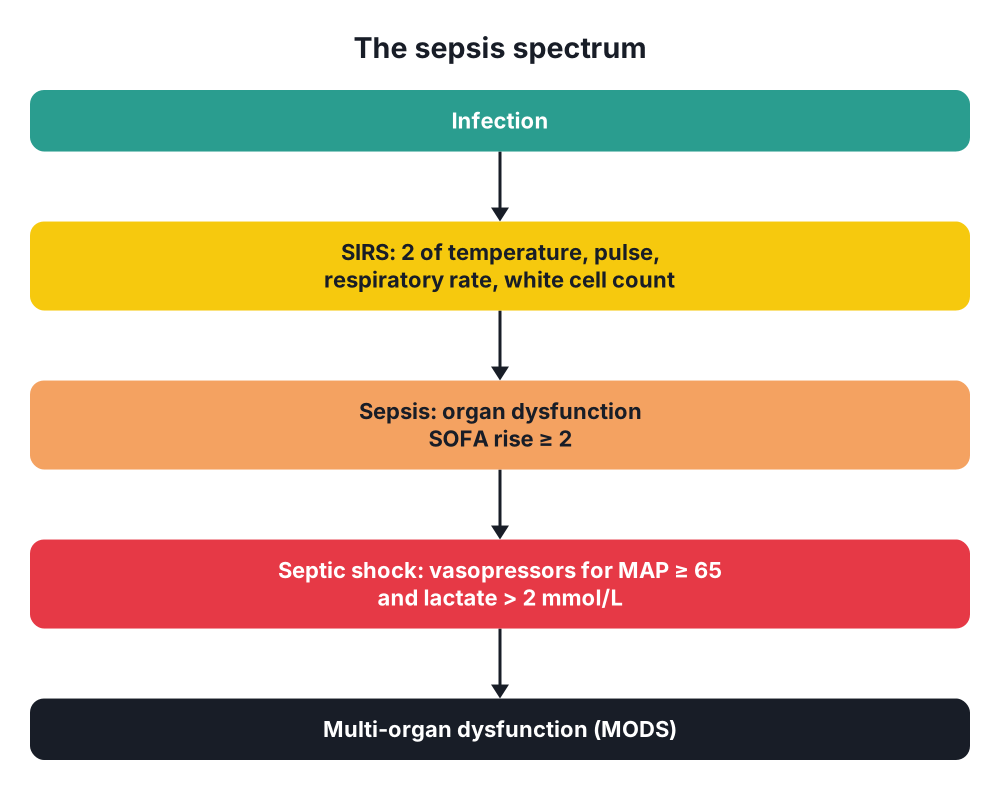
Systemic inflammatory response syndrome (SIRS)
- Systemic inflammation from any insult (infection, trauma, burns, pancreatitis)
- 2 or more criteria:
- Temperature > 38 °C or < 36 °C
- Heart rate > 90/min
- Respiratory rate > 20/min or PaCO2 < 32 mmHg
- White cell count > 12 × 10^9/L, < 4 × 10^9/L or > 10% immature forms
- Sepsis (old definition, Sepsis-2) → SIRS + infection
Sepsis-3 (2016)
- Sepsis → life-threatening organ dysfunction caused by a dysregulated host response to infection
- Organ dysfunction → rise in Sequential Organ Failure Assessment (SOFA) score ≥ 2
- Septic shock → sepsis needing vasopressors for mean arterial pressure (MAP) ≥ 65 mmHg, with lactate > 2 mmol/L despite adequate fluids
- Septic shock mortality → > 40%
Quick SOFA (qSOFA): bedside screen, 2 or more
- Respiratory rate ≥ 22/min
- Altered mental state (Glasgow Coma Scale < 15)
- Systolic blood pressure ≤ 100 mmHg
2. Aetiology
- Surgical sources:
- Abdominal → peritonitis, anastomotic leak, cholangitis, abscess
- Soft tissue → necrotising fasciitis, phlegmon, infected wounds
- Urinary tract → obstructed infected kidney
- Lung → pneumonia
- Lines and catheters
- Organisms → Gram-negative bacilli (E. coli, Klebsiella, Pseudomonas), Staphylococcus aureus, streptococci, anaerobes, fungi (Candida)
- Risk factors → age, diabetes, immunosuppression, cancer, recent surgery, invasive devices
3. Pathogenesis: mechanism of development
- Bacterial products → endotoxin (lipopolysaccharide of Gram-negative bacteria), exotoxins, peptidoglycan
- Recognised by immune cells (toll-like receptors)
- Release of cytokines → tumour necrosis factor alpha (TNF-α), interleukin-1, interleukin-6
- Endothelial activation:
- Vasodilatation → nitric oxide
- Capillary leak → hypovolaemia, tissue oedema
- Microthrombosis → disseminated intravascular coagulation (DIC)
- Impaired oxygen use by cells (mitochondrial dysfunction)
- Compensatory anti-inflammatory response → immunosuppression, secondary infection
- Multi-organ dysfunction syndrome (MODS)
4. Clinical picture
- Fever or hypothermia, rigors
- Tachycardia, tachypnoea
- Warm, flushed skin early → cold, mottled skin late
- Hypotension
- Confusion, agitation
- Oliguria
- Signs of the source → peritonitis, cellulitis, chest signs
- Organ dysfunction:
- Lung → acute respiratory distress syndrome (ARDS)
- Kidney → acute kidney injury
- Liver → jaundice
- Blood → thrombocytopenia, DIC
- Gut → ileus, stress ulcer
- Brain → encephalopathy
- Septicopyaemia → swinging fever with metastatic abscesses
5. Diagnosis
Laboratory
- Blood cultures → 2 sets before antibiotics
- Lactate
- Full blood count, CRP, procalcitonin
- Urea, creatinine, liver function, bilirubin
- Clotting, platelets, fibrinogen
- Arterial blood gas
- Cultures from the source → urine, sputum, pus, drain fluid
Imaging
- Chest X-ray
- Ultrasound → biliary tree, kidneys, collections
- CT → abdominal source, collections, leaks
6. Treatment: principles
Sepsis bundle within 1 h (Surviving Sepsis Campaign)
- Measure lactate; repeat if > 2 mmol/L
- Blood cultures before antibiotics
- Broad-spectrum intravenous antibiotics within 1 h
- Crystalloid 30 mL/kg for hypotension or lactate ≥ 4 mmol/L
- Vasopressors (noradrenaline) for MAP < 65 mmHg despite fluids
Source control
- Drain, debride, remove → as soon as possible, within 6–12 h
- Drainage of abscess → percutaneous or surgical
- Laparotomy for peritonitis, leak
- Debridement of necrotising soft tissue infection
- Decompression of obstructed biliary or urinary tract
- Removal of infected lines and devices
Supportive care
- Oxygen, ventilation for ARDS
- Renal replacement therapy
- Hydrocortisone → shock not responding to vasopressors
- Glucose control (< 10 mmol/L)
- Thromboprophylaxis, stress ulcer prophylaxis
- Nutrition
- De-escalate antibiotics by culture results
7. Complications
- Septic shock
- ARDS
- Acute kidney injury
- DIC
- MODS
- Death
Show as a list
Sepsis
- Definitions
- Bacteraemia
- Septicaemia
- Septicopyaemia
- SIRS
- Sepsis-3
- Septic shock
- Mechanism
- Endotoxin
- Cytokines
- Capillary leak
- MODS
- Screening
- qSOFA
- SOFA ≥ 2
- 1-hour bundle
- Lactate
- Blood cultures
- Antibiotics
- Fluids
- Vasopressors
- Source control
- Drain
- Debride
- Remove devices