
59. Pyloric stenosis
High yield
Gastric outlet obstruction from infantile muscle hypertrophy or, in adults, scarred ulcer or cancer; correct fluids, then operate.
Exam Prep · State examSurgery · Upper GISurgery · General surgery
1. Definition
- Pyloric stenosis (gastric outlet obstruction) → narrowing of the pylorus or first part of the duodenum that blocks gastric emptying
- Infantile hypertrophic pyloric stenosis (IHPS) → thickening of the circular pyloric muscle in the first weeks of life
- Adult pyloric stenosis → acquired narrowing from scarring of a peptic ulcer or from cancer (antrum, pancreatic head, duodenum)
2. Epidemiology
- IHPS:
- About 2–3 per 1,000 live births (1 in 300–900)
- Boys : girls about 4 : 1; first-born boys
- Onset 2–8 weeks of age (peak 3–6 weeks)
- Family history → higher risk in children of affected mothers
- Adult:
- Benign ulcer stricture → fallen with H. pylori eradication and PPIs
- Today malignancy is the commonest cause of gastric outlet obstruction in adults in the West (over half)
3. Aetiology and risk factors
Infantile
- Cause unknown; multifactorial
- Lack of nitric oxide synthase in pyloric muscle → failure to relax
- Genetic factors, family history
- Erythromycin (or azithromycin) in the first 2 weeks of life (motilin agonist)
- Bottle feeding, maternal smoking, prematurity
Adult
- Chronic duodenal or pyloric channel ulcer → fibrosis and scarring
- Gastric antral cancer
- Pancreatic cancer, duodenal or ampullary tumours, lymphoma
- Chronic pancreatitis, Crohn's disease, caustic stricture
- Adult form of hypertrophic pyloric stenosis (rare)
4. Pathogenesis
Infantile
- Pyloric circular muscle thickens → "olive" tumour
- Lumen narrows → milk cannot leave the stomach
- Stomach dilates; strong peristalsis visible
- Projectile vomiting of gastric contents (no bile)
Metabolic changes (both forms)
- Loss of gastric acid (H⁺ and Cl⁻) → hypochloraemic metabolic alkalosis
- Loss of fluid → dehydration → kidneys hold sodium via aldosterone
- Sodium kept in exchange for potassium and H⁺ → hypokalaemia
- Paradoxical aciduria → acid urine despite systemic alkalosis (late sign)
- Alkalosis lowers ionised calcium → tetany in adults
- Infants → risk of postoperative apnoea if alkalosis is not corrected (alkalosis depresses breathing)
5. Classification
- Infantile hypertrophic (congenital, acquired in the first weeks)
- Adult:
- Benign → peptic ulcer, caustic, Crohn's
- Malignant → gastric, pancreatic, duodenal
- Adult by stage (classic):
- Compensated → stomach still pushes against the block; strong peristalsis
- Decompensated → large, atonic stomach; stasis; metabolic changes
6. Clinical picture
Symptoms
- Infant:
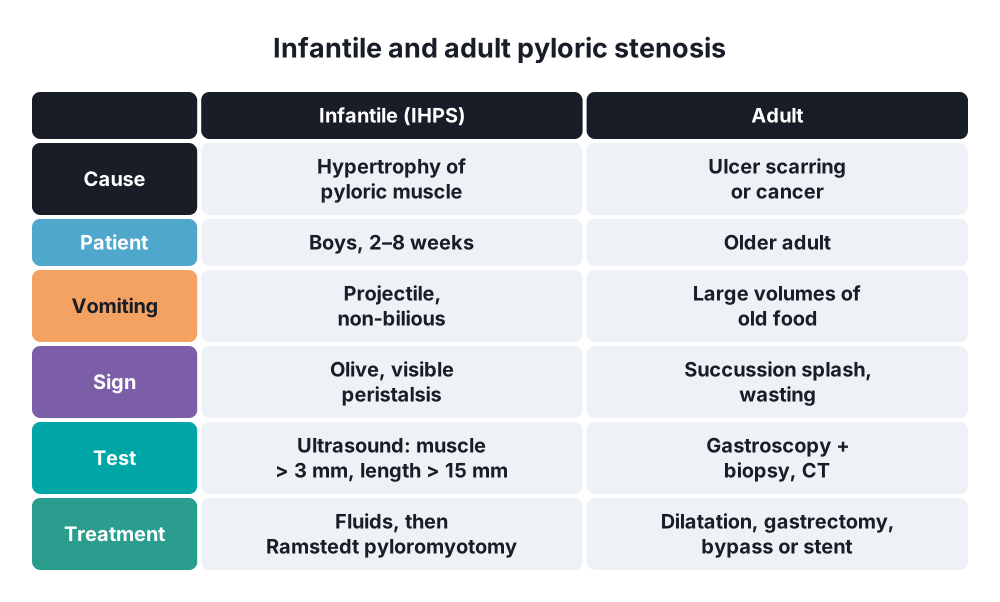
- Non-bilious, projectile vomiting after feeds, from 2–8 weeks
- Hungry baby that feeds again straight after vomiting
- Weight loss, fewer wet nappies, constipation
- Late → lethargy, jaundice (unconjugated)
- Adult:
- Vomiting of large volumes of undigested food eaten many hours or days before; foul, no bile
- Early fullness, epigastric bloating, weight loss
- Long history of ulcer pain (benign) or short history with weight loss and anaemia (cancer)
Signs
- Infant:
- Palpable "olive" in the right upper quadrant or epigastrium during a test feed (positive predictive value about 99%)
- Visible gastric peristalsis from left to right
- Dehydration → sunken fontanelle, dry mouth
- Adult:
- Succussion splash more than 4 hours after a meal
- Visible peristalsis, epigastric distension
- Wasting, dehydration
- Epigastric mass, Virchow's (Troisier's) node in cancer
7. Diagnosis
Infant
- Ultrasound → test of choice:
- Pyloric muscle thickness > 3 mm
- Pyloric channel length > 15–16 mm
- No passage of fluid through the pylorus
- Blood gas → hypochloraemic, hypokalaemic metabolic alkalosis
- U&E, glucose
- Contrast meal → only if ultrasound is not available or unclear ("string sign", "shoulder sign")
Adult
- Bloods → U&E, chloride, bicarbonate, FBC, albumin
- Nasogastric aspiration → large volume of old food and fluid (saline load test: over 400 mL left after 30 minutes)
- Gastroscopy (after washouts) → cause; biopsy every case to rule out cancer
- CT → staging of cancer, pancreatic mass
- Barium meal → large stomach, delayed emptying, narrow pylorus
- Endoscopic ultrasound → small tumours
8. Differential diagnosis
- Infant:
- Gastro-oesophageal reflux (not projectile, baby thrives)
- Overfeeding, milk allergy
- Bilious vomiting → malrotation with volvulus (surgical emergency)
- Infection (UTI, sepsis, meningitis), raised intracranial pressure
- Congenital adrenal hyperplasia (salt-losing: low sodium, high potassium, acidosis)
- Adult:
- Gastroparesis (diabetes, after vagotomy)
- Gastric or pancreatic cancer
- Superior mesenteric artery syndrome
- Gastric volvulus, bezoar
9. Treatment
Conservative
- IHPS is not an emergency operation; it is a medical emergency:
- Stop feeds; NG tube if vomiting
- IV fluids → 0.9% saline with 5% (or 10%) glucose, add potassium chloride once urine is passed
- Correct the alkalosis before surgery → chloride > 100 mmol/L and bicarbonate < 28 mmol/L (unit targets vary)
- Adult:
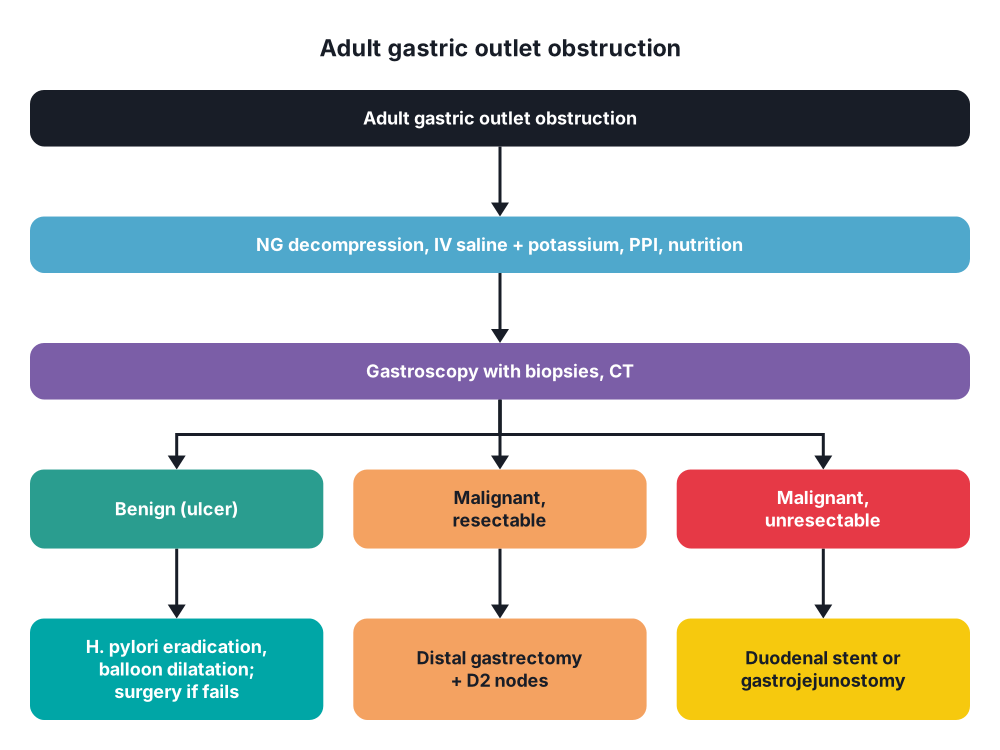
- NG decompression and gastric washouts
- IV 0.9% saline with potassium → corrects alkalosis
- Nutrition → parenteral or nasojejunal
- IV proton pump inhibitor; treat H. pylori
- Benign stricture → endoscopic balloon dilatation (repeat sessions; good results in many)
- Malignant, unfit or advanced → endoscopic duodenal stent (self-expanding metal stent)
Surgical: infant
- Ramstedt pyloromyotomy → open (right upper quadrant or supraumbilical incision) or laparoscopic:
- Deliver the pylorus
- Longitudinal incision through the serosa and muscle from the pyloric vein of Mayo to the gastric antrum
- Spread the muscle until the mucosa bulges through
- Do not breach the mucosa at the duodenal end (thin, where the duodenal fornix lies)
- Check for leaks with air through the NG tube
- Feeds restart within 4–6 hours; discharge in 1–2 days
Surgical: adult
- Benign:
- Failed dilatation → gastrojejunostomy (laparoscopic) or antrectomy; vagotomy now rarely needed with PPIs
- Pyloroplasty (Heineke-Mikulicz, Finney) if the duodenum is soft
- Malignant:
- Resectable gastric cancer → distal gastrectomy with D2 lymphadenectomy
- Unresectable → gastrojejunostomy or endoscopic stent; EUS-guided gastroenterostomy (newer)
- Stent → quick relief, short life expectancy; bypass → more lasting, longer life expectancy (over 2 months)
10. Complications
- Disease → dehydration, metabolic alkalosis, hypokalaemia, tetany, aspiration pneumonia, malnutrition
- Pyloromyotomy:
- Mucosal perforation (1–2%; repair and delay feeds)
- Incomplete pyloromyotomy (persistent vomiting over 5 days)
- Wound infection, incisional hernia
- Postoperative apnoea (uncorrected alkalosis)
- Adult surgery → anastomotic leak, delayed gastric emptying, dumping, stent migration or blockage
Show as a list
Pyloric stenosis
- Infantile
- Boys, 2-8 weeks
- Projectile, non-bilious
- Olive
- Ultrasound > 3 mm
- Metabolic
- Low chloride
- Low potassium
- Alkalosis
- Paradoxical aciduria
- Infant treatment
- Fluids first
- Ramstedt pyloromyotomy
- Adult
- Ulcer scar
- Cancer commonest now
- Succussion splash
- Biopsy all
- Adult treatment
- NG, saline, potassium
- Balloon dilatation
- Gastrojejunostomy
- Stent if palliative