12. Postoperative period and complications
High yield
Postoperative care and observation, and complications classified by time, system and Clavien-Dindo grade, with prevention and treatment.
Exam Prep · State examSurgery · General surgery
1. Definition
- Postoperative period → from the end of the operation to full recovery of working capacity
- Phases:
- Early → first 3–5 days
- Late → until discharge
- Remote → after discharge, until recovery
- Uncomplicated course → normal response to surgical trauma
- Complicated course → a complication develops
2. Clinical observation and patient care
Monitoring
- Observations → pulse, blood pressure, respiratory rate, oxygen saturation, temperature
- Early warning score (NEWS2) → triggers medical review
- Consciousness, pain score
- Fluid balance → input, urine output (> 0.5 mL/kg/h), drains, nasogastric aspirate
- Wound and drains → bleeding, discharge
- Bowel function → flatus, bowel sounds, stool
- Laboratory → full blood count, urea, electrolytes, C-reactive protein (CRP)
Care
- Analgesia → multimodal: paracetamol, NSAIDs, opioids, epidural, regional blocks
- Fluids → stop intravenous fluids once drinking
- Early mobilisation → day 0–1
- Breathing exercises, incentive spirometry, physiotherapy
- Early oral feeding
- Venous thromboembolism (VTE) prophylaxis → low molecular weight heparin, stockings, intermittent pneumatic compression
- Antiemetics
- Glucose control in diabetics
- Remove catheters, lines and drains early
- Enhanced Recovery After Surgery (ERAS) → bundle of these measures; shorter stay, fewer complications
Normal postoperative findings
- Mild fever < 38 °C in the first 48 h → response to surgical trauma
- Raised CRP and white cell count, peaking on day 2–3
- Paralytic ileus for 24–72 h after laparotomy
- Water and sodium retention for 24–48 h → low urine output
3. Classification of complications
By time
- Immediate → within 24 h: primary or reactionary haemorrhage, shock, atelectasis, anaesthetic complications
- Early → days 2–30: infection, anastomotic leak, VTE, pneumonia, ileus
- Late → after 30 days: incisional hernia, adhesions, strictures, scars
By origin
- General → from surgery and anaesthesia in any operation
- Specific → from a particular operation (bile leak after cholecystectomy)
Clavien-Dindo classification
- Grade I → deviation from normal course without specific treatment
- Grade II → drugs, blood transfusion, total parenteral nutrition
- Grade III → surgical, endoscopic or radiological intervention (IIIa without, IIIb under general anaesthesia)
- Grade IV → life-threatening, intensive care (IVa single organ, IVb multi-organ)
- Grade V → death
4. Complications by system
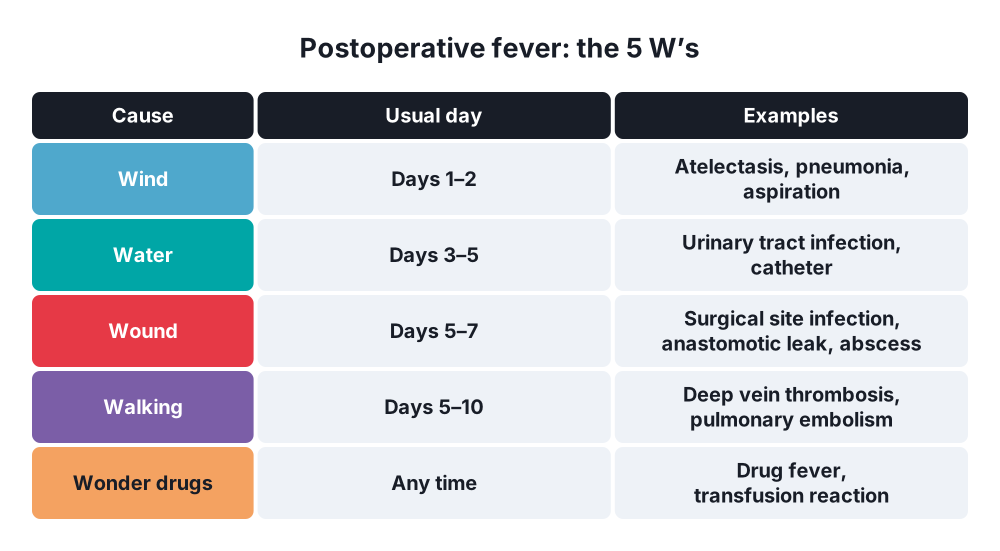
Fever timeline (5 W's)
- Wind → days 1–2; atelectasis, pneumonia
- Water → days 3–5; urinary tract infection
- Wound → days 5–7; wound infection
- Walking → days 5–10; deep vein thrombosis (DVT), pulmonary embolism (PE)
- Wonder drugs → any time; drug fever, transfusion reaction
- Day 5–7 with abdominal signs → anastomotic leak, intra-abdominal abscess
Wound
- Haematoma, seroma
- Surgical site infection → redness, pain, discharge; open and drain
- Dehiscence → burst abdomen day 7–10; salmon-pink serous discharge is the warning sign
- Incisional hernia → late
Respiratory
- Atelectasis → most common early complication; physiotherapy, analgesia
- Pneumonia, aspiration
- Pleural effusion
- Acute respiratory distress syndrome (ARDS)
- Pulmonary embolism
Cardiovascular
- Haemorrhage → primary, reactionary, secondary
- Hypotension, shock
- Myocardial infarction, arrhythmias (atrial fibrillation)
- DVT and PE → prevention with mechanical and drug prophylaxis
Gastrointestinal
- Nausea and vomiting
- Paralytic ileus → nasogastric decompression, fluids, correct potassium
- Early adhesive obstruction
- Anastomotic leak → days 5–7; sepsis, peritonitis; CT, drainage or relaparotomy
- Clostridioides difficile colitis
Urinary
- Urinary retention → catheter
- Urinary tract infection
- Acute kidney injury → hypovolaemia, sepsis, nephrotoxic drugs
Neurological
- Postoperative delirium → elderly; exclude hypoxia, sepsis, drugs, retention
- Stroke
Other
- Pressure ulcers
- Line infection, thrombophlebitis
- Fluid and electrolyte disturbances → hypokalaemia, hyponatraemia
- Hyperglycaemia
5. Prevention
- Preoperative optimisation → stop smoking, treat anaemia, nutrition, glucose, cardiac and lung disease
- Antibiotic prophylaxis → within 60 min before incision
- Careful surgical technique and haemostasis
- VTE prophylaxis
- Early mobilisation, physiotherapy
- ERAS pathways
Show as a list
Postoperative period
- Care
- Monitoring
- Analgesia
- Early mobilisation
- VTE prophylaxis
- ERAS
- Classification
- Immediate, early, late
- General, specific
- Clavien-Dindo
- Complications
- Wound
- Respiratory
- Cardiovascular
- Gastrointestinal
- Urinary
- Neurological
- Fever 5 W's
- Wind
- Water
- Wound
- Walking
- Wonder drugs