77. Pancreatic carcinoma
High yield
Ductal adenocarcinoma presents late with painless jaundice; staged by resectability on CT and treated with Whipple and chemotherapy.
Exam Prep · State examSurgery · HPBSurgery · Surgical oncology
1. Definition
- Pancreatic carcinoma → malignant tumour of the exocrine pancreas; pancreatic ductal adenocarcinoma (PDAC) in about 90%
- Periampullary tumours → arise within 1 cm of the ampulla of Vater: pancreatic head, ampulla, distal CBD, duodenum (pancreatic head is the most common and has the worst prognosis)
- Other exocrine tumours → acinar cell carcinoma, colloid (mucinous) carcinoma from IPMN, adenosquamous, undifferentiated with osteoclast-like giant cells
2. Epidemiology
- About 3% of cancers, but the 3rd–4th cause of cancer death in the West (expected to become 2nd)
- Age → over 60 (peak 65–75); men slightly more
- Location → head about 65–70%, body and tail 20–25%, diffuse 5–10%
- At diagnosis → only 15–20% resectable, 30–35% locally advanced, 50% metastatic
- 5-year survival about 10–12% for all patients; 20–30% after resection with adjuvant chemotherapy
- Ampullary cancer → better prognosis (5-year survival 40–60% after resection; presents early with jaundice)
3. Aetiology and risk factors
- Smoking → strongest modifiable risk (doubles the risk; about 25% of cases)
- Age
- Obesity, physical inactivity, high fat and red meat diet
- Diabetes → long-standing type 2 is a risk; new-onset diabetes over 50 may be an early sign of the cancer
- Chronic pancreatitis (especially hereditary)
- Alcohol (heavy), via pancreatitis
- Family history → 2 or more first-degree relatives (familial pancreatic cancer)
- Genetic syndromes:
- BRCA2 (and BRCA1, PALB2)
- Peutz-Jeghers (STK11) → highest relative risk
- Familial atypical multiple mole melanoma (CDKN2A / p16)
- Lynch syndrome
- Hereditary pancreatitis (PRSS1)
- Familial adenomatous polyposis, ataxia-telangiectasia
- Precursors → pancreatic intraepithelial neoplasia (PanIN), IPMN, MCN
- Blood group non-O, H. pylori (weak)
4. Pathogenesis
- PanIN progression → low grade to high grade to invasive cancer:
- KRAS mutation → over 90% (early event)
- CDKN2A (p16) loss → intermediate
- TP53 and SMAD4 (DPC4) loss → late
- Dense desmoplastic stroma → poor drug delivery, hypoxia; resistant to chemotherapy
- Spread:
- Local → CBD (jaundice), duodenum (obstruction, bleeding), portal vein and SMV, SMA, coeliac axis, perineural invasion (coeliac plexus → back pain)
- Lymphatic → peripancreatic, hepatoduodenal ligament, coeliac, para-aortic nodes
- Haematogenous → liver (most common), lung, bone
- Peritoneum → ascites, Sister Mary Joseph nodule, Blumer's shelf
- Body and tail tumours → no jaundice → found later, larger, more often metastatic
5. Classification
Histology
- Ductal adenocarcinoma (90%) and variants
- Acinar cell, colloid, adenosquamous, undifferentiated
- (Neuroendocrine tumours → see question 78)
TNM 8th edition (by size)
- T1 → ≤ 2 cm (T1a ≤ 0.5, T1b 0.5–1, T1c 1–2 cm)
- T2 → > 2 and ≤ 4 cm
- T3 → > 4 cm
- T4 → involves coeliac axis, SMA or common hepatic artery (any size)
- N1 → 1–3 nodes; N2 → 4 or more
- M1 → distant metastases
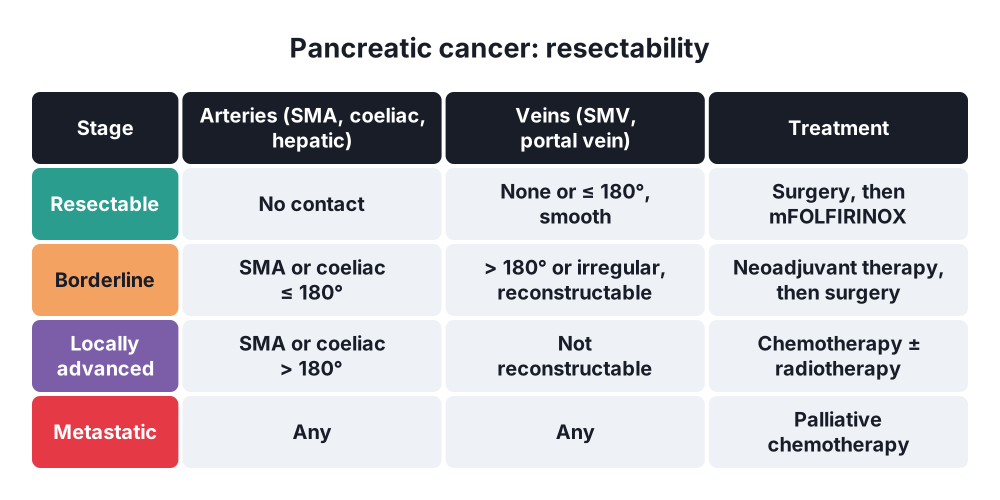
Resectability (NCCN)
- Resectable → no arterial contact (coeliac, SMA, common hepatic); no SMV or portal vein contact, or ≤ 180° without contour change
- Borderline resectable:
- SMV/portal vein → contact > 180°, or ≤ 180° with contour irregularity or thrombosis, reconstructable
- SMA or coeliac → contact ≤ 180°
- Common hepatic artery → short-segment contact, reconstructable
- Locally advanced (unresectable) → SMA or coeliac contact > 180°; unreconstructable SMV/portal vein
- Metastatic → liver, peritoneum, lung, distant nodes
6. Clinical picture
Symptoms
- Head tumours:
- Painless progressive obstructive jaundice → dark urine, pale stools, itch
- Weight loss, anorexia
- Vague epigastric pain
- Steatorrhoea (duct obstruction)
- Body and tail tumours → epigastric pain radiating to the back (coeliac plexus invasion; worse lying flat, better leaning forward), marked weight loss; no jaundice until late (liver or hilar spread)
- New-onset diabetes in an older, thin patient
- Acute pancreatitis in an older patient without a cause
- Vomiting (duodenal obstruction)
- Depression, fatigue
- Migratory thrombophlebitis (Trousseau's syndrome), DVT, pulmonary embolism
Signs
- Jaundice, scratch marks
- Palpable, non-tender gallbladder → Courvoisier's law (jaundice with a palpable gallbladder is unlikely to be from stones)
- Hepatomegaly (metastases or obstruction)
- Epigastric mass (advanced)
- Virchow's node (Troisier's sign), Sister Mary Joseph nodule, ascites, Blumer's shelf
- Cachexia
- Splenomegaly → splenic vein thrombosis (body or tail)
7. Diagnosis
Blood tests
- LFT → cholestatic (bilirubin, ALP, GGT)
- CA 19-9 → raised in about 80%; not for screening or diagnosis alone; false positive in jaundice and cholangitis; negative in Lewis antigen-negative people (5–10%); useful for prognosis and follow-up
- CEA, HbA1c, FBC, INR, albumin
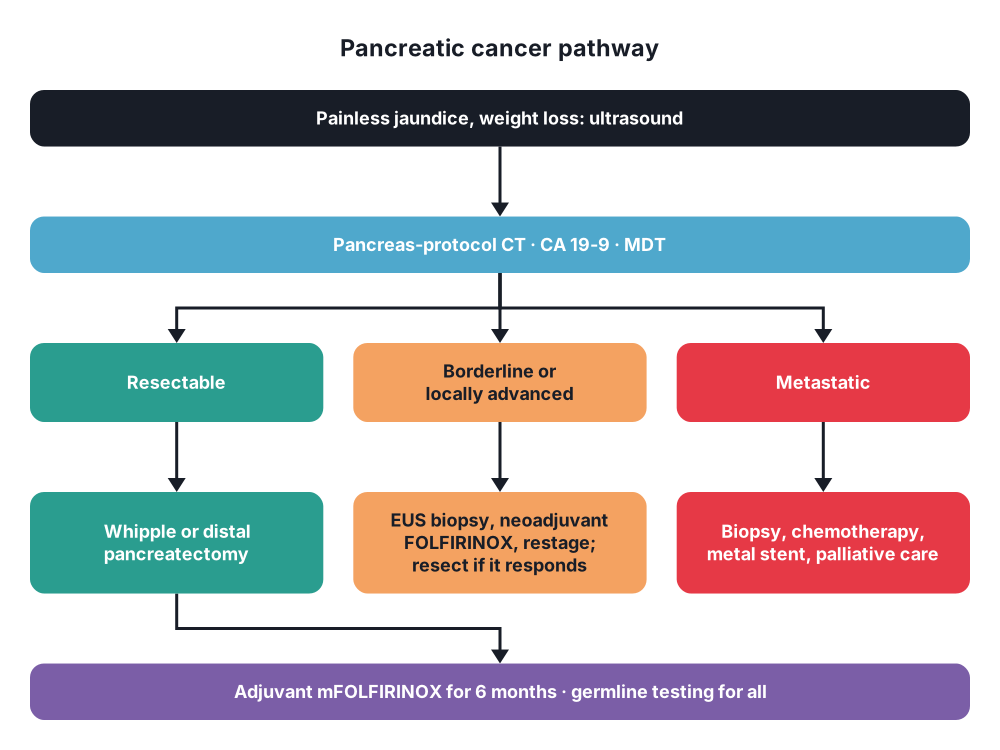
- Germline genetic testing for all patients (BRCA, PALB2, MMR → targeted treatment and family screening)
Imaging
- Ultrasound → first test in jaundice: dilated ducts, mass, liver metastases
- Pancreas-protocol multiphase CT (arterial and portal venous phases, thin slices) → key staging test: mass (hypodense), vessel contact, metastases; "double duct sign" (dilated CBD and pancreatic duct)
- MRI with MRCP → small liver metastases, cystic lesions
- EUS → small tumours, vessel involvement; EUS-guided FNA or core biopsy (before neoadjuvant therapy or for unresectable disease)
- PET-CT → selected (borderline, high CA 19-9)
- Staging laparoscopy → high CA 19-9, large or body-tail tumours, borderline disease (finds small peritoneal and liver deposits)
- ERCP → biliary stent for cholangitis, severe jaundice, or delay before surgery (neoadjuvant therapy); brushings for cytology
Biopsy
- Not required before resection of a typical resectable mass
- Required before chemotherapy (neoadjuvant or palliative)
8. Differential diagnosis
- Other periampullary cancers → ampullary, distal cholangiocarcinoma, duodenal
- Chronic pancreatitis with an inflammatory mass
- Autoimmune (IgG4) pancreatitis → "sausage-shaped" gland, IgG4 high, responds to steroids
- Pancreatic neuroendocrine tumour (enhancing, slower)
- Cystic neoplasms (IPMN, MCN)
- Metastases to the pancreas (renal cell carcinoma), lymphoma
- CBD stones, Mirizzi syndrome, benign biliary stricture
- Peptic ulcer disease, gastric cancer
9. Treatment
Conservative
- Multidisciplinary team decision for every patient
- Adjuvant chemotherapy after resection (all fit patients, start within 12 weeks, 6 months):
- Modified FOLFIRINOX (oxaliplatin, irinotecan, leucovorin, fluorouracil) → fit patients; median survival about 54 months (PRODIGE 24)
- Gemcitabine with capecitabine (ESPAC-4) → less fit
- Gemcitabine alone → frail patients
- Neoadjuvant therapy → borderline resectable and locally advanced tumours (FOLFIRINOX or gemcitabine with nab-paclitaxel ± chemoradiotherapy), then restage and resect if possible; increasingly used for resectable disease in trials
- Metastatic or unresectable:
- FOLFIRINOX or NALIRIFOX (fit), gemcitabine with nab-paclitaxel, gemcitabine alone (frail)
- Olaparib maintenance in germline BRCA mutation
- Pembrolizumab for MSI-high tumours (rare)
- Median survival about 8–12 months
- Palliation:
- Jaundice → ERCP with self-expanding metal stent (first choice); PTBD if ERCP fails
- Duodenal obstruction → duodenal stent or gastrojejunostomy (laparoscopic; better for longer survival)
- Pain → opioids, EUS-guided coeliac plexus neurolysis, radiotherapy
- Pancreatic enzyme replacement (Creon) → improves weight and survival
- Thromboprophylaxis (high VTE risk), nutrition, palliative care, psychological support
Surgical
- Only potential cure; candidate → resectable or responding borderline tumour, fit patient
- Pancreaticoduodenectomy (Whipple) → head, uncinate and periampullary tumours:
- Assess for metastases (laparoscopy or laparotomy)
- Kocher manoeuvre; check the SMV/portal vein and SMA
- Cholecystectomy; divide the common hepatic duct
- Divide the gastroduodenal artery
- Divide the stomach (classic) or duodenum (pylorus-preserving)
- Divide the pancreas at the neck over the portal vein
- Divide the jejunum beyond the ligament of Treitz; dissect the uncinate process off the SMV and SMA (SMA margin)
- Remove the head, duodenum, distal CBD, gallbladder, ± antrum, and nodes
- Reconstruction (Child's) → pancreaticojejunostomy (or pancreaticogastrostomy), hepaticojejunostomy, gastro- or duodenojejunostomy
- Venous resection (SMV/portal vein) with reconstruction → same survival as standard Whipple when needed for R0
- Distal pancreatectomy with splenectomy → body and tail tumours; RAMPS (radical antegrade modular pancreatosplenectomy) for better posterior margins; Appleby procedure (with coeliac axis resection) in selected cases
- Total pancreatectomy → diffuse tumour, positive neck margin, IPMN throughout the gland (causes brittle diabetes)
- Minimally invasive (laparoscopic or robotic) → distal pancreatectomy widely; Whipple in expert centres
- High-volume centres → lower mortality (under 3–5%)
- Preoperative biliary drainage → not routine (more complications); only if cholangitis, very high bilirubin, or neoadjuvant therapy
- Contraindications to resection → metastases (liver, peritoneal, distant nodes), arterial encasement > 180° (unless good response to neoadjuvant therapy), poor fitness
- Surgical bypass (hepaticojejunostomy ± gastrojejunostomy) → unresectable disease found at laparotomy
10. Complications
Of the disease
- Obstructive jaundice, cholangitis
- Duodenal obstruction
- Pain, cachexia
- Venous thromboembolism, Trousseau's syndrome
- Diabetes, malabsorption
- Ascites, GI bleeding
Of the Whipple
- Postoperative pancreatic fistula (10–30%; ISGPS grade B or C)
- Delayed gastric emptying (most common; 15–30%)
- Post-pancreatectomy haemorrhage → early (technical) or late (sentinel bleed from a pseudoaneurysm, gastroduodenal stump; angioembolisation)
- Bile leak, chyle leak, intra-abdominal abscess
- Marginal ulcer, diabetes, exocrine insufficiency
- Mortality under 3–5% in high-volume centres; morbidity 30–50%
Show as a list
Pancreatic cancer
- Risk
- Smoking
- Diabetes, obesity
- Chronic pancreatitis
- BRCA2, CDKN2A, PJS
- PanIN, IPMN
- Pathology
- Ductal adenocarcinoma
- KRAS > 90%
- Head 65-70%
- Perineural spread
- Clinical
- Painless jaundice
- Courvoisier
- Back pain: body, tail
- New diabetes
- Trousseau
- Tests
- Pancreas-protocol CT
- Double duct sign
- CA 19-9: follow-up
- EUS biopsy
- Staging laparoscopy
- Stage
- Resectable
- Borderline
- Locally advanced: SMA > 180
- Metastatic
- Treatment
- Whipple
- Distal pancreatectomy
- mFOLFIRINOX adjuvant
- Neoadjuvant: borderline
- Metal stent, bypass