74. Pancreas: congenital anomalies and trauma
High yield
Divisum, annular and ectopic pancreas; pancreatic injury is graded by duct damage, which decides drainage or resection.
Exam Prep · State examSurgery · HPBSurgery · Emergency and traumaSurgical Anatomy · Hepatobiliary
1. Definition
- Congenital anomalies → faults in the fusion, rotation or position of the pancreatic buds:
- Pancreas divisum → dorsal and ventral ducts do not fuse
- Annular pancreas → ring of pancreatic tissue around the second part of the duodenum
- Ectopic (heterotopic) pancreas → pancreatic tissue outside the pancreas, without duct or vascular connection
- Others → agenesis, hypoplasia, congenital cysts, anomalous pancreaticobiliary junction
- Pancreatic trauma → injury to the gland or main pancreatic duct from blunt, penetrating or iatrogenic force
2. Epidemiology
- Pancreas divisum → most common anomaly (about 7–10%); most never have symptoms
- Annular pancreas → about 1 in 7,000–20,000; half present in newborns (Down's syndrome, duodenal atresia, malrotation), half in adults
- Ectopic pancreas → 1–14% at autopsy; stomach (antrum, greater curve), duodenum, jejunum, Meckel's diverticulum
- Pancreatic injury → under 5% of abdominal trauma (protected deep in the retroperitoneum), but mortality 10–30%
- Blunt → handlebar injury in children, steering wheel and seat-belt injuries in adults
- Penetrating → about two-thirds in many series; associated injuries in over 90% (liver, stomach, duodenum, major vessels)
- Isolated injury → mostly blunt
3. Aetiology and risk factors
Embryology (revision)
- Dorsal bud → body, tail, part of the head; duct becomes the accessory duct (Santorini) → minor papilla
- Ventral bud → uncinate process and lower head; rotates behind the duodenum with the bile duct; duct becomes the main duct (Wirsung) → major papilla with the CBD
- Weeks 6–8 → the buds fuse; the ducts join
Anatomy (revision)
- Head in the duodenal C-loop; uncinate process behind the superior mesenteric vessels
- Neck in front of the portal vein (SMV-splenic confluence), over the spine (L1–L2)
- Body and tail toward the splenic hilum; splenic artery along the upper border, splenic vein behind
- Blood supply → gastroduodenal artery (superior pancreaticoduodenal) and SMA (inferior pancreaticoduodenal) for the head; splenic artery for body and tail
Causes
- Divisum → no fusion of the ducts → most secretion drains through the small minor papilla (relative obstruction)
- Annular → ventral bud fails to rotate fully and wraps around the duodenum
- Ectopic → bits of bud carried with the developing gut
- Trauma:
- Blunt → crushing of the gland against the spine (neck and body)
- Penetrating → stab, gunshot
- Iatrogenic → splenectomy, gastrectomy, nephrectomy, ERCP, biopsy
4. Pathogenesis
- Divisum → raised pressure behind the minor papilla → recurrent acute pancreatitis and chronic pancreatitis of the dorsal gland (in a few)
- Annular → narrowing of D2 → duodenal obstruction (infants: complete or partial; adults: peptic ulcer, pancreatitis)
- Ectopic → mostly silent; may cause ulceration, bleeding, obstruction, intussusception; rarely pancreatitis or cancer in the rest
- Trauma:
- Main duct injury is the key factor → pancreatic juice leaks → fistula, pseudocyst, abscess, autodigestion
- Contusion without duct injury → traumatic pancreatitis
- Head injuries often come with duodenal, bile duct and vascular injury (portal vein, SMV, IVC)
- Delayed diagnosis → retroperitoneal sepsis, higher mortality
5. Classification
Congenital
- Fusion → divisum (complete, incomplete)
- Rotation → annular (complete, incomplete)
- Position → ectopic (Heinrich types I–III by acini, ducts, islets)
- Number and size → agenesis, hypoplasia
- Ducts → anomalous pancreaticobiliary junction (long common channel; choledochal cyst, gallbladder cancer)
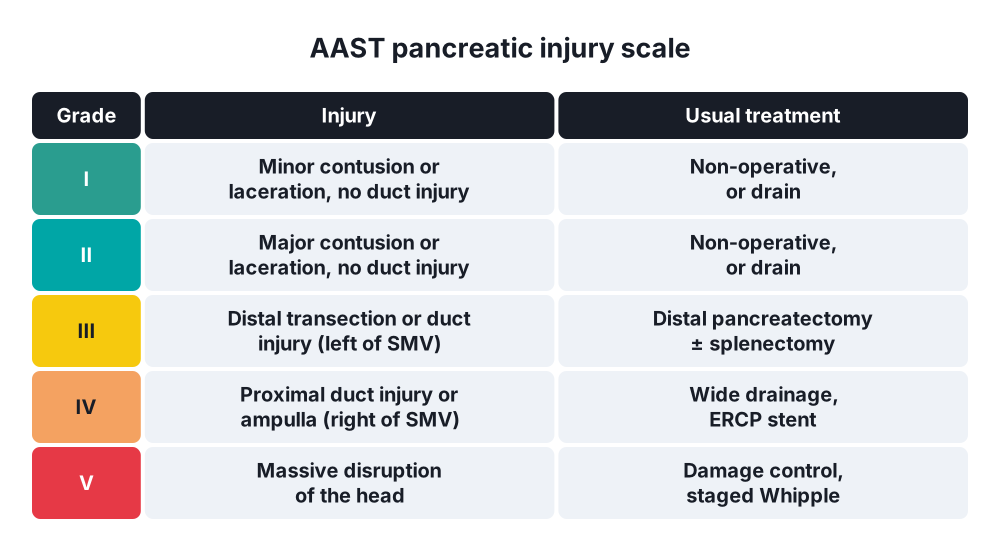
AAST pancreatic injury scale
- Grade I → minor contusion or superficial laceration, no duct injury
- Grade II → major contusion or laceration, no duct injury or tissue loss
- Grade III → distal transection or parenchymal injury with duct injury (left of the SMV)
- Grade IV → proximal transection or injury involving the ampulla (right of the SMV)
- Grade V → massive disruption of the pancreatic head
- Key line → superior mesenteric vein separates distal (body and tail) from proximal (head)
6. Clinical picture
Symptoms
- Divisum → usually none; recurrent episodes of acute pancreatitis without another cause; chronic epigastric pain
- Annular:
- Newborn → bilious vomiting (obstruction below the ampulla in most), feeding intolerance; polyhydramnios before birth
- Adult → postprandial fullness, vomiting, epigastric pain, peptic ulcer, pancreatitis
- Ectopic → incidental; dyspepsia, bleeding, obstruction
- Trauma:
- Symptoms often mild at first (retroperitoneal organ)
- Epigastric pain radiating to the back, vomiting
- Later (hours or days) → peritonitis, fever, ileus, pseudocyst
Signs
- Trauma:
- Epigastric tenderness, seat-belt or handlebar bruise
- Upper abdominal guarding; signs may be slight
- Shock → associated vascular or liver injury
- Peritonitis when duodenum or bowel is injured
- Annular in newborns → upper abdominal distension, visible peristalsis; Down's features
7. Diagnosis
Congenital
- MRCP with secretin → best test for divisum (separate dorsal duct to the minor papilla) and annular duct
- ERCP → historical diagnosis; now for therapy
- Newborn annular → abdominal X-ray "double bubble" (stomach and duodenum); contrast study
- Adult annular → CT (ring of tissue around D2), MRCP, EUS
- Ectopic → endoscopy: submucosal nodule with a central dimple (umbilication); EUS
Trauma
- Serum amylase and lipase → raised in most, but normal in up to 40% early; rising levels on repeat testing are more useful
- CT with IV contrast (pancreatic phase) → first test in stable patients:
- Laceration, fluid around the pancreas, fluid between the splenic vein and pancreas, haematoma
- Misses up to 40–50% of duct injuries early → repeat CT at 12–24 hours if suspicion remains
- MRCP (secretin) → duct integrity in stable patients
- ERCP → shows the duct leak and allows a stent
- Intraoperative → inspect the whole gland (Kocher manoeuvre, open the lesser sac), on-table pancreatography, look for duct transection
- FAST → free fluid; often negative in isolated pancreatic injury
8. Differential diagnosis
- Divisum → other causes of recurrent pancreatitis: gallstones, microlithiasis, alcohol, hypertriglyceridaemia, sphincter of Oddi dysfunction, IPMN, genetic
- Annular in newborns → duodenal atresia, duodenal web, malrotation with volvulus (must be excluded urgently)
- Ectopic → GIST, leiomyoma, carcinoid, lymphoma
- Trauma → duodenal injury, liver, spleen, kidney injury, hollow viscus injury
9. Treatment
Conservative
- Asymptomatic divisum → no treatment
- Symptomatic divisum with recurrent pancreatitis → ERCP with minor papilla sphincterotomy ± stent (helps recurrent acute pancreatitis; less for chronic pain)
- Ectopic pancreas → leave if asymptomatic and diagnosis is certain
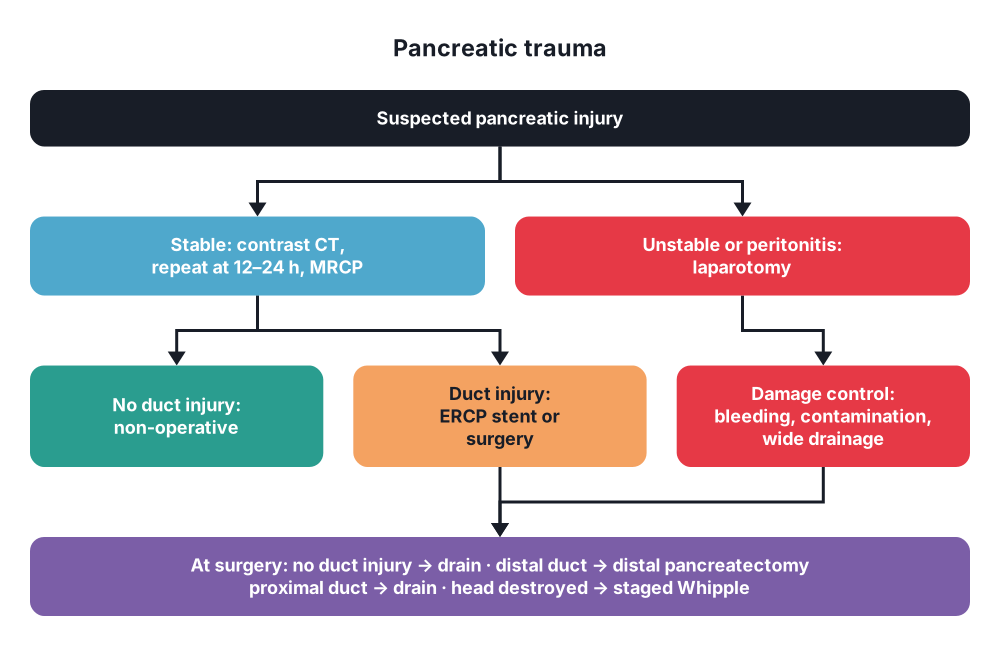
- Pancreatic trauma, grades I–II (no duct injury) in stable patients → non-operative:
- Nil by mouth, analgesia, IV fluids, monitoring of amylase and lipase
- Early enteral nutrition, repeat CT if worse
- Somatostatin analogues → no clear benefit
- Duct injury in selected stable patients → endoscopic transpapillary stent (partial duct injury), especially in children
- Pseudocyst after trauma → wait 4–6 weeks; endoscopic or percutaneous drainage if symptomatic
Surgical: congenital
- Annular pancreas → duodenoduodenostomy (diamond-shaped, Kimura) in newborns; or duodenojejunostomy, gastrojejunostomy in adults
- Do not divide the ring → pancreatic fistula, pancreatitis, duct injury
- Ectopic pancreas with symptoms or doubt → local excision (endoscopic or laparoscopic wedge resection)
- Divisum after failed endoscopy → surgical sphincteroplasty, or resection or drainage for chronic disease
Surgical: trauma
- Indications → instability, peritonitis, other injuries needing laparotomy, duct injury not suitable for a stent
- Damage control first in unstable patients → control bleeding, contamination; wide drainage of the pancreas; definitive surgery later
- By grade:
- Grade I–II found at laparotomy → haemostasis and closed suction drainage (no repair of the gland)
- Grade III (distal duct injury) → distal pancreatectomy with or without splenectomy (spleen preserved in stable patients and children)
- Grade IV (proximal duct injury) → wide drainage (most); duct stent by ERCP later; resection of the distal gland only if a large part is involved
- Grade V (head destruction with duodenum) → damage control, then pancreaticoduodenectomy (Whipple) in a staged way (rarely needed; very high mortality)
- Combined pancreaticoduodenal injury → duodenal repair, pyloric exclusion with gastrojejunostomy (historical), drainage, feeding jejunostomy
- Feeding jejunostomy at the first operation in severe injury
10. Complications
Congenital
- Divisum → recurrent acute pancreatitis, chronic pancreatitis
- Annular → duodenal obstruction, peptic ulcer, pancreatitis, bile duct obstruction
Trauma
- Pancreatic fistula (most common; 10–35%) → most close with drainage, nutrition and time; octreotide may shorten output; ERCP stent
- Pseudocyst (main duct injury missed or treated non-operatively)
- Peripancreatic abscess, infected necrosis
- Traumatic pancreatitis
- Pseudoaneurysm of the splenic or gastroduodenal artery → late bleeding (angioembolisation)
- Duct stricture → recurrent pancreatitis, chronic pancreatitis of the distal gland
- Exocrine and endocrine insufficiency (diabetes) after resection
- After splenectomy → overwhelming post-splenectomy infection (vaccinate)
- Mortality → mostly from associated vascular injuries early, and sepsis and multiorgan failure late
Show as a list
Pancreas: congenital and trauma
- Embryology
- Dorsal bud: Santorini
- Ventral bud: Wirsung
- Fusion weeks 6-8
- Divisum
- 7-10%
- Minor papilla
- Recurrent pancreatitis
- Secretin MRCP
- Annular
- Ventral bud ring
- Double bubble
- Down's syndrome
- Duodenoduodenostomy
- Ectopic
- Stomach, duodenum
- Umbilicated nodule
- Trauma
- Handlebar, seat belt
- Neck over spine
- Amylase may be normal
- CT, MRCP, ERCP
- AAST grades
- I-II: drain
- III: distal pancreatectomy
- IV: drain, stent
- V: staged Whipple
- Complications
- Fistula
- Pseudocyst
- Pseudoaneurysm