103. Other anorectal diseases
High yield
Pilonidal sinus, pruritus ani, anal warts, stenosis, perianal Crohn's, hidradenitis, infections, foreign bodies and anal cancer.
Exam Prep · State examSurgery · General surgerySurgery · Colorectal
1. Definition
- This question covers the anorectal conditions not dealt with under haemorrhoids, fissure, prolapse, abscess and fistula
- Pilonidal sinus → chronic infected sinus in the natal cleft caused by hair driven into the skin ("nest of hair")
- Pruritus ani → persistent itching of the perianal skin; a symptom, not a diagnosis
- Anal warts (condylomata acuminata) → benign skin growths caused by human papillomavirus (HPV)
- Anal stenosis → narrowing of the anal canal that makes defecation difficult
- Perianal Crohn's disease → fissures, fistulas, abscesses, skin tags and strictures caused by Crohn's disease
- Hidradenitis suppurativa → chronic inflammation of apocrine-gland skin with abscesses, sinus tracts and scarring
- Solitary rectal ulcer syndrome → benign ulcer or polypoid lesion of the anterior rectal wall linked with straining and internal intussusception
- Anal cancer → malignant tumour of the anal canal or anal margin, mostly squamous cell carcinoma
2. Epidemiology
- Pilonidal sinus → young men aged 15–30 (male to female about 3–4:1); hairy, overweight, sitting jobs ("jeep disease")
- Pruritus ani → 1–5% of the population; men more often
- Anal warts → the most common sexually transmitted infection; more common in men who have sex with men and in HIV
- Perianal Crohn's disease → 20–35% of patients with Crohn's; can be the first sign
- Hidradenitis suppurativa → about 1%; more often in women, but perineal disease is more common in men; starts after puberty
- Anal cancer → about 1–2% of large bowel cancers; rising; HIV and HPV 16 and 18 raise the risk
3. Aetiology and risk factors
Pilonidal sinus
- Acquired → loose hair is sucked into enlarged follicles (midline pits) by friction and movement of the buttocks
- Hirsutism, deep natal cleft, obesity, sitting jobs, poor hygiene
Pruritus ani
- Idiopathic in about half
- Faecal soiling (haemorrhoids, fissure, fistula, prolapse, loose stool), excess washing or wiping, sweating
- Skin disease → contact dermatitis (creams, soaps, wipes), psoriasis, lichen sclerosus, eczema
- Infection → threadworms (children), candida (diabetes, antibiotics), scabies, warts
- Systemic → diabetes, jaundice, renal failure
- Neoplasia → anal intraepithelial neoplasia, Paget's disease, Bowen's disease, anal cancer
Anal warts and anal cancer
- HPV → types 6 and 11 cause warts; types 16 and 18 cause dysplasia and cancer
- Anal intercourse, many partners, HIV, transplant and other immunosuppression, smoking, cervical neoplasia
Anal stenosis
- After surgery (about 90%) → haemorrhoidectomy without mucosal bridges, stapled operations
- Crohn's disease, radiation, tuberculosis, chronic laxative abuse, trauma, congenital anorectal malformation
Other
- Hidradenitis → blocked hair follicles, smoking, obesity, genetic factors
- Solitary rectal ulcer → chronic straining, internal intussusception, digital self-evacuation
- Foreign bodies → sexual practice, assault, accidental, concealment of drugs
4. Pathogenesis
- Pilonidal sinus → hair enters through midline pits → foreign body reaction → infection → abscess → chronic sinus with lateral openings
- Pruritus ani → moisture and faecal enzymes irritate the skin → itching → scratching → skin damage → more itching (itch-scratch cycle); worse at night
- HPV → infects the basal cells of the squamous epithelium → warts, or dysplasia (AIN) that may progress to squamous cell carcinoma
- Perianal Crohn's → transmural inflammation of the anorectum → deep fissures, complex fistulas, abscesses, strictures, "elephant ear" skin tags
- Hidradenitis → follicular occlusion → rupture → abscess → interconnected tunnels (sinus tracts) and scars
- Solitary rectal ulcer → repeated straining against a closed pelvic floor → mucosal ischaemia → ulcer with fibromuscular obliteration of the lamina propria
5. Classification
Pilonidal disease
- Asymptomatic pits, acute pilonidal abscess, chronic pilonidal sinus, recurrent disease
Hidradenitis (Hurley stages)
- Stage I → abscesses without tunnels or scars
- Stage II → recurrent abscesses with tunnels and scars, separate lesions
- Stage III → diffuse, interconnected tunnels across the whole area
Anal cancer by site
- Anal canal (above the anal verge) and perianal skin (within 5 cm of the anal verge)
- Squamous cell carcinoma (80–90%), adenocarcinoma, melanoma, basal cell carcinoma
6. Clinical picture
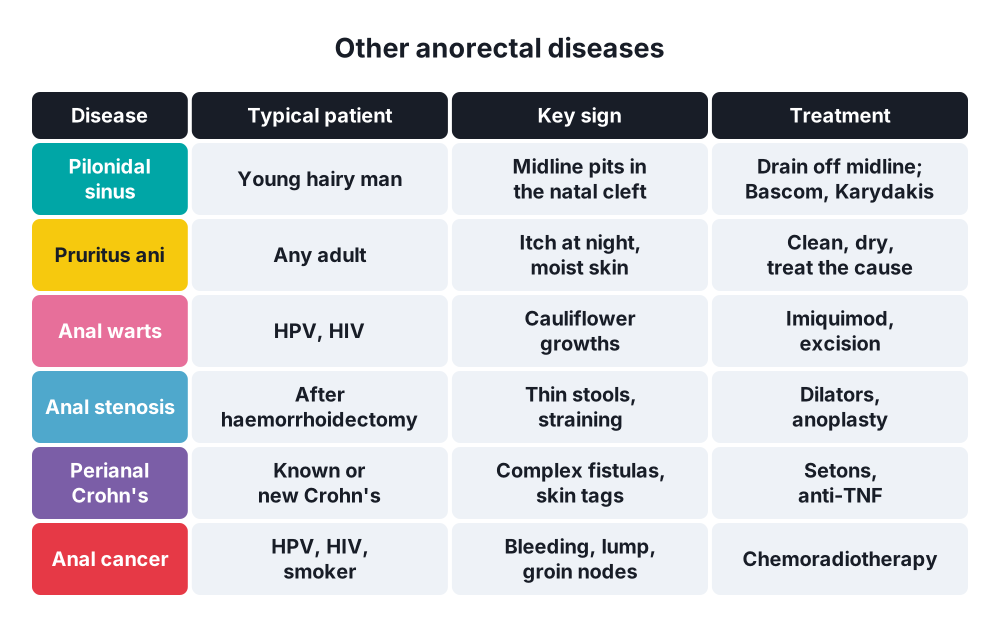
- Pilonidal sinus:
- Midline pits in the natal cleft, often with hairs; lateral secondary openings with discharge
- Acute abscess → painful, red, fluctuant swelling just off the midline, 4–5 cm above the anus
- Pruritus ani → itching worse at night and after defecation; red, moist or thickened (lichenified) skin
- Anal warts → cauliflower-like growths around the anus and in the canal; itching, bleeding, discharge
- Buschke–Löwenstein tumour → giant condyloma that invades locally
- Anal stenosis → hard to pass stool, thin stools, pain, bleeding; laxative dependence
- Perianal Crohn's → multiple painless or atypical fissures, complex fistulas (watering-can perineum), abscesses, bluish skin tags
- Hidradenitis → recurrent painful nodules and discharging tunnels in the perineum, groins, buttocks and axillae; pitted scars
- Solitary rectal ulcer → mucus, bleeding, straining, tenesmus, feeling of incomplete emptying; anterior rectal ulcer 5–10 cm from the verge
- Anal cancer → bleeding, pain, lump, itching, discharge, change in bowel habit; inguinal lymph nodes may be enlarged
- STIs → proctitis (gonorrhoea, chlamydia, lymphogranuloma venereum), painful vesicles (herpes), painless chancre or painful ulcer (syphilis)
- Rectal foreign body → pain, bleeding; signs of perforation (peritonitis, sepsis)
7. Diagnosis
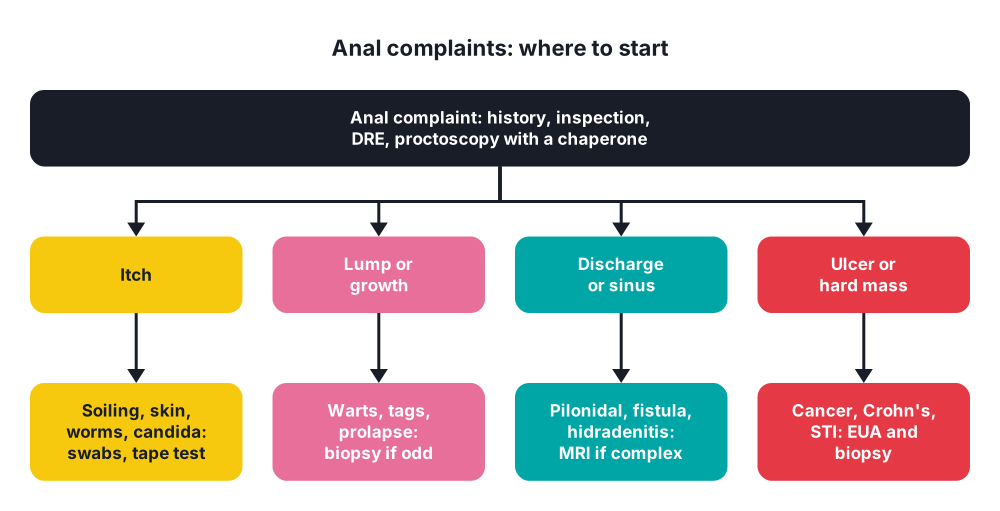
- History and gentle examination with a chaperone → inspection, DRE, proctoscopy, sigmoidoscopy
- Pilonidal sinus → clinical
- Pruritus ani → look for the cause: DRE, proctoscopy, skin scraping, swabs for candida, sticky-tape test for threadworms, glucose; biopsy of abnormal skin
- Anal warts → clinical; proctoscopy for canal lesions; biopsy atypical lesions (especially in HIV); screen for other STIs and HIV
- Perianal Crohn's → EUA, MRI pelvis, colonoscopy with ileal intubation
- Hidradenitis → clinical
- Solitary rectal ulcer → biopsy (excludes cancer), defecography (internal intussusception)
- STIs → swabs for nucleic acid amplification tests, HSV PCR, syphilis serology (VDRL or RPR plus a treponemal test), HIV test
- Anal cancer:
- Biopsy under EUA
- MRI pelvis → local stage
- CT chest, abdomen and pelvis or PET-CT → nodes and metastases
- Fine-needle aspiration of enlarged inguinal nodes; HIV test
- Foreign body → abdominal X-ray (position, free air), CT if perforation is suspected
8. Differential diagnosis
- Pilonidal abscess against perianal abscess (pilonidal is higher, in the natal cleft, not connected with the anal canal)
- Pilonidal sinus against hidradenitis, furuncle, anal fistula, sacrococcygeal teratoma
- Anal warts against condylomata lata (secondary syphilis), skin tags, anal cancer
- Atypical fissure or ulcer → Crohn's, cancer, tuberculosis, syphilis, herpes, HIV
- Solitary rectal ulcer against rectal cancer and IBD
9. Treatment
Conservative
- Pruritus ani:
- Treat the cause; keep the area clean and dry; wash with water only, pat dry, no soaps, wipes or creams
- Fibre to firm the stool, cotton underwear
- Short course of a mild steroid cream; capsaicin for resistant cases
- Threadworms → mebendazole for the whole family; candida → antifungal
- Anal warts → topical imiquimod or podophyllotoxin for small external warts; HPV vaccination (also for prevention)
- Anal stenosis (mild) → fibre, stool softeners, anal dilators
- Perianal Crohn's → drain sepsis and place loose setons, then medical therapy: metronidazole or ciprofloxacin, azathioprine, anti-TNF (infliximab, adalimumab)
- Hidradenitis → stop smoking, weight loss; antibiotics (tetracyclines, clindamycin with rifampicin); anti-TNF (adalimumab) for stage II–III
- Solitary rectal ulcer → fibre, stop straining, biofeedback
- STIs:
- Gonorrhoea → ceftriaxone
- Chlamydia → doxycycline
- Syphilis → benzathine penicillin
- Herpes → aciclovir
- Trace and treat partners
- Anal squamous cell carcinoma → chemoradiotherapy (Nigro protocol) is first-line:
- Radiotherapy with 5-fluorouracil and mitomycin C
- Cure in about 70–80% with the sphincter preserved
Surgical
- Pilonidal sinus:
- Acute abscess → incision and drainage off the midline; about half are cured by this alone
- Chronic or recurrent sinus → elective surgery after the acute phase
- Pit-picking (Bascom, Gips procedure) → minimal excision of the pits; quick recovery
- Off-midline closure → Karydakis flap, Bascom cleft lift, Limberg rhomboid flap → lower recurrence than midline closure
- Wide excision with healing by secondary intention → long healing time; NPWT can help
- Avoid midline wounds; remove hair (shaving, laser) to cut recurrence
- Anal warts → excision, cautery, cryotherapy or laser; send tissue for histology; recurrence 20–30%
- Anal stenosis (severe) → anoplasty with an advancement flap (V–Y, house or island flap); limited internal sphincterotomy if the sphincter is tight
- Perianal Crohn's → avoid fistulotomy and excision of skin tags; loose setons; advancement flap when quiescent; defunctioning stoma or proctectomy for severe disease
- Hidradenitis → deroofing of tunnels; wide excision of all affected skin for stage III, with healing by secondary intention or grafts
- Solitary rectal ulcer → ventral mesh rectopexy if linked to intussusception or prolapse; stoma as a last resort
- Rectal foreign body:
- Removal under sedation or anaesthesia, by hand or with endoscopy
- If that fails, laparoscopic or open "milking" down, then colotomy
- Perforation → laparotomy, repair or resection, often a stoma
- Always do sigmoidoscopy after removal
- Anal cancer:
- Local excision → small (under 2 cm) well-differentiated perianal skin tumours
- Salvage abdominoperineal resection → persistent or recurrent disease after chemoradiotherapy
- Inguinal node dissection for persistent node disease
10. Complications
- Pilonidal sinus → recurrence (higher with midline closure), wound breakdown, chronic non-healing wound, rarely squamous carcinoma in long-standing disease
- Pruritus ani → lichenification, skin infection
- Anal warts → recurrence, progression to AIN and cancer
- Anal stenosis surgery → flap necrosis, incontinence
- Perianal Crohn's → incontinence, rectovaginal fistula, stricture, cancer in long-standing fistulas
- Hidradenitis → scarring, contractures, squamous cell carcinoma (rare)
- Anal cancer treatment → radiation proctitis, skin damage, stenosis, incontinence, sexual dysfunction
Prognosis
- Anal cancer → 5-year survival about 65–80% after chemoradiotherapy (stage dependent); inguinal node spread worsens it
Show as a list
Other anorectal diseases
- Pilonidal sinus
- Young hairy men
- Midline pits
- Drain off midline
- Bascom, Karydakis
- Pruritus ani
- Soiling, skin, worms
- Clean and dry
- Anal warts
- HPV 6, 11
- Imiquimod, excision
- Anal stenosis
- After surgery
- Dilators, anoplasty
- Perianal Crohn's
- Setons, anti-TNF
- Hidradenitis
- Hurley I-III
- Excision
- Anal cancer
- HPV 16, 18
- Chemoradiotherapy
- Salvage APR