68. Obstructive jaundice
High yield
Blocked bile flow; stones give painful jaundice, cancer painless; image, prepare the patient, then drain or resect.
Exam Prep · State examSurgery · HPBSurgery · Surgical oncology
1. Definition
- Jaundice → yellow skin and sclera from raised serum bilirubin; seen when bilirubin is over 35–50 µmol/L (normal under 17–21)
- Obstructive (surgical, posthepatic) jaundice → jaundice from mechanical blockage of bile flow in the extrahepatic or large intrahepatic ducts
- Conjugated hyperbilirubinaemia with dilated ducts
2. Epidemiology
- Commonest causes in adults:
- CBD stones → most common cause
- Pancreatic head cancer → most common malignant cause
- Cholangiocarcinoma, ampullary cancer, gallbladder cancer, metastases at the porta
- Stones → younger, women; cancer → older (over 60)
- Children → biliary atresia, choledochal cyst
3. Aetiology and risk factors
Bilirubin metabolism (revision)
- Haem from old red cells → unconjugated bilirubin (bound to albumin, not water-soluble)
- Liver takes it up; conjugation with glucuronic acid (UDP-glucuronyl transferase)
- Conjugated bilirubin excreted in bile
- Gut bacteria → urobilinogen (some reabsorbed, passed in urine) and stercobilin (colours stool)
Types of jaundice
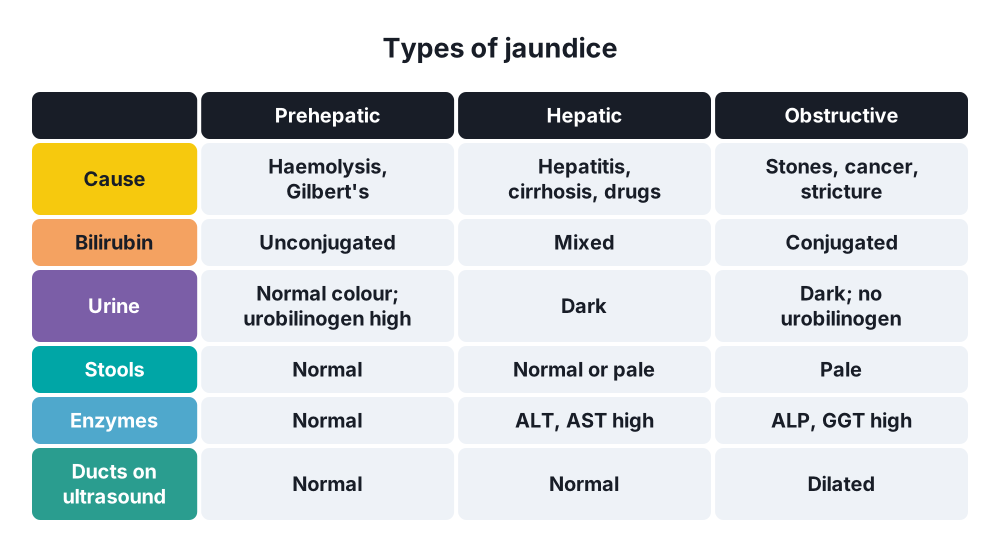
- Prehepatic → haemolysis, Gilbert's syndrome (unconjugated; no bilirubin in urine)
- Hepatic → hepatitis, cirrhosis, drugs (mixed)
- Posthepatic (obstructive) → blockage of the ducts (conjugated)
Causes of obstruction
- In the lumen:
- Stones (most common)
- Parasites (Ascaris, Clonorchis, hydatid daughter cysts), blood clot (haemobilia)
- In the wall:
- Cholangiocarcinoma (Klatskin tumour at the hilum)
- Benign stricture → bile duct injury, chronic pancreatitis, PSC, IgG4 disease
- Biliary atresia, choledochal cyst
- Ampullary carcinoma, sphincter of Oddi stenosis
- Outside the wall (compression):
- Pancreatic head carcinoma
- Chronic pancreatitis, pancreatic pseudocyst
- Mirizzi syndrome
- Nodes at the porta hepatis (metastases, lymphoma)
- Duodenal diverticulum, duodenal tumour
- Drugs (cholestasis without obstruction) → co-amoxiclav, flucloxacillin, chlorpromazine, steroids, oral contraceptives
4. Pathogenesis
- Bile cannot reach the gut:
- Conjugated bilirubin returns to the blood → water-soluble → dark urine
- No bilirubin in the gut → pale (clay-coloured) stools; no urobilinogen in the urine
- Bile salts build up in the skin → itch (pruritus)
- No bile salts in the gut → fat malabsorption (steatorrhoea), vitamin K deficiency → coagulopathy (prolonged INR)
- Systemic effects (why jaundiced patients are high-risk for surgery):
- Endotoxaemia → gut barrier fails without bile salts → endotoxin into portal blood
- Acute kidney injury (hepatorenal: endotoxin, dehydration; bilirubin toxicity)
- Impaired immunity, poor wound healing, infection (cholangitis)
- Cardiovascular depression, bleeding
- Long-standing → secondary biliary cirrhosis
- Courvoisier's law → "in the presence of jaundice, a palpable, non-tender gallbladder is unlikely to be due to stones" (stones cause a fibrotic, shrunken gallbladder); suggests pancreatic head or periampullary cancer
5. Classification
- By level:
- Intrahepatic
- Hilar (Bismuth-Corlette types I–IV for hilar cholangiocarcinoma)
- Mid CBD
- Distal (periampullary) → pancreatic head, ampulla, distal CBD, duodenum
- By cause → benign (stones, strictures, pancreatitis) or malignant
- By course → complete (cancer: continuous, progressive) or incomplete and intermittent (stones: fluctuates)
- By pain → painful (stones) or painless (cancer)
6. Clinical picture
Symptoms
- Jaundice; dark urine; pale stools; itch
- Stones → biliary colic before the jaundice, fluctuating jaundice, fever and rigors (cholangitis)
- Cancer → painless, progressive jaundice; weight loss, anorexia; back pain (pancreatic cancer invading the coeliac plexus); new diabetes, steatorrhoea
- Ampullary cancer → intermittent jaundice (tumour sloughs), melaena (bleeding), "silver stool" (pale stool with blood)
- Ask → alcohol, drugs, travel, transfusions, previous biliary surgery, family history
Signs
- Yellow sclera and skin; scratch marks (excoriation)
- Palpable gallbladder (Courvoisier's sign) → distal malignant obstruction
- Hepatomegaly → metastases, congestion
- Epigastric mass, Virchow's node, ascites → advanced cancer
- Fever, RUQ tenderness → cholangitis
- Signs of chronic liver disease (spider naevi, palmar erythema) → point to a hepatic cause
- Migratory thrombophlebitis (Trousseau's sign) → pancreatic cancer
7. Diagnosis
Blood and urine
- LFT:
- Raised conjugated bilirubin
- ALP and GGT raised much more than transaminases (cholestatic pattern)
- Transaminases high with acute stone impaction (can briefly reach the hundreds)
- Urine → bilirubin positive, urobilinogen absent
- INR (prolonged; corrects with vitamin K, unlike liver failure)
- FBC, U&E (renal function), albumin, CRP
- Tumour markers → CA 19-9 (pancreas, cholangiocarcinoma; falsely high in jaundice and cholangitis), CEA
- Hepatitis serology, autoantibodies, IgG4 → hepatic causes
Imaging (stepwise)
- Ultrasound → first test: dilated ducts (obstruction) or not (hepatic cause); level of block; stones; liver metastases
- CT (pancreatic protocol, triple phase) → mass, staging, vascular involvement, resectability
- MRCP → biliary tree map, stones, strictures, hilar tumours (non-invasive)
- EUS → small pancreatic or ampullary tumours, distal CBD stones; fine-needle biopsy
- ERCP → therapy (stones out, stent), brushings for cytology; ampullary biopsy
- PTC (percutaneous transhepatic cholangiography) → hilar obstruction, failed ERCP; drainage
- PET-CT, staging laparoscopy → selected cancers
8. Differential diagnosis
- Hepatic jaundice → viral, alcoholic or drug hepatitis, cirrhosis, autoimmune hepatitis
- Intrahepatic cholestasis → primary biliary cholangitis, PSC, pregnancy, sepsis, TPN, drugs
- Prehepatic → haemolysis, Gilbert's syndrome
- Carotenaemia (yellow skin, white sclera)
- Within obstructive causes → stone vs cancer vs stricture
9. Treatment
Conservative
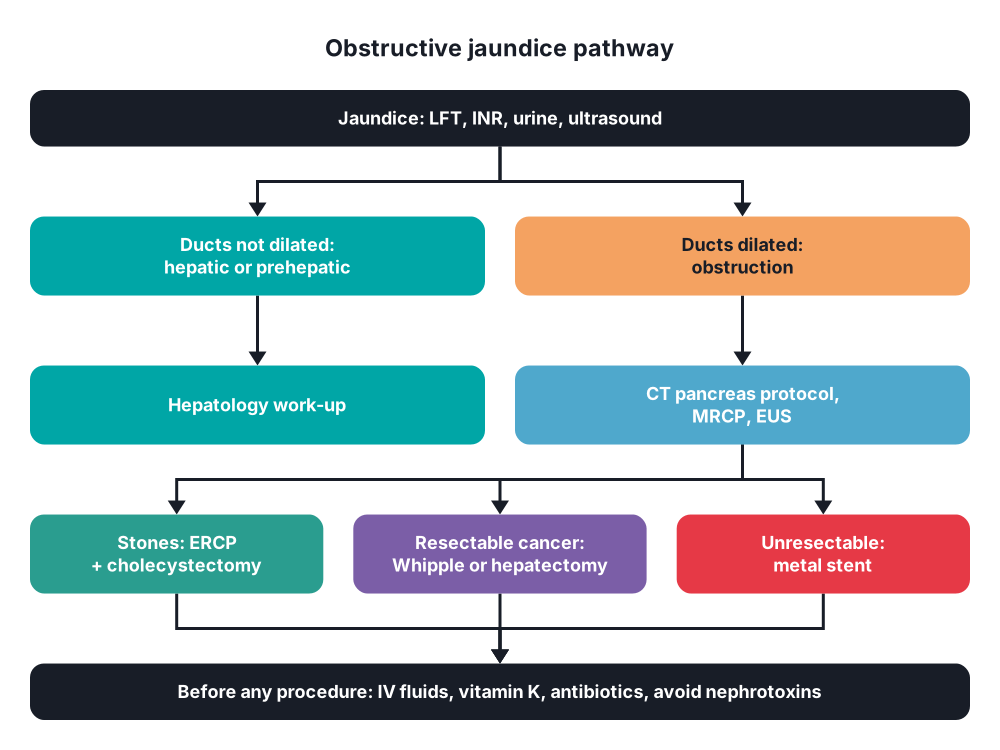
- Preparation of the jaundiced patient (before any procedure):
- IV fluids; keep good urine output (over 0.5 mL/kg/h); avoid nephrotoxins (aminoglycosides, NSAIDs, contrast if possible) → prevents hepatorenal failure
- Vitamin K IV (10 mg daily for 3 days); FFP if urgent
- Antibiotic prophylaxis before ERCP or surgery (or treatment if cholangitis)
- Nutrition support
- Itch → cholestyramine, antihistamines, sertraline, rifampicin; drainage is the real cure
- Glucose control; check for new diabetes
- Treat the cause:
- Hepatic and prehepatic → medical
- Drug cholestasis → stop the drug
Surgical: biliary drainage
- ERCP → stones: sphincterotomy and extraction; stent for strictures and tumours
- Plastic stent → benign, temporary
- Self-expanding metal stent (SEMS) → malignant obstruction (longer patency); covered or uncovered
- PTBD → hilar tumours, failed ERCP, altered anatomy
- EUS-guided drainage → failed ERCP
- Preoperative biliary drainage before a Whipple → not routine; more infection without benefit (DROP trial); drain only if cholangitis, very high bilirubin (over 250 µmol/L), itch, or delay for neoadjuvant therapy
Surgical: definitive
- Stones → ERCP clearance plus laparoscopic cholecystectomy, or one-stage laparoscopic CBD exploration
- Resectable periampullary or pancreatic head cancer → pancreaticoduodenectomy (Whipple) or pylorus-preserving form
- Hilar cholangiocarcinoma → hepatectomy with bile duct resection and hepaticojejunostomy; liver transplantation in selected patients
- Distal cholangiocarcinoma → Whipple
- Benign strictures → endoscopic stents; Roux-en-Y hepaticojejunostomy for bile duct injury and failed stenting
- Choledochal cyst → excision and hepaticojejunostomy
- Unresectable cancer (palliation):
- Metal stent (first choice)
- Surgical bypass (hepaticojejunostomy plus gastrojejunostomy) if found at laparotomy or duodenal obstruction
- Duodenal stent for gastric outlet obstruction
- Coeliac plexus block for pain; chemotherapy
10. Complications
- Cholangitis, liver abscess
- Acute kidney injury (hepatorenal syndrome)
- Coagulopathy, bleeding
- Malabsorption, weight loss, vitamin deficiencies (A, D, E, K)
- Secondary biliary cirrhosis, liver failure
- Wound breakdown, infection after surgery
- Procedures → post-ERCP pancreatitis, perforation, stent occlusion or migration, bile leak, haemobilia (PTBD)
Show as a list
Obstructive jaundice
- Bilirubin
- Conjugated in blood
- Dark urine
- Pale stools
- Itch
- Causes
- Lumen: stones
- Wall: cholangiocarcinoma, stricture
- Outside: pancreas head, Mirizzi
- Clinical
- Painful: stones
- Painless: cancer
- Courvoisier
- Tests
- LFT: ALP, GGT
- Ultrasound: dilated ducts
- CT, MRCP, EUS
- ERCP, PTC
- Preparation
- Fluids
- Vitamin K
- Antibiotics
- Treatment
- ERCP stones out
- Stent: plastic, metal
- Whipple
- Hepaticojejunostomy