91. Obstructive (obturation) ileus
High yield
Bowel blocked from inside or by its wall with intact blood supply; tumours, gallstones, bezoars, faeces and strictures.
Exam Prep · State examSurgery · General surgerySurgery · Emergency and trauma
1. Definition
- Obstructive (obturation) ileus → mechanical intestinal obstruction in which the lumen is closed but the mesentery and blood supply are not compressed at first
- The block is either inside the lumen (obturation in the strict sense) or in the bowel wall (tumour, stricture), or a mass presses the bowel from outside without trapping its mesentery
- Opposite of strangulation ileus, where the blood supply is cut off from the start (question 90)
- The bowel can still become ischaemic later from distension (wall tension), especially in a closed loop (large bowel with a competent ileocaecal valve)
- General features, tests and drip and suck → question 89; intussusception → question 92; gastric bezoars → question 62
2. Epidemiology
- The most common form of large bowel obstruction in the West → colorectal cancer (about 60–80% of LBO)
- Gallstone ileus → 1–4% of all SBO, but up to 25% of SBO in patients over 65 without hernias or previous surgery; women about 3–4 : 1; mean age about 70
- Bezoars → about 2–4% of SBO; more after gastric surgery and in psychiatric patients
- Faecal impaction → common in the elderly, bedbound and institutionalised
- Ascaris worm bolus → children in endemic areas (Africa, Asia, Latin America)
- Small bowel tumours → rare primary cause; metastases (melanoma, ovary, colon) more common
- Mortality → gallstone ileus about 15–20% (elderly, delay, comorbidity); malignant LBO about 10–15% as an emergency
3. Aetiology and risk factors
In the lumen
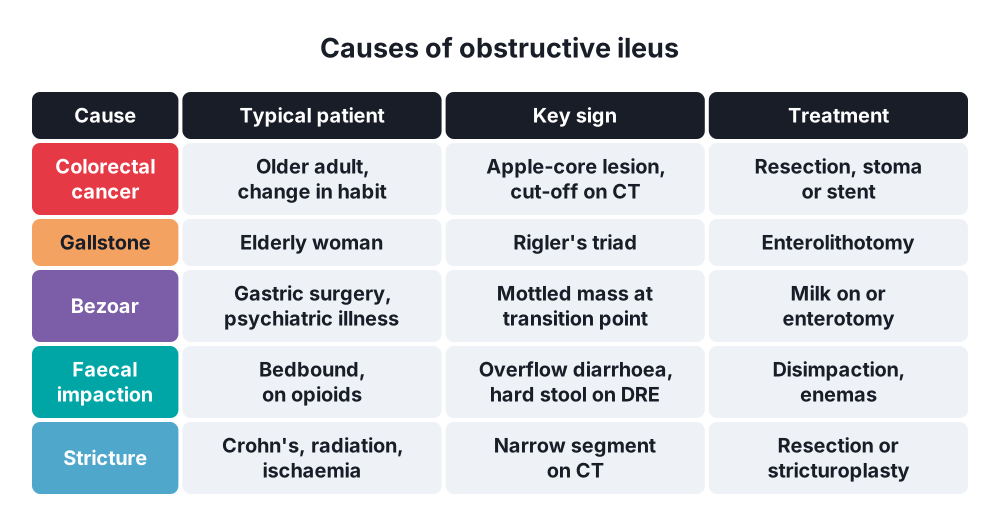
- Gallstone → large stone (over 2–2.5 cm) passes through a cholecystoduodenal fistula (about 70–80%), less often cholecystocolic or choledochoduodenal; impacts in the terminal ileum (narrowest part, about 60–70%), then the jejunum, duodenum (Bouveret's syndrome: gastric outlet), sigmoid
- Bezoars:
- Phytobezoar → plant fibres (persimmon, citrus pith, celery); the most common
- Trichobezoar → hair (young women with trichotillomania and trichophagia); Rapunzel syndrome when the tail reaches the small bowel
- Pharmacobezoar → drugs (cholestyramine, sucralfate, extended-release tablets); lactobezoar in infants
- Risk factors → previous gastric surgery (vagotomy, gastrectomy, gastric bypass), diabetic gastroparesis, poor chewing, no teeth, hypothyroidism
- Food bolus → after gastric surgery, poorly chewed food (dried fruit, meat)
- Faecal impaction (faecaloma) → elderly, immobile, opioids, anticholinergics, neurological disease, dehydration; barium after contrast studies
- Foreign bodies → swallowed objects, often at the ileocaecal valve or in a stricture; retained capsule endoscopy capsule
- Worms → Ascaris lumbricoides bolus in the terminal ileum
- Meconium ileus → newborns with cystic fibrosis
- Enteroliths → in diverticula, strictures (Crohn's), Meckel's
In the wall
- Tumours → colorectal adenocarcinoma (left colon most often), small bowel tumours (adenocarcinoma, lymphoma, GIST, neuroendocrine tumour)
- Inflammatory strictures → Crohn's disease, diverticular disease, TB
- Ischaemic stricture → after ischaemic colitis or mesenteric ischaemia
- Radiation stricture (after pelvic radiotherapy)
- Anastomotic stricture
- Congenital → atresia, stenosis, duplication, Hirschsprung's disease (functional segment)
- Intramural haematoma (anticoagulation, trauma)
Outside the wall (compression without strangulation)
- Extrinsic tumour or nodes (ovarian cancer, carcinomatosis), abscess, pancreatic pseudocyst, endometriosis, retroperitoneal fibrosis
4. Pathogenesis
- Lumen blocked → contents and gas build up above the block
- Peristalsis increases (colic), then the bowel tires and dilates
- Fluid moves into the lumen and wall → dehydration, electrolyte loss (question 89)
- Bacteria multiply → faeculent vomiting, translocation
- Wall tension rises (Laplace's law) → venous congestion → arterial ischaemia; pressure necrosis where a stone or faecaloma presses on the wall (stercoral ulcer)
- Onset is slower than in strangulation; patients are often less sick at first
- Tumours → slow narrowing (change in bowel habit, ribbon stools), then sudden complete block (acute on chronic) from faeces or oedema
- Competent ileocaecal valve (about a third) → closed loop → caecal perforation when the caecum passes about 10–12 cm
- Gallstone ileus → tumbling obstruction: the stone moves forward, sticks, then moves on → intermittent symptoms over days
- Stercoral perforation → faecaloma ulcerates the colon wall (sigmoid, rectosigmoid) → faecal peritonitis
5. Classification
By site of the block
- Intraluminal (obturation) → gallstone, bezoar, food, faeces, foreign body, worms, meconium
- Intramural → tumour, stricture (inflammatory, ischaemic, radiation, anastomotic), congenital
- Extramural compression → tumour, abscess, cyst (mesentery not trapped)
By level
- Small bowel (gallstone, bezoar, food, worms, small bowel tumour) or large bowel (cancer, faeces, diverticular stricture)
By degree and onset
- Complete or partial; acute, chronic or acute on chronic
Gallstone ileus: Rigler's triad
- Pneumobilia (air in the bile ducts), small bowel obstruction, ectopic gallstone (calcified in only about 10–20%); a fourth sign is a change in the stone's position on serial films
6. Clinical picture
General
- Features of obstruction (question 89) → colicky pain, vomiting, distension, absolute constipation
- Usually slower onset, less pain and fewer systemic signs than strangulation
By cause
- Colorectal cancer:
- Weeks or months of change in bowel habit, rectal bleeding, weight loss, iron deficiency anaemia
- Then sudden absolute constipation and marked distension; vomiting late
- Right iliac fossa tenderness → distended, threatened caecum
- Rectal examination → a rectal tumour, blood
- Gallstone ileus:
- Elderly woman, often with a history of biliary disease (but only about half have known gallstones)
- Intermittent ("tumbling") obstruction over several days → colic, vomiting, settling, then recurring
- Few signs early; jaundice uncommon
- Bezoar:
- Previous gastric surgery, psychiatric illness, poor dentition
- Trichobezoar → epigastric mass, halitosis, patchy hair loss
- Faecal impaction:
- Elderly, bedbound, on opioids; paradoxical overflow diarrhoea (liquid stool passes round the faecaloma)
- Hard faeces on rectal examination (in most); palpable faecal masses that indent ("doughy")
- Confusion, urinary retention
- Foreign body → history of ingestion (children, prisoners, psychiatric patients, body packers)
- Ascaris → child from an endemic area, worms passed in stool or vomit, palpable mobile mass
Signs
- Distension, loud tinkling bowel sounds, dehydration
- Mass → tumour, faecaloma, bezoar, intussusception
- Peritonism, fever, tachycardia → ischaemia, perforation (stercoral, caecal, at the stone)
7. Diagnosis
Bloods
- FBC (anaemia in cancer), U&E, CRP, lactate, LFT (gallstone ileus: often normal), CEA after diagnosis of cancer
Imaging
- Plain abdominal X-ray → dilated loops, fluid levels; may show:
- Rigler's triad in gallstone ileus (all three in only about 30–50%)
- Mottled mass of a bezoar or faecaloma; radio-opaque foreign body
- Dilated colon with a cut-off and a caecum over 10 cm (LBO)
- CT abdomen and pelvis with IV contrast → investigation of choice:
- Transition point and cause
- Gallstone ileus → pneumobilia, ectopic stone at the transition point, fistula and a shrunken gallbladder; sensitivity over 90%
- Bezoar → intraluminal mass with mottled gas (like faeces) at the transition point
- Colorectal cancer → mass with shouldering, nodes, liver and lung metastases (stage the chest at the same time)
- Signs of ischaemia, perforation, caecal diameter
- Water-soluble contrast enema or CT with rectal contrast → LBO vs pseudo-obstruction; shows an "apple-core" lesion; may soften faecal impaction
- Flexible sigmoidoscopy or colonoscopy → biopsy of the tumour, stent placement
- Upper GI endoscopy → Bouveret's syndrome, gastric bezoar
- Stool for ova and parasites (Ascaris); ultrasound shows worms in children
8. Differential diagnosis
- Strangulation obstruction (constant pain, peritonism, raised lactate)
- Adhesive SBO (previous surgery)
- Pseudo-obstruction (Ogilvie's) → no cut-off on CT or contrast enema
- Sigmoid volvulus (coffee bean sign)
- Paralytic ileus
- Intussusception (target sign)
- Gallstone ileus vs acute cholecystitis (fistula may follow it), mesenteric ischaemia
- Faecal impaction vs colorectal cancer (always check after disimpaction)
9. Treatment
Conservative
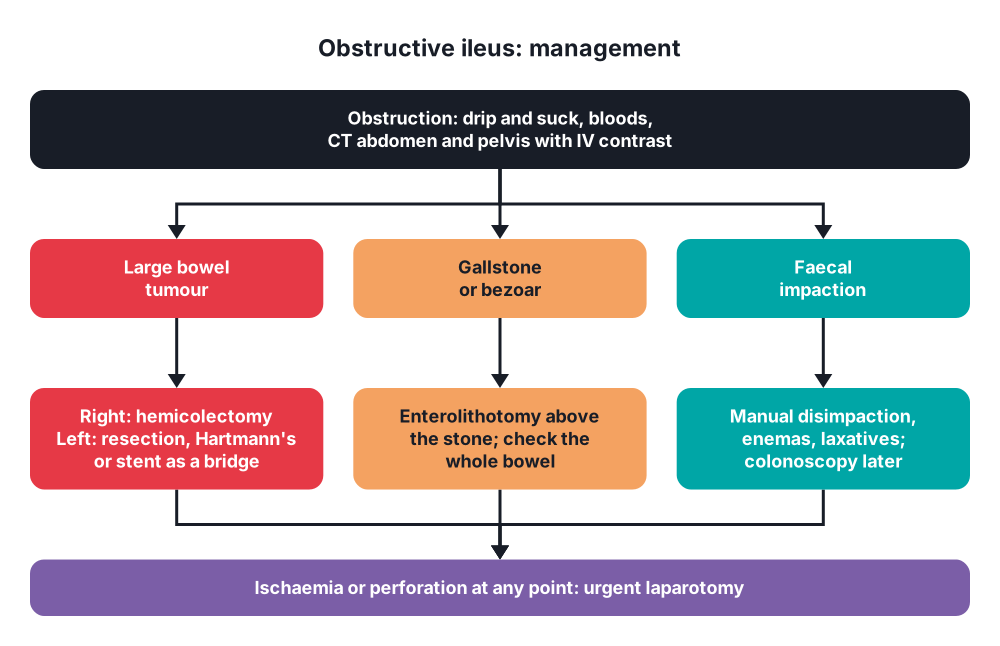
- Resuscitation for all → IV fluids, NG tube, catheter, correct potassium, analgesia, VTE prophylaxis (question 89)
- Faecal impaction:
- Manual disimpaction (with sedation if needed), phosphate or arachis oil enemas, then osmotic laxatives (macrogol)
- Water-soluble contrast enema may soften it
- Prevent recurrence → fluids, fibre, review constipating drugs, regular laxatives
- Colonoscopy later to exclude cancer when appropriate
- Bezoars:
- Phytobezoars in the stomach → enzymatic dissolution (Coca-Cola lavage, cellulase, papain), endoscopic fragmentation and removal
- Small bowel bezoar with partial obstruction → may soften and pass; water-soluble contrast
- Trichobezoars → resist dissolution → surgery or endoscopy
- Psychiatric referral for trichophagia
- Ascaris → antihelminthics (albendazole, mebendazole) once the obstruction settles, plus water-soluble contrast or hypertonic saline enema; surgery if no response or signs of ischaemia
- Malignant LBO:
- Self-expanding metal stent → bridge to surgery (convert an emergency to a planned resection after staging and bowel preparation) or palliation in incurable disease or unfit patients
- Risks → perforation (about 5–10%), migration, re-obstruction; possible tumour seeding
- Mainly for left-sided cancers
- Malignant SBO in advanced cancer → octreotide, steroids, antiemetics, venting gastrostomy, palliative care
- Crohn's stricture in an acute flare → steroids, nutrition (question 84)
- Foreign body → endoscopic removal if within reach; most pass on their own; body packers → conservative unless obstruction or packet rupture
Surgical
- Gallstone ileus:
- Enterolithotomy → longitudinal enterotomy proximal to the stone on healthy bowel, remove the stone, close transversely; resect if the bowel is ischaemic or perforated
- Milk the stone back if it is impacted; do not crush it in place
- Search the whole small bowel for more stones (about 10% have more than one)
- Laparoscopic or laparoscopic-assisted enterolithotomy in selected patients
- Fistula and gallbladder → usually left alone at the emergency operation (enterolithotomy alone has lower mortality); one-stage (enterolithotomy + cholecystectomy + fistula closure) only in fit, stable patients; interval cholecystectomy if symptoms recur
- Bouveret's syndrome → endoscopic removal or lithotripsy first; gastrotomy or duodenotomy if it fails
- Bezoar → laparotomy or laparoscopy, milk the bezoar into the caecum if soft, otherwise enterotomy and removal; check the stomach for the source (gastrotomy if a gastric bezoar is present)
- Colorectal cancer with obstruction:
- Right or transverse colon → right or extended right hemicolectomy with primary ileocolic anastomosis (end ileostomy if unstable or the bowel is poor)
- Left colon or rectosigmoid:
- Resection with primary anastomosis ± defunctioning ileostomy (stable patients, experienced surgeon); on-table lavage in selected cases
- Hartmann's procedure → unstable, perforated, poor tissue, faecal peritonitis
- Subtotal colectomy with ileorectal or ileosigmoid anastomosis → caecal ischaemia or perforation, synchronous tumours
- Defunctioning colostomy or ileostomy alone → very unfit patients or before neoadjuvant treatment (rectal cancer)
- Stent as a bridge then elective resection (question 86)
- Rectal cancer with obstruction → loop colostomy (or ileostomy) first, then staging and neoadjuvant treatment (question 100)
- Small bowel tumour → segmental resection with mesentery and nodes; bypass if unresectable
- Stricture (Crohn's, radiation, ischaemic) → resection or stricturoplasty (Crohn's), bypass in radiation enteritis
- Stercoral perforation → Hartmann's procedure with removal of all faecal masses
- Foreign body or worms that fail to pass → milk into the colon, or enterotomy
10. Complications
Of the obstruction
- Dehydration, electrolyte disturbance, acute kidney injury
- Ischaemia, perforation (caecal, stercoral, at the stone), faecal peritonitis, sepsis
- Aspiration pneumonia
- Gallstone ileus → recurrence (about 5–10%, stones left in the bowel or gallbladder), cholangitis through the fistula, gallbladder cancer (rare)
Of treatment
- Anastomotic leak, enterotomy leak, fistula
- Stoma complications, Hartmann's never reversed in many elderly patients
- Stent → perforation, migration, re-obstruction
- Wound infection, incisional hernia, adhesions
Prognosis
- Depends on the cause; malignant obstruction has a worse long-term outlook (stage at presentation is often advanced)
Show as a list
Obstructive ileus
- Inside lumen
- Gallstone
- Bezoar
- Faeces
- Foreign body, worms
- In the wall
- Colorectal cancer
- Strictures
- Small bowel tumours
- Gallstone ileus
- Elderly woman
- Tumbling obstruction
- Rigler's triad
- Enterolithotomy
- Tests
- AXR
- CT: transition point
- Contrast enema
- Endoscopy
- Treatment
- Drip and suck
- Disimpaction
- Stent: bridge or palliation
- Resection or Hartmann's