
71. Liver abscess
High yield
Pyogenic abscesses need drainage and antibiotics; amoebic abscesses respond to metronidazole; always look for the source.
Exam Prep · State examSurgery · HPBSurgery · Emergency and trauma
1. Definition
- Liver abscess → collection of pus in the liver parenchyma
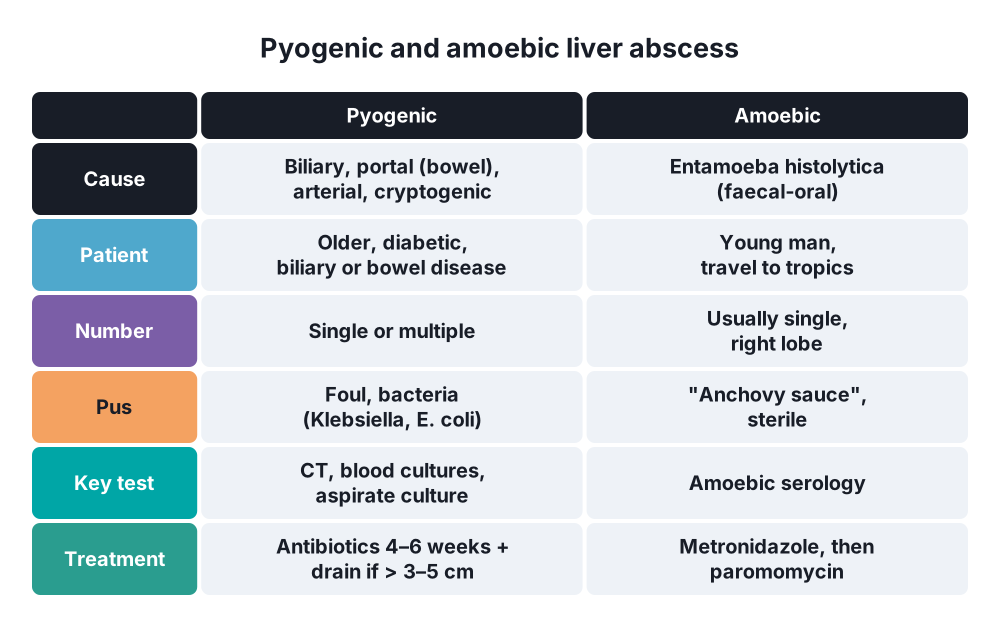
- Pyogenic → bacterial (most common in the West)
- Amoebic → Entamoeba histolytica (most common worldwide)
- Others → fungal (Candida, in immunosuppressed patients), infected hydatid cyst, infected tumour
2. Epidemiology
- Pyogenic → about 1–2 per 100,000 a year in the West (higher in East Asia: 10–18 per 100,000); age 50–70; men slightly more
- Amoebic → tropics and subtropics (India, Mexico, Africa, South-East Asia); young men (20–40), male : female up to 10 : 1; travellers and migrants
- Amoebic liver abscess → the most common extraintestinal form of amoebiasis (in 3–9% of intestinal infection)
- Right lobe in about 75% (larger, gets most of the portal flow from the right colon)
- Pyogenic single in about 60%; multiple more often with biliary causes
- Mortality → pyogenic 2–12% today (was 50–70% before drainage and CT); amoebic under 1–3% if uncomplicated
3. Aetiology and risk factors
Pyogenic: routes of infection
- Biliary (most common, 40–60%) → cholangitis from stones, malignant obstruction, strictures, after biliary-enteric anastomosis or stents
- Portal vein (pylephlebitis) → appendicitis, diverticulitis, inflammatory bowel disease, pelvic sepsis, colorectal cancer
- Hepatic artery → bacteraemia (endocarditis, dental infection, IV drug use)
- Direct spread → empyema of the gallbladder, perforated ulcer, subphrenic abscess
- Trauma and iatrogenic → liver injury, after liver resection, radiofrequency ablation, TACE, biopsy
- Cryptogenic (no cause found) → 20–40%; many hide a colorectal cancer
Organisms
- Klebsiella pneumoniae → most common in East Asia and increasingly in the West; hypervirulent strains, diabetes, metastatic spread (eye: endophthalmitis, lung, brain)
- E. coli, Enterococcus, Streptococcus (milleri group: S. anginosus)
- Anaerobes (Bacteroides) → often mixed
- Staphylococcus aureus → bacteraemia, trauma, children
Risk factors
- Diabetes mellitus
- Cirrhosis, malignancy (biliary, pancreatic, colorectal)
- Immunosuppression, chronic kidney disease
- Older age, proton pump inhibitors
Amoebic
- Faecal-oral route; cysts in contaminated water or food
- Poor sanitation, travel, men who have sex with men, alcohol, immunosuppression
4. Pathogenesis
Pyogenic
- Bacteria reach the liver (bile, portal, arterial, direct)
- Local infection, necrosis, pus
- Small abscesses may join into one large cavity
- Untreated → rupture, sepsis, death
Amoebic
- Cysts swallowed → trophozoites in the colon (amoebic colitis, flask-shaped ulcers)
- Trophozoites invade the portal venules → liver
- Liquefactive necrosis → cavity filled with "anchovy sauce" pus (pink-brown, odourless, sterile)
- Trophozoites found in the wall, not in the pus
- Often single, large, right lobe, near the diaphragm (posterosuperior)
- Rupture → into the pleura and lung (most common), peritoneum, pericardium (left lobe; high mortality)
5. Classification
- By cause → pyogenic, amoebic, fungal, mixed (secondary infection of an amoebic abscess)
- By route (pyogenic) → biliary, portal, arterial, direct, traumatic, cryptogenic
- By number → solitary or multiple
- By size → small (< 3 cm), medium (3–5 cm), large (> 5 cm), used for choosing aspiration or drain
- By structure → unilocular or multiloculated
6. Clinical picture
Symptoms
- Fever with rigors, sweats (over 90%)
- RUQ pain, constant, dull; worse on breathing and moving
- Malaise, anorexia, weight loss, nausea
- Right shoulder tip pain, cough, pleuritic chest pain (diaphragm)
- Pyogenic → older, often diabetic, with biliary or bowel disease; may present with sepsis alone ("pyrexia of unknown origin")
- Amoebic → young man, travel history; often acute onset; diarrhoea in only about 20–30% (most have no colitis symptoms at the time)
Signs
- Fever, tachycardia
- Tender hepatomegaly; tenderness over the lower right ribs or between them (intercostal tenderness)
- Point tenderness over the abscess
- Raised right hemidiaphragm, reduced breath sounds at the right base, pleural effusion
- Jaundice → mainly with biliary causes or large and multiple abscesses (uncommon in amoebic)
- Septic shock in severe cases
7. Diagnosis
Blood tests
- FBC → leucocytosis, anaemia
- CRP high
- LFT → raised ALP (most common), mild rise in bilirubin and transaminases; low albumin
- Blood cultures (positive in 50% of pyogenic)
- Glucose, HbA1c (undiagnosed diabetes)
- Amoebic serology (ELISA; positive in over 90%, may stay positive for years) → send in every patient from an endemic area
- Stool microscopy and antigen test → often negative
Imaging
- Ultrasound → first test: round or oval hypoechoic lesion with irregular wall, debris; guides drainage
- CT with contrast → most sensitive (over 95%): low-density lesion with an enhancing rim ("double target" sign); gas (Klebsiella, anaerobes); finds the source (diverticulitis, appendicitis, biliary disease, tumour)
- MRI and MRCP → biliary cause
- Chest X-ray → raised right hemidiaphragm, effusion
Aspiration
- Ultrasound- or CT-guided aspiration → Gram stain, culture, sensitivities
- Amoebic pus → "anchovy sauce", sterile; trophozoites rarely seen
Look for the cause
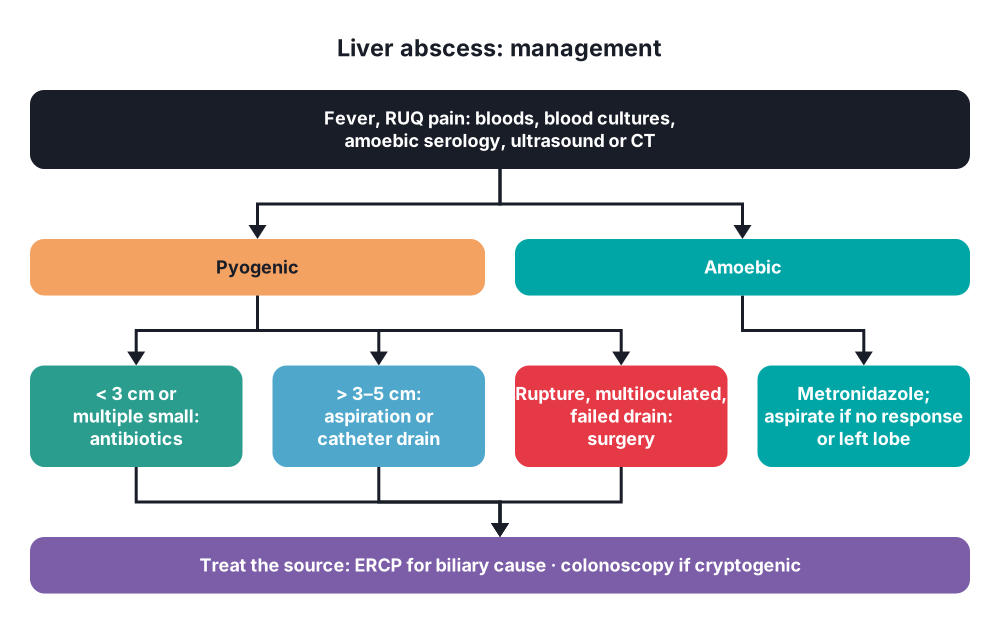
- Colonoscopy in cryptogenic pyogenic abscess (especially Klebsiella or streptococcus) → colorectal cancer
- Echocardiography if streptococcal or staphylococcal bacteraemia (endocarditis)
- Eye examination in Klebsiella abscess
8. Differential diagnosis
- Infected hydatid cyst (endemic area, daughter cysts, serology)
- Necrotic tumour (HCC, metastasis)
- Simple liver cyst, biloma, haematoma
- Acute cholecystitis, cholangitis
- Subphrenic abscess
- Right lower lobe pneumonia, empyema
- Hepatitis
9. Treatment
Conservative
- Pyogenic:
- IV broad-spectrum antibiotics at once (after blood cultures) → e.g. piperacillin-tazobactam, or ceftriaxone with metronidazole; adjust to cultures
- Duration → 4–6 weeks in total: IV for 2–3 weeks (until fever and CRP settle), then oral
- Antibiotics alone → small abscesses (under 3 cm) and multiple tiny abscesses
- Treat the source → ERCP for biliary obstruction, appendicectomy, colorectal surgery
- Control diabetes, nutrition, VTE prophylaxis
- Amoebic:
- Metronidazole 750 mg three times daily for 7–10 days → cure in over 90%; fever settles in 3–5 days
- Then a luminal amoebicide to clear cysts from the gut (prevent relapse) → paromomycin or diloxanide furoate
- Aspiration only if → no response in 3–5 days, large abscess (over 5–10 cm) at risk of rupture, left lobe abscess (pericardial rupture), uncertain diagnosis, pregnancy
Surgical
- Percutaneous drainage (ultrasound or CT) → first choice for pyogenic abscesses over 3–5 cm:
- Needle aspiration (repeat if needed) → abscesses 3–5 cm
- Catheter drainage (pigtail) → over 5 cm; leave until output is low and the cavity shrinks; flush
- Success about 80–90%
- Surgical drainage (laparoscopic or open) → indications:
- Rupture with peritonitis
- Multiloculated or very large abscesses (over 10 cm) that do not drain
- Thick pus or failed percutaneous drainage
- Coexisting surgical disease (gallbladder, bowel)
- Left lobe abscess near the heart
- Technique → open the cavity, break down loculi, wash out, wide-bore drains; liver resection in selected cases (destroyed segment, hepatolithiasis, tumour)
- Biliary cause → biliary drainage is part of source control (ERCP, PTBD)
- Ruptured amoebic abscess → peritoneum: drainage and metronidazole; pleura: chest drain; pericardium: pericardiocentesis (emergency)
10. Complications
- Septic shock, multiorgan failure
- Rupture → peritoneum, pleura (empyema), lung (bronchohepatic fistula; patient coughs up pus), pericardium (cardiac tamponade)
- Portal or hepatic vein thrombosis
- Metastatic infection (Klebsiella) → endophthalmitis (blindness), meningitis, lung abscess
- Recurrence (biliary causes, cancer, inadequate drainage)
- Drain complications → bleeding, catheter dislodgement, bile leak, pneumothorax
Prognosis
- Worse with → biliary or malignant cause, multiple abscesses, septic shock, jaundice, older age, delayed treatment
Show as a list
Liver abscess
- Pyogenic
- Biliary: commonest
- Portal: diverticulitis
- Cryptogenic: colon cancer
- Klebsiella, E. coli
- Diabetes
- Amoebic
- E. histolytica
- Young men, travel
- Anchovy sauce
- Right lobe
- Clinical
- Fever, rigors
- RUQ pain
- Tender liver
- Tests
- Ultrasound
- CT: rim, gas
- Blood cultures
- Amoebic serology
- Treatment
- Antibiotics 4-6 weeks
- Drain > 3-5 cm
- Metronidazole + paromomycin
- Surgery if rupture
- Complications
- Sepsis
- Rupture: pleura, pericardium
- Endophthalmitis