53. Inguinal hernia
High yield
Indirect through the deep ring, direct through Hesselbach's triangle; repaired by Lichtenstein mesh or laparoscopic TEP or TAPP.
Exam Prep · State examSurgery · General surgerySurgical Anatomy · Abdominal wall and hernia
1. Definition
- Inguinal hernia → protrusion of abdominal contents through the inguinal canal, above the inguinal ligament
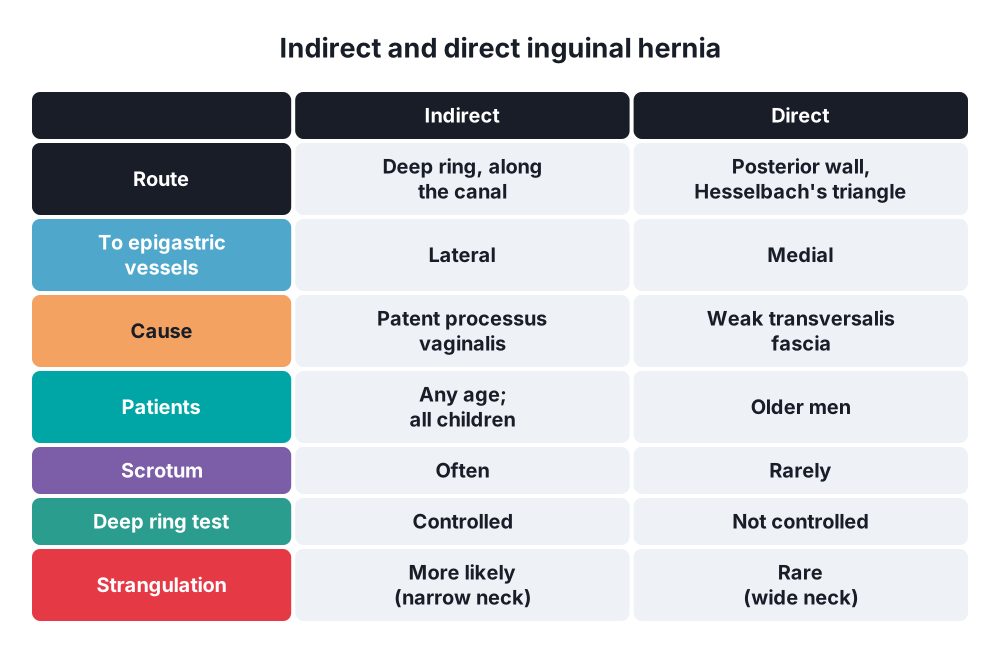
- Indirect → through the deep (internal) ring, lateral to the inferior epigastric vessels, along the canal; may reach the scrotum
- Direct → through the posterior wall (Hesselbach's triangle), medial to the inferior epigastric vessels
- Pantaloon → both, either side of the vessels
2. Epidemiology
- Most common hernia (about 75% of abdominal wall hernias)
- Men : women about 8–10 : 1; lifetime risk 27–43% in men
- More common on the right (later descent of the right testis)
- Indirect → most common type in both sexes and at all ages; all children's inguinal hernias
- Direct → older men; rare in women
- About 20 million repairs a year worldwide; 100,000 in the UK
3. Aetiology and risk factors
Anatomy of the inguinal canal (revision)
- Oblique canal, about 4 cm, above and parallel to the medial half of the inguinal ligament
- Deep ring → opening in the transversalis fascia, midpoint of the inguinal ligament (midway between ASIS and pubic tubercle), 1–2 cm above it
- Superficial ring → V-shaped gap in the external oblique aponeurosis, above and medial to the pubic tubercle
- Walls ("MALT: 2 Ms, 2 As, 2 Ls, 2 Ts"):
- Anterior → external oblique aponeurosis (+ internal oblique laterally)
- Posterior → transversalis fascia (+ conjoint tendon medially)
- Roof → arching fibres of internal oblique and transversus
- Floor → inguinal ligament (+ lacunar ligament medially)
- Hesselbach's triangle → inferior epigastric vessels (lateral), lateral edge of rectus (medial), inguinal ligament (below)
- Contents → spermatic cord (round ligament in women) and ilioinguinal nerve (outside the cord)
- Spermatic cord:
- 3 arteries → testicular, cremasteric, artery to the vas
- 3 nerves → genital branch of genitofemoral, sympathetics, (ilioinguinal runs alongside)
- 3 other → vas deferens, pampiniform plexus, lymphatics
- 3 coverings → external spermatic, cremasteric, internal spermatic fascia
Causes
- Indirect → patent processus vaginalis (congenital); prematurity in infants
- Direct → weak transversalis fascia (acquired): age, smoking, collagen defects
- Raised pressure → cough, constipation, prostate, lifting, obesity, ascites, peritoneal dialysis
- Previous appendicectomy (ilioinguinal nerve injury), family history, connective tissue disease
4. Pathogenesis
- Indirect:
- Processus vaginalis stays open after testicular descent
- Sac enters the deep ring, passes inside the cord (inside internal spermatic fascia)
- Exits the superficial ring → scrotum (complete, inguinoscrotal)
- Narrow neck → higher risk of strangulation
- Direct:
- Transversalis fascia stretches in Hesselbach's triangle
- Broad, diffuse bulge; rarely enters the scrotum
- Wide neck → strangulation rare
- Sliding hernia → caecum (right), sigmoid colon (left) or bladder forms part of the sac wall
5. Classification
By anatomy
- Indirect (bubonocele → in the canal; funicular → to the top of the testis; complete → in the scrotum)
- Direct
- Pantaloon
- Recurrent
European Hernia Society (EHS)
- L (lateral = indirect), M (medial = direct), F (femoral)
- Defect size → 1 (≤ 1.5 cm, one finger), 2 (1.5–3 cm, two fingers), 3 (> 3 cm)
- P (primary) or R (recurrent)
Nyhus
- I indirect, normal ring (children)
- II indirect, dilated ring
- III a direct, b large indirect, c femoral
- IV recurrent
6. Clinical picture
Symptoms
- Groin lump, often noticed after lifting or straining
- Dragging ache or discomfort, worse at the end of the day
- Many have no symptoms
- Complications → painful, tense, irreducible lump; vomiting, distension (obstruction)
Signs
- Examine standing, then lying, both sides
- Lump above and medial to the pubic tubercle (femoral hernia lies below and lateral)
- Cough impulse
- Reducible; you cannot get above a scrotal hernia (unlike a hydrocele)
- Deep ring occlusion test → reduce the hernia, press over the deep ring, ask the patient to cough:
- Controlled → indirect
- Appears medially → direct
- Not reliable; the type is confirmed at operation
- Indirect → descends obliquely along the canal into the scrotum; reduces upwards and laterally
- Direct → forward bulge, reduces straight back, rarely scrotal
- Examine the testes, abdomen (masses, ascites), chest, prostate
7. Diagnosis
- Clinical in most
- Ultrasound → uncertain lump, occult hernia, groin pain
- MRI → occult hernia, athletes' groin (most accurate)
- CT → obese patients, complications
- Herniography → rarely
- Emergency → FBC, U&E, lactate; abdominal X-ray for obstruction
8. Differential diagnosis
- Femoral hernia (below and lateral to the pubic tubercle)
- Hydrocele (can get above it, transilluminates), encysted hydrocele of the cord
- Varicocele ("bag of worms")
- Undescended or ectopic testis
- Inguinal lymph nodes
- Saphena varix, femoral artery aneurysm, psoas abscess
- Lipoma of the cord
- Groin pain → adductor strain, athletic pubalgia, hip disease
9. Treatment
Conservative
- Watchful waiting → men with no or few symptoms:
- Incarceration risk very low (about 0.2–0.3% a year)
- About 70% need surgery within 10 years because of pain
- Unfit patients → observe; truss gives little relief
- Women → repair all (risk of a missed femoral hernia)
- Children → repair all promptly (high incarceration risk, especially < 1 year)
Surgical
- Indications → symptomatic hernia, history of irreducibility, all women and children, complications
- Infants and children → herniotomy only (ligate and excise the patent processus vaginalis); no repair of the wall
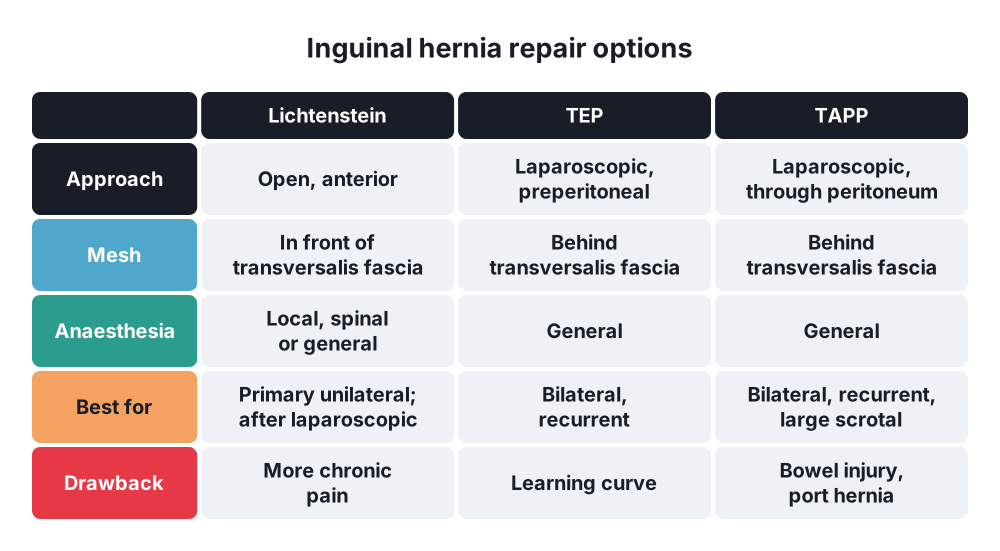
- Adults: open tension-free mesh repair (Lichtenstein) → standard open operation; local, regional or general anaesthesia:
- Skin crease incision above the inguinal ligament
- Open the external oblique aponeurosis; protect the ilioinguinal and iliohypogastric nerves
- Mobilise the cord
- Indirect sac → separate from the cord, reduce or ligate and excise at the deep ring
- Direct sac → invert; plicate the transversalis fascia
- Polypropylene mesh → from 1–2 cm over the pubic tubercle to beyond the deep ring; sutured to the inguinal ligament below and internal oblique above; tails cross behind the cord to make a new deep ring
- Close external oblique
- Laparoscopic repair → mesh behind the transversalis fascia (preperitoneal); covers all three sites (direct, indirect, femoral):
- TEP (totally extraperitoneal) → peritoneum not opened
- TAPP (transabdominal preperitoneal) → peritoneum opened, then closed over the mesh
- Best for bilateral and recurrent hernias (after open repair) and women (NICE, EHS)
- Less chronic pain, faster return to work; needs general anaesthesia
- Danger zones → "triangle of doom" (vas medially, testicular vessels laterally; external iliac vessels inside) and "triangle of pain" (lateral to the testicular vessels, below the iliopubic tract: lateral femoral cutaneous and genitofemoral nerves); no tacks in these
- Tissue (non-mesh) repairs:
- Shouldice → four-layer imbrication of transversalis fascia; low recurrence in expert hands
- Bassini, McVay (Cooper's ligament) → historical, contaminated fields
- Recurrence after open repair → laparoscopic; after laparoscopic → open
- Strangulated → emergency open (or laparoscopic) repair; resect dead bowel
10. Complications
Early
- Haematoma (2%), seroma
- Wound infection (< 5%)
- Urinary retention (older men, spinal anaesthesia)
- Ischaemic orchitis, testicular atrophy (< 1%) → damage to the pampiniform plexus
- Bowel or bladder injury (sliding hernia, laparoscopy)
Late
- Chronic postoperative groin pain (inguinodynia) → 10–12% some pain, 1–3% severe; ilioinguinal, iliohypogastric, genital branch of genitofemoral nerves; treatment → analgesia, nerve block, triple neurectomy, mesh removal
- Recurrence → 1–3% with mesh, higher with tissue repairs
- Mesh infection, mesh migration
- Vas injury → infertility
- Port-site hernia (laparoscopic)
Show as a list
Inguinal hernia
- Anatomy
- Deep ring: mid-inguinal ligament
- Superficial ring
- Hesselbach's triangle
- Spermatic cord
- Types
- Indirect: lateral
- Direct: medial
- Pantaloon
- Sliding
- Clinical
- Lump above pubic tubercle
- Cough impulse
- Deep ring test
- Treatment
- Watchful waiting
- Herniotomy: child
- Lichtenstein mesh
- TEP, TAPP
- Shouldice
- Complications
- Haematoma
- Chronic pain
- Recurrence
- Testicular atrophy