106. Hirschsprung's disease, dolichosigma and dolichocolon
High yield
Absent ganglion cells cause functional obstruction; an over-long colon causes constipation. Biopsy confirms Hirschsprung's.
Exam Prep · State examSurgery · General surgerySurgery · Colorectal
1. Definition
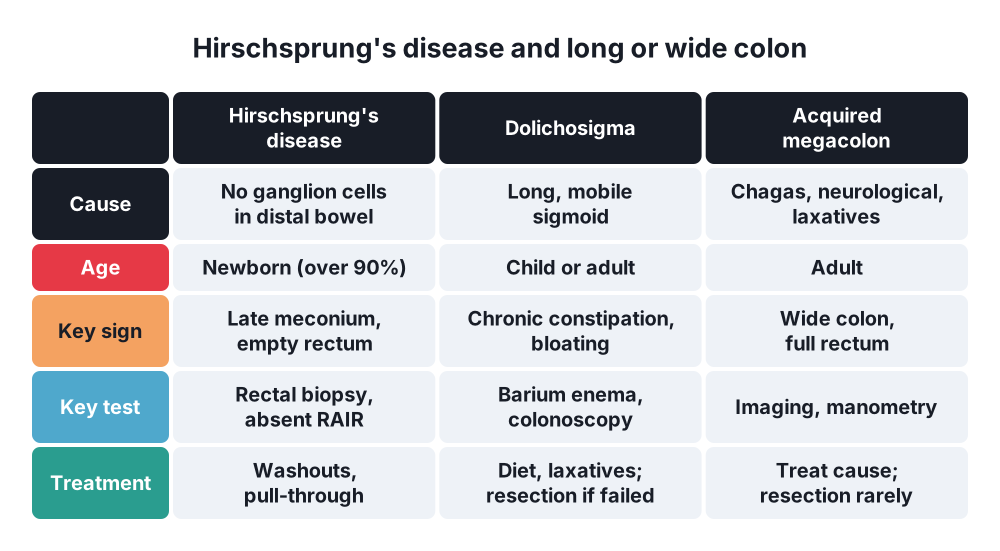
- Hirschsprung's disease (congenital aganglionic megacolon) → absence of ganglion cells in the myenteric (Auerbach) and submucosal (Meissner) plexuses of the distal bowel
- Always starts at the internal anal sphincter and extends upwards for a varying length
- The aganglionic segment is narrow and does not relax → functional obstruction
- The normal bowel above it dilates (megacolon)
- Dolichocolon → abnormally long colon (or part of it) with normal width and normal innervation
- Dolichosigma → abnormally long, mobile sigmoid colon (the most common form of dolichocolon)
- Megadolichocolon → a colon that is both long and wide
- Megacolon → abnormal dilatation of the colon (congenital, as in Hirschsprung's, or acquired)
2. Epidemiology
Hirschsprung's disease
- About 1 in 5000 live births
- Boys 4 times more often than girls (short-segment disease)
- Down syndrome in 3–5%; family history raises the risk
- Over 90% are diagnosed in the newborn period; a few present later in childhood or as adults
Dolichosigma and dolichocolon
- Common; found in up to 15–25% of people on barium enema, often without symptoms
- Higher in Eastern Europe and Russia, where it is described more often; also with Chagas disease in South America (megacolon)
- Children and adults; women more often
3. Aetiology and risk factors
Hirschsprung's disease
- Failure of neural crest cells to migrate down the bowel (weeks 5–12 of gestation), cranial to caudal
- The earlier migration stops, the longer the aganglionic segment
- Genes → RET proto-oncogene (chromosome 10) in many familial cases; EDNRB, EDN3, SOX10
- Associations → Down syndrome, Waardenburg syndrome, MEN 2A, congenital heart disease, congenital central hypoventilation
Dolichosigma and dolichocolon
- Congenital → abnormal rotation and fixation of the colon, long mesentery
- Acquired → chronic constipation, low-fibre diet, ageing, hypothyroidism, neurological disease
- Chagas disease (Trypanosoma cruzi) → destroys ganglion cells; acquired megacolon and megaoesophagus
4. Pathogenesis
Hirschsprung's disease
- No ganglion cells → no inhibitory (nitric oxide) signals → the segment stays tonically contracted
- Increased cholinergic nerve fibres (hypertrophied nerve trunks)
- Rectoanal inhibitory reflex absent → the internal sphincter does not relax when the rectum fills
- Stool and gas collect above the narrow segment → proximal dilatation and hypertrophy
- Stasis → bacterial overgrowth → Hirschsprung-associated enterocolitis (the main cause of death)
Dolichosigma
- The long, mobile loop slows transit and forms kinks and angles → constipation
- Stool dries in the loop, then stretches the wall → loss of tone → megadolichocolon
- The long loop on a narrow mesentery can twist → sigmoid volvulus
5. Classification
Hirschsprung's disease by length of aganglionosis
- Short-segment (classic) (about 75–80%) → rectum and sigmoid
- Long-segment (about 15%) → up to the splenic flexure or transverse colon
- Total colonic aganglionosis (about 5–8%) → whole colon and some terminal ileum
- Ultrashort-segment → only a few centimetres above the anus
- Total intestinal aganglionosis → very rare, often fatal
Dolichosigma by stage
- Compensated → constipation for up to 3 days, relieved by diet and laxatives
- Subcompensated → constipation for 3–7 days, needs enemas, pain and bloating
- Decompensated → constipation for over a week, faecal stones, megacolon, risk of volvulus
6. Clinical picture
Hirschsprung's disease in the newborn
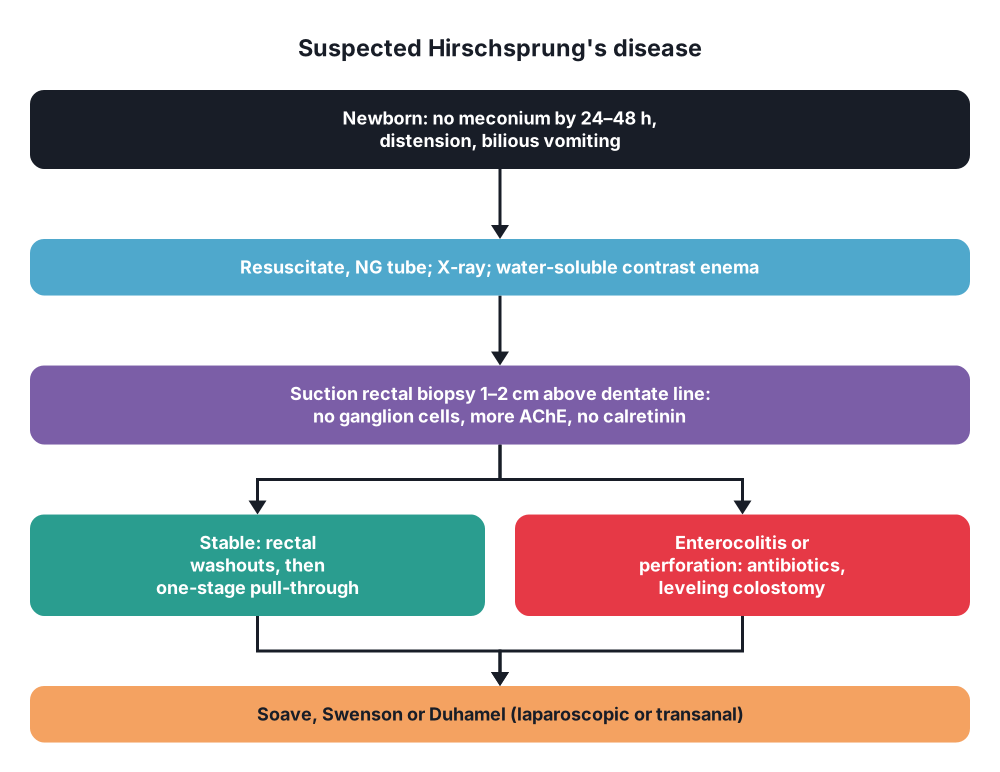
- Delayed passage of meconium (over 24–48 hours) → over 90%
- Abdominal distension, bilious vomiting, feeding intolerance
- DRE → tight anus, then an explosive release of gas and stool ("blast sign")
- Enterocolitis → fever, foul explosive diarrhoea, distension, lethargy, shock; may perforate
Hirschsprung's disease in older children and adults
- Chronic severe constipation since birth, needing enemas
- Distended abdomen, palpable faecal masses, failure to thrive
- Empty rectum on DRE (stool is held above the narrow segment), unlike functional constipation where the rectum is full
- Soiling is uncommon (unlike functional constipation)
Dolichosigma and dolichocolon
- Chronic constipation, often from childhood, getting worse with time
- Bloating, cramping pain in the left iliac fossa, relieved by defecation
- Hard, "sheep" stools, faecal masses, faecal stones
- Halitosis, poor appetite, intoxication symptoms (headache, fatigue)
- Complications → sigmoid volvulus, faecal impaction, stercoral ulcer
7. Diagnosis
Hirschsprung's disease
- Plain abdominal X-ray → dilated bowel loops, absent rectal gas
- Contrast enema (water-soluble, without bowel preparation):
- Narrow distal segment, transition zone (cone), dilated bowel above
- Rectosigmoid index under 1 (rectum narrower than the sigmoid)
- Retained contrast at 24 hours
- Can be normal in neonates (sensitivity about 70%)
- Anorectal manometry → absent rectoanal inhibitory reflex (useful in older children and adults)
- Rectal biopsy → gold standard:
- Suction biopsy at the bedside in infants, at least 1–2 cm above the dentate line (the lowest part is normally hypoganglionic)
- Full-thickness biopsy under anaesthesia in older children and adults
- Findings → no ganglion cells, hypertrophied nerve trunks, increased acetylcholinesterase staining, absent calretinin staining
- Intraoperative frozen sections → map the transition zone
Dolichosigma and dolichocolon
- Barium enema (irrigography) or CT colonography → long sigmoid with extra loops, normal or wide calibre
- Colonoscopy → excludes tumour, polyps, IBD; scope may loop
- Colonic transit study (radio-opaque markers)
- Anorectal manometry → RAIR present (excludes Hirschsprung's)
- Thyroid function, calcium, glucose → secondary causes of constipation
8. Differential diagnosis
- Meconium ileus (cystic fibrosis), meconium plug syndrome, small left colon syndrome (diabetic mother)
- Intestinal atresia, anorectal malformation, malrotation
- Functional constipation → starts after weaning or toilet training, full rectum, soiling, normal RAIR
- Hypothyroidism, hypercalcaemia, drugs (opioids)
- Intestinal neuronal dysplasia, internal sphincter achalasia
- Acquired megacolon → Chagas disease, neurological disease, chronic laxative abuse, idiopathic megarectum
- Colorectal cancer in adults with new constipation
- Ogilvie's syndrome (acute colonic pseudo-obstruction)
9. Treatment
Conservative
- Hirschsprung's disease before surgery:
- Resuscitation, NG decompression, IV fluids
- Rectal washouts (warm saline, 10–20 mL/kg, via a soft catheter) once or several times a day until the effluent is clear
- Enterocolitis → NG tube, IV fluids, broad-spectrum antibiotics (metronidazole), rectal washouts; stoma if it does not settle
- Dolichosigma (compensated and subcompensated):
- High-fibre diet, plenty of fluids, regular meals and toilet routine
- Osmotic laxatives (macrogol, lactulose), stimulant laxatives in short courses
- Enemas for impaction
- Physiotherapy, exercise, abdominal massage
- Prokinetics or secretagogues (prucalopride) for slow transit
Surgical
- Hirschsprung's disease → resect the aganglionic bowel and bring normal ganglionated bowel down to just above the dentate line
- One-stage primary pull-through (often laparoscopic-assisted or fully transanal) is now standard in most infants
- Two-stage → leveling colostomy first (ganglionated bowel confirmed on frozen section) for severe enterocolitis, perforation, poor condition or long-segment disease
- Swenson → full-thickness rectal resection and coloanal anastomosis (the original operation)
- Soave (endorectal pull-through) → mucosa of the aganglionic rectum stripped, normal colon pulled through the muscular cuff; the most widely used (laparoscopic or transanal)
- Duhamel → normal colon brought down behind the rectum, side-to-side anastomosis forming a reservoir
- Total colonic aganglionosis → total colectomy and ileoanal pull-through
- Ultrashort segment → internal sphincter myectomy or botox
- Dolichosigma (decompensated) → surgery when conservative treatment fails or after volvulus:
- Sigmoid resection with primary anastomosis (often laparoscopic)
- Subtotal colectomy with ileorectal anastomosis → slow-transit constipation involving the whole colon, after full physiological testing
- Sigmoid volvulus → endoscopic decompression, then elective sigmoid resection in the same admission
- Old fixation operations (sigmoidopexy) have high recurrence and are abandoned
10. Complications
Of Hirschsprung's disease
- Enterocolitis (before and after surgery, 20–50%) → leading cause of death
- Perforation (caecum or appendix), sepsis
- Malnutrition, failure to thrive
After pull-through
- Constipation, soiling and incontinence (in a third or more)
- Recurrent enterocolitis
- Anastomotic leak or stricture
- Retained or acquired aganglionosis (transition zone left behind) → repeat biopsy and redo pull-through
- Urinary and sexual dysfunction (rare)
Of dolichosigma
- Sigmoid volvulus, faecal impaction, stercoral ulcer and perforation
- Chronic megacolon
Prognosis
- Hirschsprung's → most children have good function by adolescence; mortality now under 5%, mostly from enterocolitis
Show as a list
Hirschsprung's disease and dolichocolon
- Hirschsprung's
- No ganglion cells
- Narrow distal segment
- Dilated normal bowel above
- RET, Down syndrome
- Presentation
- Meconium over 24-48 h
- Distension, bilious vomiting
- Blast sign
- Enterocolitis
- Diagnosis
- Contrast enema
- Absent RAIR
- Suction rectal biopsy
- Treatment
- Washouts
- Pull-through
- Swenson, Soave, Duhamel
- Dolichosigma
- Long sigmoid
- Chronic constipation
- Diet, laxatives
- Resection if failed
- Volvulus risk