7. Haemostasis
High yield
Spontaneous haemostasis by spasm, platelet plug and clotting; artificial haemostasis is temporary or definitive.
Exam Prep · State examSurgery · Emergency and traumaSurgery · Operative techniques
1. Definition
- Haemostasis → stopping of bleeding
- Spontaneous (physiological) → the body's own mechanisms
- Artificial (surgical) → temporary or definitive methods used by the doctor
2. Classification of bleeding
By vessel
- Arterial → bright red, pulsatile jet
- Venous → dark red, steady flow; risk of air embolism in neck veins
- Capillary → oozing from the whole surface
- Parenchymal → liver, spleen, kidney; no spontaneous stop
By direction
- External → onto the body surface
- Internal → into a cavity (haemothorax, haemoperitoneum) or tissue (haematoma)
- Occult → found only by tests (faecal occult blood)
By time
- Primary → at the time of injury or operation
- Reactionary → within 24 h; slipped ligature, rising blood pressure
- Secondary → 7–14 days; infection eroding a vessel
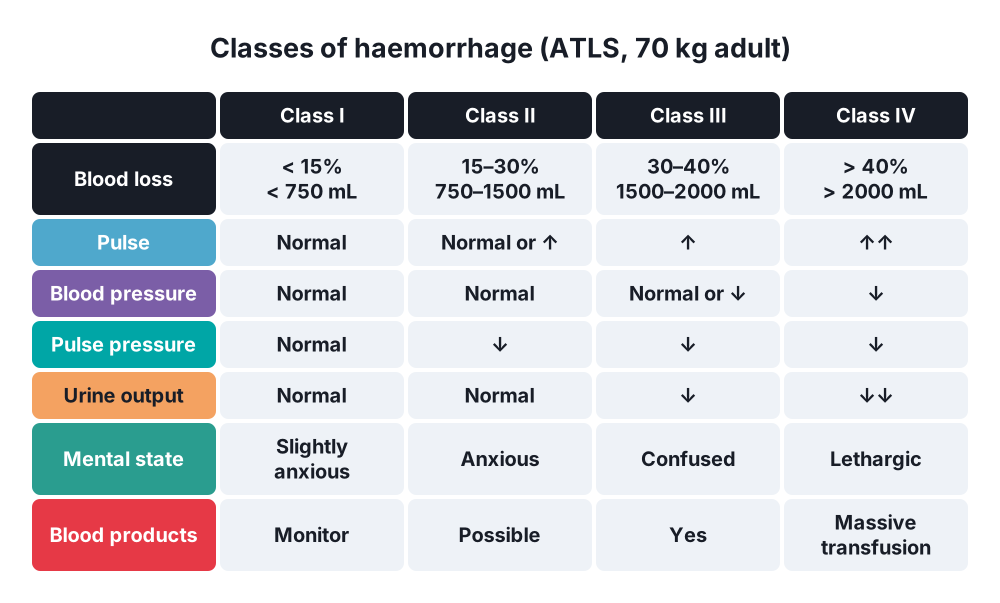
By volume: American College of Surgeons classes of haemorrhage
- Class I → < 15% blood volume (< 750 mL); minimal signs
- Class II → 15–30% (750–1500 mL); tachycardia, narrowed pulse pressure
- Class III → 30–40% (1500–2000 mL); hypotension, confusion, oliguria
- Class IV → > 40% (> 2000 mL); life-threatening, marked hypotension
3. Spontaneous haemostasis
- Vascular phase → reflex vasoconstriction, retraction of the cut vessel ends
- Platelet phase → adhesion to collagen (von Willebrand factor), activation, aggregation → white platelet plug
- Coagulation phase → cascade activates thrombin; fibrinogen → fibrin; red thrombus
- Clot retraction → seals the defect
- Fibrinolysis → plasmin removes the clot as the vessel heals
- Effective → capillaries, small veins and arteries
- Ineffective → large arteries, parenchymal organs, coagulopathy, anticoagulants
4. Artificial haemostasis: temporary
- Elevation of the limb
- Direct pressure on the wound → first measure in all external bleeding
- Pressure dressing → venous and capillary bleeding
- Digital pressure on the artery against bone, proximal to the wound:
- Common carotid → transverse process of C6 (carotid tubercle)
- Subclavian → first rib
- Brachial → humerus, medial bicipital groove
- Femoral → superior pubic ramus, mid-inguinal point
- Maximal joint flexion → elbow, knee
- Tourniquet → limb arterial bleeding not controlled by pressure
- Applied proximal to the wound, over one bone
- Record the time of application
- Maximum 2 h
- Too loose → venous congestion, more bleeding
- Haemostatic clamp in the wound
- Wound packing (tamponade) → haemostatic gauze
- Balloon tamponade → Sengstaken-Blakemore tube, Foley catheter in a wound
- Resuscitative endovascular balloon occlusion of the aorta (REBOA)
- Temporary vascular shunt
5. Artificial haemostasis: definitive
Mechanical
- Ligation of the vessel in the wound
- Transfixion (suture) ligation → large vessels, slip-proof
- Ligation in continuity (at a distance) → secondary bleeding in infected wounds
- Clips, staplers
- Vascular suture or repair, patch, graft → restores blood flow in main arteries
- Packing of the liver → damage control surgery
- Organ removal → splenectomy, nephrectomy
Thermal
- Diathermy → monopolar, bipolar
- Ultrasonic and advanced bipolar energy devices
- Argon plasma coagulation, laser
- Hot saline packs → diffuse oozing
- Cold → cryotherapy, ice packs
Chemical and pharmacological
- Local:
- Adrenaline infiltration → vasoconstriction
- Haemostatic agents → oxidised cellulose, gelatin sponge, collagen
- Fibrin sealant, thrombin
- Bone wax → bone bleeding
- Systemic:
- Tranexamic acid → inhibits fibrinolysis; 1 g within 3 h of injury
- Vitamin K, protamine (heparin reversal)
- Prothrombin complex concentrate → warfarin reversal
- Desmopressin
Biological
- Muscle, omentum, fat → placed on a bleeding surface
- Blood products → fresh frozen plasma, platelets, cryoprecipitate
Endovascular
- Embolisation → coils, particles, glue
- Stent graft
6. Clinical and surgical significance
- External limb bleeding → direct pressure first, tourniquet if it fails
- Massive haemorrhage → damage control resuscitation:
- Permissive hypotension
- Early blood products in 1:1:1 ratio
- Tranexamic acid
- Avoid the lethal triad: hypothermia, acidosis, coagulopathy
Show as a list
Haemostasis
- Spontaneous
- Vasoconstriction
- Platelet plug
- Coagulation
- Clot retraction
- Temporary
- Direct pressure
- Digital pressure
- Tourniquet
- Packing, clamp
- Definitive
- Mechanical
- Thermal
- Chemical
- Biological
- Endovascular
- Bleeding timing
- Primary
- Reactionary
- Secondary