101. Haemorrhoids and anal fissure
High yield
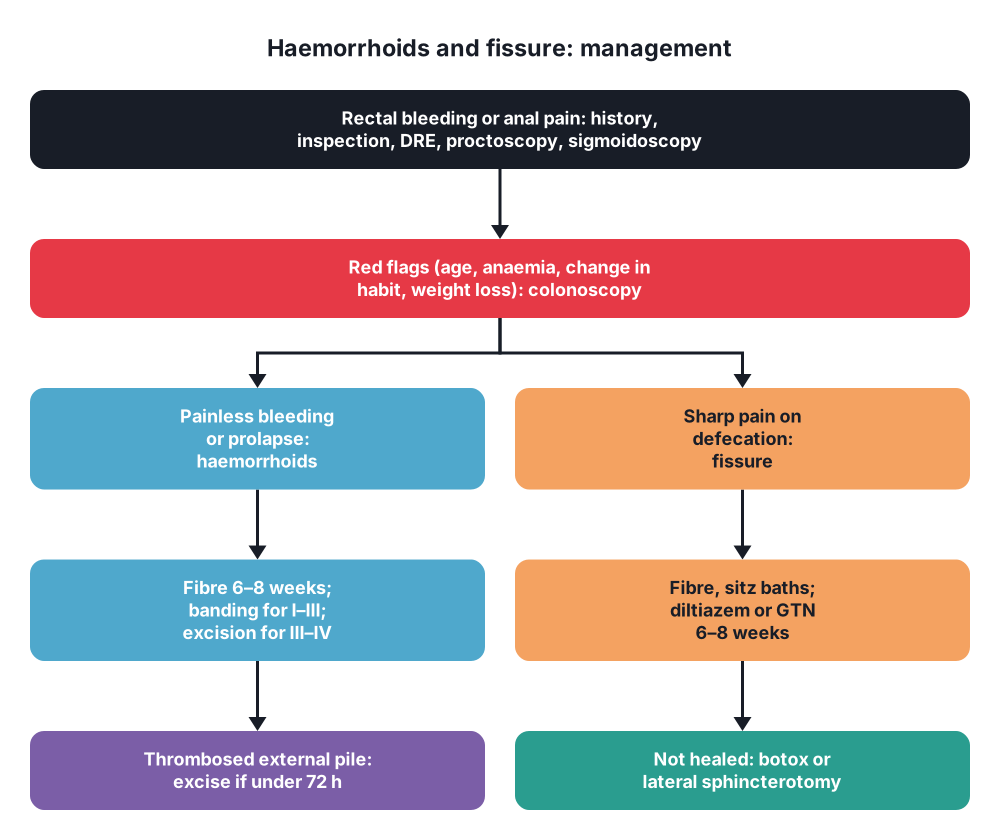
Painless bright red bleeding suggests haemorrhoids; sharp pain on defecation suggests a fissure. Both start with fibre.
Exam Prep · State examSurgery · General surgerySurgery · Colorectal
1. Definition
- Haemorrhoids → symptomatic enlargement or downward slide of the normal anal vascular cushions
- The cushions are normal structures (submucosa, smooth muscle, arteriovenous connections) that help seal the anal canal
- They only become "haemorrhoids" when they bleed, prolapse or thrombose
- Internal haemorrhoids → arise above the dentate line; covered by columnar mucosa; no somatic pain fibres
- External haemorrhoids → the plexus below the dentate line; covered by anoderm; painful when thrombosed
- Anal fissure → a longitudinal tear in the anoderm of the distal anal canal, from the anal verge towards the dentate line
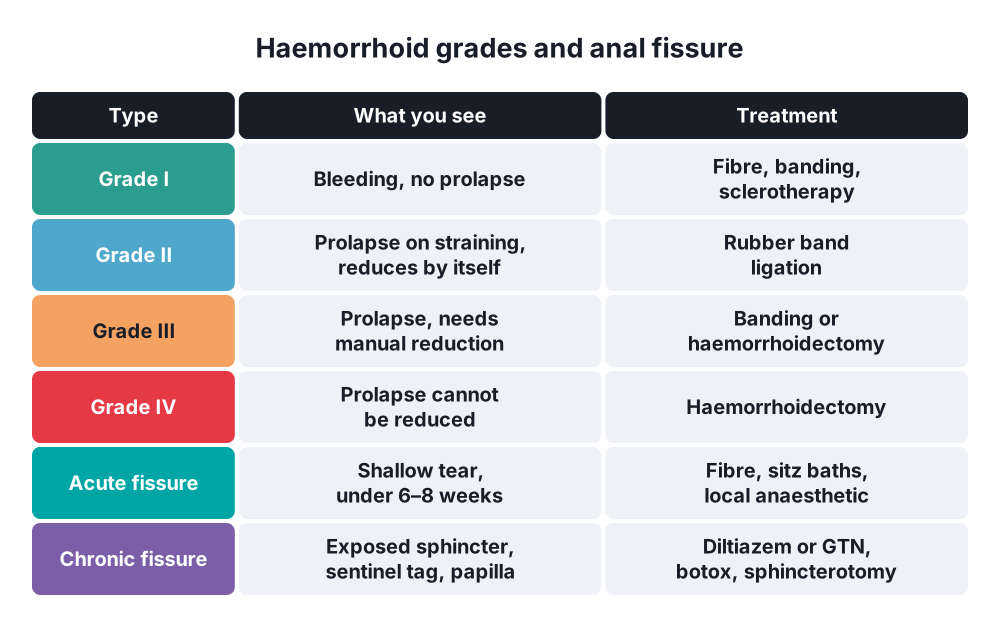
- Acute → under 6–8 weeks; shallow tear with clean edges
- Chronic → over 6–8 weeks; exposed internal sphincter fibres in the base, sentinel skin tag below, hypertrophied anal papilla above
2. Epidemiology
- Haemorrhoids → symptoms in about 5% of the population; peak at 45–65 years; equal in men and women
- Common in pregnancy and after childbirth
- Anal fissure → common at any age, peak in young and middle-aged adults; equal sex ratio
- Fissure position → posterior midline in about 75–90%; anterior midline in about 10–25% (more often in women after childbirth)
3. Aetiology and risk factors
Haemorrhoids
- Constipation and straining, long time on the toilet (reading or phone use)
- Low-fibre diet, chronic diarrhoea
- Pregnancy (pressure from the uterus, hormones), pelvic tumours
- Ageing → the supporting tissue (Treitz muscle, elastic fibres) weakens from the 2nd–3rd decade
- Raised intra-abdominal pressure (heavy lifting, chronic cough)
- Portal hypertension causes anorectal varices, which are a separate condition
Anal fissure
- Passage of a hard stool (most common), or an episode of diarrhoea
- High resting tone of the internal anal sphincter
- Childbirth (anterior fissures)
- Anal intercourse, trauma
- Secondary (atypical) fissures → Crohn's disease, anal cancer, tuberculosis, HIV, syphilis, herpes, leukaemia
4. Pathogenesis
Haemorrhoids
- Straining raises anal canal pressure → engorgement of the cushions → stretching and breakdown of their supporting tissue → the cushions slide down
- Bleeding is arterial (bright red), because the cushions contain direct arteriovenous connections fed by branches of the superior rectal artery
- Classic cushion positions → 3, 7 and 11 o'clock with the patient in lithotomy (left lateral, right anterior, right posterior)
- Prolapsed cushions are squeezed by the sphincter → oedema, thrombosis, strangulation, necrosis
Anal fissure
- Hard stool tears the anoderm → pain → spasm of the internal sphincter
- Spasm raises resting pressure and reduces blood flow → local ischaemia at the posterior midline, where blood supply is poorest
- The ischaemic ulcer does not heal → more pain → more spasm (a vicious cycle)
- Treatment aims to break the cycle by relaxing the internal sphincter
5. Classification
Internal haemorrhoids (Goligher)
- Grade I → bleed, no prolapse
- Grade II → prolapse on straining, reduce on their own
- Grade III → prolapse, need manual reduction
- Grade IV → permanently prolapsed, cannot be reduced
Other forms
- External haemorrhoids, mixed (interno-external) haemorrhoids
- Thrombosed external haemorrhoid (perianal haematoma)
- Strangulated or thrombosed internal haemorrhoids (acute haemorrhoidal crisis)
- Skin tags → redundant folds of skin left after earlier swelling
Anal fissure
- Acute or chronic
- Primary (typical, midline) or secondary (atypical, off the midline, multiple, painless)
6. Clinical picture
Haemorrhoids
- Painless bright red bleeding with defecation → on the paper, dripping into the pan, streak on the stool (not mixed in)
- Prolapse → a lump on straining that goes back on its own or must be pushed back
- Mucus discharge, soiling, perianal itching
- Pain is not typical of uncomplicated internal haemorrhoids → think of fissure, abscess or thrombosis
- Thrombosed external haemorrhoid → sudden severe pain and a tense, blue, tender lump at the anal margin, often after straining or lifting
- Strangulated internal haemorrhoids → irreducible, swollen, purple or black prolapse with severe pain; may cause urinary retention
- Chronic heavy bleeding can cause iron-deficiency anaemia (more likely on anticoagulants or with cirrhosis)
Anal fissure
- Sharp, tearing pain during defecation ("passing glass") followed by burning or throbbing for minutes to hours (sphincter spasm)
- Small amount of bright red blood on the paper
- Fear of defecation → constipation → harder stool → worse fissure
- Chronic fissure → less pain but persistent; a skin tag (sentinel pile) may be the only thing the patient notices
7. Diagnosis
- History → the pattern of pain and bleeding usually gives the diagnosis
- Inspection → parting the buttocks shows a fissure, skin tag, thrombosed haemorrhoid or prolapse
- Ask the patient to strain to show prolapse (sitting on a commode if needed)
- Digital rectal examination → normal in internal haemorrhoids (soft cushions are not palpable); excludes a low rectal tumour
- Avoid DRE and anoscopy in an acute fissure → too painful; examine later or under anaesthesia
- Proctoscopy (anoscopy) → shows and grades internal haemorrhoids
- Rigid or flexible sigmoidoscopy → in every patient with rectal bleeding
- Colonoscopy → age over 50 (or local screening age), change in bowel habit, iron-deficiency anaemia, weight loss, family history of colorectal cancer, dark blood mixed with stool
- Bloods → FBC (anaemia), clotting if on anticoagulants
- Examination under anaesthesia (EUA) → atypical fissure, unclear diagnosis, severe pain; biopsy atypical fissures
- Sublingual GTN may relax the sphincter enough to allow a gentle examination of a fissure
8. Differential diagnosis
- Colorectal or anal cancer → never blame bleeding on haemorrhoids without examining the rectum and the colon when indicated
- Rectal prolapse → concentric folds (haemorrhoids have radial folds)
- Perianal abscess → constant throbbing pain, swelling, fever
- Anal fistula, pilonidal sinus
- Inflammatory bowel disease (proctitis, Crohn's fissure)
- Anal warts, polyps, hypertrophied anal papilla
- Proctalgia fugax → brief severe pain at night with a normal examination
- Anorectal varices in portal hypertension
9. Treatment
Conservative
- For everyone (haemorrhoids and fissure):
- Fibre 20–35 g a day (bulk laxatives such as ispaghula) and fluids, aiming for soft, easy stools
- Do not strain; limit toilet time to 2–3 minutes; no reading or phone on the toilet
- Warm sitz baths after defecation
- Topical creams (local anaesthetic, astringent, short-course steroid) relieve symptoms but do not cure
- Give conservative treatment 6–8 weeks before considering a procedure
- Haemorrhoids, office procedures (grade I–II, selected grade III):
- Rubber band ligation → most effective office treatment; band placed above the dentate line, so it does not hurt
- Pain means the band is too low → remove it at once
- Avoid or use with care on anticoagulants or antiplatelets → bleeding when the ulcer sloughs at 7–10 days
- Injection sclerotherapy → 5% phenol in almond oil, about 1–5 mL into the submucosa at the apex of the cushion; useful on anticoagulants
- Infrared coagulation → grade I–II
- Rubber band ligation → most effective office treatment; band placed above the dentate line, so it does not hurt
- Thrombosed external haemorrhoid:
- Under 72 hours with severe pain → excision under local anaesthetic (faster relief, fewer recurrences than incision of the clot)
- Over 72 hours → conservative (analgesia, laxatives, sitz baths, topical nifedipine or lidocaine); resolves in days
- Strangulated internal haemorrhoids → analgesia, ice, sugar as an osmotic agent, anal block and gentle reduction; surgery if necrotic or not settling
- Anal fissure:
- Acute → fibre, laxatives, sitz baths, topical anaesthetic; about 90% heal
- Chronic → chemical sphincterotomy for 6–8 weeks:
- Topical diltiazem 2% (or nifedipine) → first choice; heals about 65–95%; few side effects
- Topical GTN 0.2–0.4% → heals about 50%; headache in up to 20–30% makes many stop
- Botulinum toxin injection into the internal sphincter (20–100 units) → effect for about 3 months; second line or for those at risk of incontinence; transient flatus incontinence
Surgical
- Haemorrhoids:
- Excisional haemorrhoidectomy → grade III–IV, mixed haemorrhoids, failure of banding; lowest recurrence
- Milligan–Morgan (open) → the three main cushions excised, wounds left open
- Ferguson (closed) → wounds closed with absorbable suture; less pain and faster healing
- Leave bridges of anoderm and mucosa between wounds to avoid stenosis; keep the internal sphincter intact
- Energy devices (bipolar, ultrasonic) are faster and less painful
- Stapled haemorrhoidopexy (PPH) → excises a ring of mucosa above the cushions and lifts them; less pain, but more recurrence; risks rectovaginal fistula, chronic pain, perforation
- Doppler-guided haemorrhoidal artery ligation (HAL, THD) with mucopexy → grade II–III; less pain; more recurrence than excision; costly
- Emergency haemorrhoidectomy for strangulated or necrotic haemorrhoids by an experienced surgeon; preserve as much mucosa as possible
- Packing the anal canal after surgery is not useful
- Excisional haemorrhoidectomy → grade III–IV, mixed haemorrhoids, failure of banding; lowest recurrence
- Anal fissure:
- Lateral internal sphincterotomy (LIS) → treatment of choice for chronic fissure that fails medical treatment; heals 88–100%; recurrence about 2%
- Divide the distal internal sphincter for the length of the fissure (not beyond the dentate line), at 3 or 9 o'clock, open or closed technique
- Risk of minor incontinence (mostly flatus) 8–30%, often temporary
- Avoid in women with obstetric injury, previous anal surgery, low resting pressure, IBD → use botox or an anal advancement flap
- Fissurectomy with botox → an option to preserve the sphincter
- Manual anal dilatation (Lord's) is abandoned → uncontrolled sphincter tearing and incontinence
- Lateral internal sphincterotomy (LIS) → treatment of choice for chronic fissure that fails medical treatment; heals 88–100%; recurrence about 2%
10. Complications
Of haemorrhoids
- Anaemia from chronic bleeding
- Thrombosis, strangulation, gangrene, ulceration
- Rarely portal pyaemia
Of treatment
- Banding → pain, bleeding at 7–10 days, urinary retention, very rarely pelvic sepsis
- Haemorrhoidectomy → pain, urinary retention (1–15%), secondary bleeding (1–2%, usually at 7–10 days from infection), anal stenosis, incontinence
- Pelvic sepsis → pain, fever and urinary retention after any anorectal procedure is an emergency → EUA and debridement
- Stapled haemorrhoidopexy → rectovaginal fistula, staple line bleeding, chronic pain, rectal perforation
- Sphincterotomy → incontinence to flatus or liquid, recurrence, abscess or fistula (closed technique)
Prognosis
- Most haemorrhoids are controlled with fibre and banding; recurrence after banding about 25% over years
- Most acute fissures heal; chronic fissures have up to 50% recurrence after medical treatment, about 2% after LIS
Show as a list
Haemorrhoids and anal fissure
- Haemorrhoids
- Cushions 3, 7, 11
- Painless bright red bleeding
- Grades I-IV
- Fibre, banding
- Haemorrhoidectomy III-IV
- Thrombosed external
- Under 72 h excise
- Over 72 h conservative
- Anal fissure
- Posterior midline
- Pain on defecation
- Spasm and ischaemia
- Fissure treatment
- Fibre, sitz baths
- Diltiazem or GTN
- Botox
- Lateral sphincterotomy
- Red flags
- Age, anaemia
- Change in habit
- Colonoscopy