30. Goitre and special forms of goitre
High yield
Enlargement of the thyroid; diffuse or nodular, toxic or non-toxic; retrosternal goitre and thyroiditis are the special forms.
Exam Prep · State examSurgery · General surgery
1. Definition
- Goitre (struma) → enlargement of the thyroid gland, of any cause
- Non-toxic goitre → benign, non-inflammatory enlargement without hyperthyroidism
- Endemic goitre → goitre in > 10% of a population; caused by iodine deficiency
2. Epidemiology
- More than 2 billion people exposed to iodine-deficient diets
- Female predominance → 2–3 times more common in women
3. Aetiology and risk factors
- Iodine deficiency → most common cause worldwide
- Goitrogens → cabbage family vegetables, cassava, lithium, amiodarone
- Physiological → puberty, pregnancy
- Dyshormonogenesis → enzyme defects in hormone synthesis
- Autoimmune → Graves' disease, Hashimoto's thyroiditis
- Neoplasm → adenoma, carcinoma
4. Pathogenesis
- Low iodine → low thyroid hormone
- Raised thyroid-stimulating hormone (TSH)
- Diffuse follicular hyperplasia → diffuse goitre
- Cycles of hyperplasia and involution
- Nodule formation → multinodular goitre
- Some nodules become autonomous → toxic multinodular goitre
5. Classification
By morphology
- Diffuse
- Nodular → solitary nodule, multinodular
By function
- Non-toxic (euthyroid)
- Toxic → Graves' disease, toxic multinodular goitre, toxic adenoma
- Hypothyroid → Hashimoto's, severe iodine deficiency
By epidemiology
- Endemic
- Sporadic
WHO grading
- Grade 0 → no palpable or visible goitre
- Grade 1 → palpable but not visible with the neck in normal position
- Grade 2 → visible with the neck in normal position
6. Special forms of goitre
A. Retrosternal (substernal) goitre
- Significant part of the gland extends through the thoracic inlet into the mediastinum
- Most arise from a cervical goitre growing downwards
- Types → anterior (most common), posterior (behind the great vessels, trachea), isolated mediastinal (own blood supply from the chest)
- Compression in a fixed bony inlet:
- Dyspnoea, orthopnoea, stridor
- Dysphagia
- Superior vena cava obstruction → facial plethora
- Pemberton's sign → raising both arms causes facial congestion and distress
- Vocal cord palsy → rare; suggests malignancy
- CT (non-contrast) → extent, tracheal compression
- Treatment → thyroidectomy through a cervical incision in most; sternotomy if below the aortic arch or posterior
B. Lingual and ectopic thyroid
- Failed descent of the thyroid → base of tongue
- May be the only functioning thyroid tissue
C. Thyroiditis
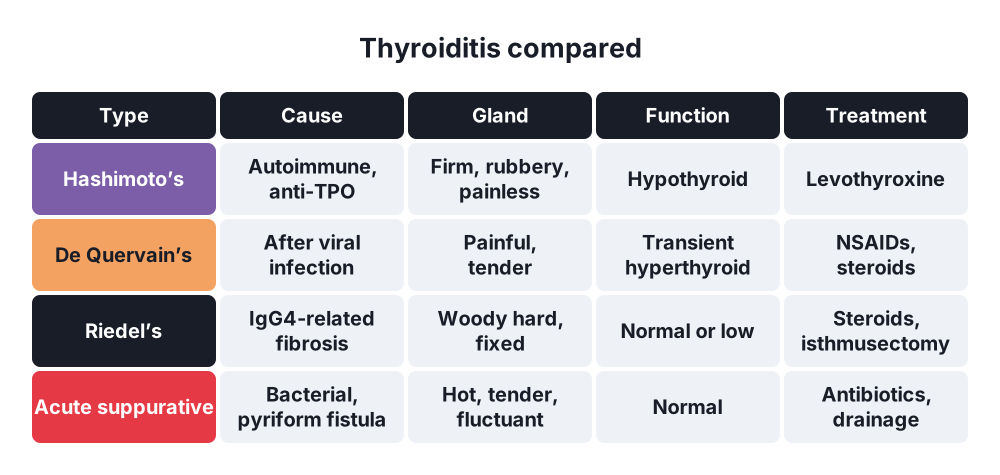
- Hashimoto's thyroiditis (chronic lymphocytic) → most common cause of hypothyroidism in iodine-replete areas; anti-thyroid peroxidase (TPO) antibodies; firm rubbery goitre; risk of thyroid lymphoma
- De Quervain's (subacute granulomatous) → after viral infection; painful tender gland, fever, raised ESR, transient hyperthyroidism, low radioiodine uptake; treat with NSAIDs or steroids
- Riedel's thyroiditis → rare, woody hard fibrosis extending into the neck; IgG4-related; mimics carcinoma; steroids, tamoxifen, isthmusectomy for compression
- Acute suppurative thyroiditis → bacterial; children with pyriform sinus fistula; drainage, antibiotics
- Painless and postpartum thyroiditis
D. Others
- Goitre of puberty and pregnancy
- Dyshormonogenetic goitre
- Amiodarone-induced goitre
7. Clinical picture
Symptoms
- Neck swelling, cosmetic concern
- Pressure symptoms → dyspnoea, dysphagia, choking, hoarseness
- Symptoms of hyper- or hypothyroidism
Signs
- Moves up on swallowing → attached to the larynx by the pretracheal fascia
- Diffuse or nodular, consistency, tenderness
- Lower border palpable or not (retrosternal extension)
- Tracheal deviation
- Bruit → Graves' disease
- Cervical lymph nodes → malignancy
8. Diagnosis
Laboratory
- TSH, free T4, free T3
- Thyroid antibodies → anti-TPO, TSH receptor antibodies (TRAb)
- Calcitonin → suspected medullary carcinoma
Imaging
- Ultrasound → size, nodules, suspicious features (TI-RADS)
- FNA of suspicious nodules → Bethesda classification
- Radioisotope scan → hot or cold nodules in hyperthyroidism
- CT or MRI → retrosternal extension, tracheal compression
- Flow-volume loop, laryngoscopy → vocal cord function before surgery
9. Treatment
Conservative
- Iodine supplementation → prevention of endemic goitre (iodised salt)
- Observation → small, asymptomatic, benign goitre
- Levothyroxine (TSH suppression) → reduces size in about 30%; side effects on heart and bone
- Radioactive iodine (RAI) → reduces size up to 50% in 1 year; toxic goitre, unfit patients
Surgical
- Indications:
- Compression of trachea or oesophagus
- Retrosternal extension
- Suspicion or proof of malignancy
- Toxic goitre not controlled medically
- Cosmetic concern, patient choice
- Operations:
- Total thyroidectomy → procedure of choice for multinodular goitre
- Hemithyroidectomy (lobectomy) → one-sided disease
- Subtotal thyroidectomy → abandoned; recurrence > 50%
- After total thyroidectomy → lifelong levothyroxine
10. Complications of thyroidectomy
- Haemorrhage → neck haematoma, airway compression; open the wound at the bedside
- Recurrent laryngeal nerve injury → hoarseness (unilateral), stridor (bilateral)
- External branch of superior laryngeal nerve → loss of high pitch
- Hypoparathyroidism → hypocalcaemia, tetany, Chvostek's and Trousseau's signs
- Thyroid storm → in uncontrolled hyperthyroidism
- Hypothyroidism
- Tracheomalacia → long-standing large goitre
- Wound infection, keloid
Show as a list
Goitre
- Causes
- Iodine deficiency
- Goitrogens
- Autoimmune
- Puberty, pregnancy
- Classification
- Diffuse, nodular
- Toxic, non-toxic
- Endemic, sporadic
- Special forms
- Retrosternal
- Lingual
- Hashimoto's
- De Quervain's
- Riedel's
- Diagnosis
- TSH, antibodies
- Ultrasound, FNA
- CT
- Surgery
- Total thyroidectomy
- Nerve, parathyroids