
64. Gastric precancerous conditions, polyps and other tumours
High yield
Atrophic gastritis, metaplasia, polyps, GIST, MALT lymphoma and neuroendocrine tumours: what to watch, remove or resect.
Exam Prep · State examSurgery · Upper GISurgery · Surgical oncology
1. Definition
- Precancerous conditions → diseases with a raised risk of gastric cancer: atrophic gastritis, intestinal metaplasia, pernicious anaemia, adenomas, gastric remnant, Ménétrier's disease
- Precancerous lesion → dysplasia (intraepithelial neoplasia), low or high grade
- Gastric polyp → any lesion raised above the mucosa
- Other gastric tumours:
- GIST (gastrointestinal stromal tumour)
- Gastric lymphoma (MALT and diffuse large B-cell)
- Neuroendocrine tumour (NET, carcinoid)
- Benign → leiomyoma, lipoma, schwannoma, ectopic pancreas
2. Epidemiology
- Gastric polyps → found in about 6% of gastroscopies
- Fundic gland polyps → about 75% (in the West; PPI users)
- Hyperplastic polyps → about 15–20%
- Adenomas → under 10% (more where H. pylori is common)
- GIST → most common mesenchymal tumour of the gut; 60% in the stomach, 30% small bowel; median age 60
- Gastric lymphoma → stomach is the commonest site of extranodal lymphoma (about 5% of gastric cancers)
- Gastric NETs → under 2% of gastric tumours; rising with more endoscopy
3. Aetiology and risk factors
- H. pylori → chronic gastritis, atrophy, metaplasia, adenomas, MALT lymphoma
- Autoimmune (pernicious anaemia) gastritis → body atrophy, high gastrin → type 1 NETs, cancer
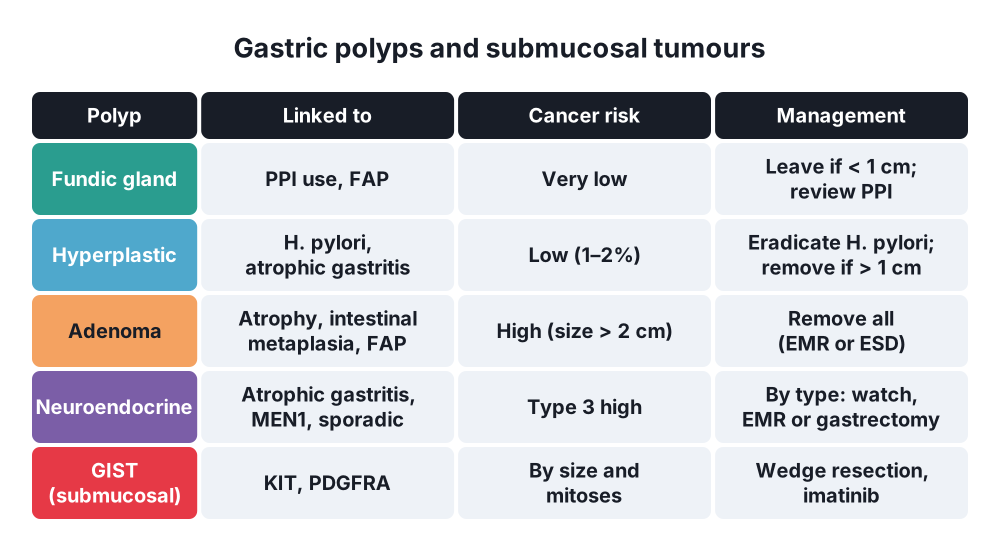
- Fundic gland polyps → long-term PPIs; many small polyps in familial adenomatous polyposis (FAP) (dysplasia possible)
- Hyperplastic polyps → chronic gastritis (H. pylori, autoimmune), around gastroenterostomy stomas
- Adenomas → atrophic gastritis, FAP
- Polyposis syndromes → Peutz-Jeghers (hamartoma), juvenile polyposis, Cowden
- Gastric remnant → 15–20 years after Billroth II (bile reflux)
- Ménétrier's disease → giant rugal folds, protein loss; TGF-alpha excess
- GIST → KIT (CD117) mutation (about 80%) or PDGFRA (about 10%); neurofibromatosis type 1, Carney triad, SDH-deficient (young)
- NETs:
- Type 1 → atrophic gastritis
- Type 2 → Zollinger-Ellison syndrome in MEN1
- Type 3 → sporadic
4. Pathogenesis
- Correa cascade → gastritis → atrophy → intestinal metaplasia → dysplasia → cancer
- Risk rises with the extent of atrophy and metaplasia (OLGA and OLGIM stages III–IV = high risk)
- Adenoma → dysplasia-carcinoma sequence; risk rises with size over 2 cm
- Hyperplastic polyp → cancer risk low (1–2%), more if over 1 cm
- GIST → from interstitial cells of Cajal (gut pacemaker cells); grows outwards (exophytic); spreads by blood to liver and peritoneum; rarely to nodes
- MALT lymphoma → H. pylori drives B-cell growth in gastric lymphoid tissue; t(11;18) translocation predicts poor response to eradication
- High gastrin (types 1 and 2) → enterochromaffin-like (ECL) cell hyperplasia → small, multiple NETs
5. Classification
Gastric polyps
- Non-neoplastic → fundic gland, hyperplastic, inflammatory fibroid, hamartomatous
- Neoplastic → adenoma (tubular, villous, tubulovillous), neuroendocrine, GIST and other submucosal
Dysplasia (Vienna)
- Low-grade, high-grade, intramucosal carcinoma, invasive
GIST risk (modified NIH / Miettinen)
- Based on size, mitotic count (per 5 mm²), site (gastric better than small bowel), rupture
- Very low, low, intermediate, high
Gastric NETs
- Type 1 (70–80%) → atrophic gastritis; high gastrin; small, many, benign
- Type 2 (5%) → gastrinoma (MEN1); high gastrin; many, low risk
- Type 3 (15–20%) → sporadic; normal gastrin; single, large, malignant
Gastric lymphoma
- MALT (marginal zone, low grade)
- Diffuse large B-cell lymphoma (high grade) → most common
- Lugano staging
6. Clinical picture
Symptoms
- Precancer and most polyps → no symptoms; found at endoscopy
- Large polyps → bleeding (anaemia), pyloric obstruction (prolapse through the pylorus)
- GIST → upper GI bleeding (ulcerated mucosa over it), abdominal mass, early satiety, pain; many found by chance
- Lymphoma → epigastric pain, weight loss, bleeding; B symptoms (fever, night sweats) in high-grade disease
- Pernicious anaemia → tiredness, neuropathy (B12)
- NET → usually none; carcinoid syndrome rare (liver metastases, type 3); type 2 → ulcers, diarrhoea
- Ménétrier's → oedema (protein loss), epigastric pain
Signs
- Pallor
- Epigastric mass (GIST, lymphoma)
- Hepatomegaly (metastases)
7. Diagnosis
- Gastroscopy with biopsies:
- Updated Sydney protocol (2 antrum, 1 incisura, 2 body) → atrophy, metaplasia, H. pylori
- Remove or biopsy polyps; image-enhanced endoscopy (narrow-band imaging)
- Gastrin and parietal cell or intrinsic factor antibodies (autoimmune gastritis)
- Submucosal mass:
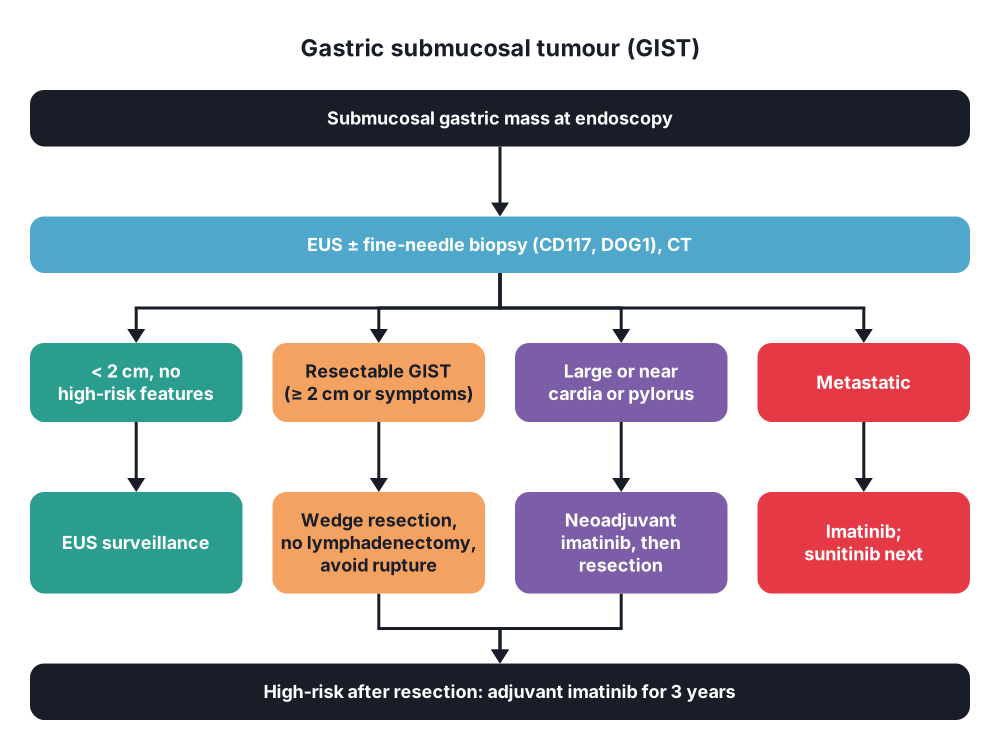
- Endoscopic ultrasound (EUS) → layer of origin (GIST from the muscularis propria, layer 4); size, features
- EUS-guided fine-needle biopsy → CD117 (KIT) and DOG1 staining for GIST
- Avoid percutaneous biopsy of a resectable GIST (rupture, seeding)
- CT → GIST size, spread; lymphoma staging; NET staging
- Lymphoma → biopsy (histology, H. pylori, t(11;18)), PET-CT, bone marrow
- NET → serum gastrin, chromogranin A, Ki-67 index (grade), gallium-68 DOTATATE PET
- Mutation testing → GIST (KIT exon 11, 9; PDGFRA D842V → resistant to imatinib)
8. Differential diagnosis
- Polyps → early gastric cancer, submucosal tumours, ectopic pancreas, varices
- Submucosal mass → GIST, leiomyoma, lipoma, schwannoma, external pressure (spleen, pancreas)
- Thick folds → lymphoma, Ménétrier's, linitis plastica, Zollinger-Ellison
9. Treatment
Conservative
- Eradicate H. pylori in everyone with gastritis, metaplasia or polyps
- Surveillance of extensive atrophy or intestinal metaplasia (MAPS II guideline):
- Extensive (antrum and body) or family history → endoscopy every 3 years
- Low-grade dysplasia without a visible lesion → repeat in 12 months
- Fundic gland polyps → no follow-up if under 1 cm; review PPI need
- Hyperplastic polyps → eradicate H. pylori; many regress
- MALT lymphoma (stage I, H. pylori positive) → H. pylori eradication alone → remission in about 75%
- No response, t(11;18) → radiotherapy; rituximab-based chemotherapy for advanced disease
- Diffuse large B-cell lymphoma → R-CHOP chemotherapy (rituximab, cyclophosphamide, doxorubicin, vincristine, prednisolone) ± radiotherapy; surgery not first-line
- GIST:
- Imatinib (tyrosine kinase inhibitor):
- Adjuvant for 3 years in high-risk resected GIST
- Neoadjuvant to shrink large tumours (organ-sparing)
- First-line in metastatic disease
- Second line → sunitinib, then regorafenib, ripretinib; avapritinib for PDGFRA D842V
- GIST under 2 cm with no high-risk EUS features → EUS surveillance
- Imatinib (tyrosine kinase inhibitor):
- Type 1 NET under 1 cm → endoscopic surveillance or endoscopic removal
- Metastatic NETs → somatostatin analogues (octreotide, lanreotide), PRRT (lutetium-177 DOTATATE), everolimus
Surgical
- Endoscopic resection:
- Adenomas → remove all (EMR or ESD)
- Hyperplastic polyps over 1 cm → remove (cancer focus possible)
- Fundic gland polyps over 1 cm, or with dysplasia → remove
- High-grade dysplasia or early cancer → ESD
- Type 1 and 2 NETs over 1 cm → EMR or ESD
- GIST → surgical resection is the only cure:
- Wedge or segmental resection with clear margins (1–2 cm enough); no lymphadenectomy (nodes rarely involved)
- Avoid tumour rupture (high recurrence risk)
- Laparoscopic resection for tumours up to about 5 cm
- Large or near the cardia or pylorus → neoadjuvant imatinib, then partial or rarely total gastrectomy
- Type 3 NET → gastrectomy with lymphadenectomy (as adenocarcinoma)
- Type 2 NET → remove the gastrinoma (duodenum or pancreas)
- Type 1 NET, many or recurrent → antrectomy (removes gastrin source)
- Lymphoma → surgery only for complications (perforation, bleeding, obstruction)
- Polyposis → endoscopic removal; prophylactic gastrectomy for CDH1 carriers
- Ménétrier's → anti-EGFR antibody (cetuximab); gastrectomy for severe protein loss or dysplasia
10. Complications
- Precancer → gastric cancer
- Polyps → bleeding, obstruction, cancer
- GIST → bleeding, rupture, liver and peritoneal metastases; imatinib side effects (oedema, rash, diarrhoea, myelosuppression)
- Lymphoma → perforation during chemotherapy, bleeding
- NETs → liver metastases, carcinoid syndrome (rare)
- Endoscopic resection → bleeding, perforation
Show as a list
Gastric precancer and tumours
- Precancer
- Atrophic gastritis
- Intestinal metaplasia
- Dysplasia
- Pernicious anaemia
- Gastric remnant
- Surveillance 3 years
- Polyps
- Fundic gland: PPI
- Hyperplastic
- Adenoma: remove
- GIST
- Cajal cells
- KIT, DOG1
- Wedge resection
- Imatinib
- Lymphoma
- MALT: eradicate H. pylori
- DLBCL: R-CHOP
- NET
- Type 1: gastritis
- Type 2: MEN1
- Type 3: gastrectomy