
105. Fistula-in-ano
High yield
An abnormal tract from the anal canal to the perianal skin; cure it without costing the patient continence.
Exam Prep · State examSurgery · General surgerySurgery · Colorectal
1. Definition
- Fistula-in-ano → an abnormal epithelium-lined tract between the anal canal or rectum (internal opening) and the perianal skin (external opening)
- Also called chronic paraproctitis in Bulgarian and Russian textbooks
- Usually the end stage of a cryptoglandular abscess that drained but did not heal
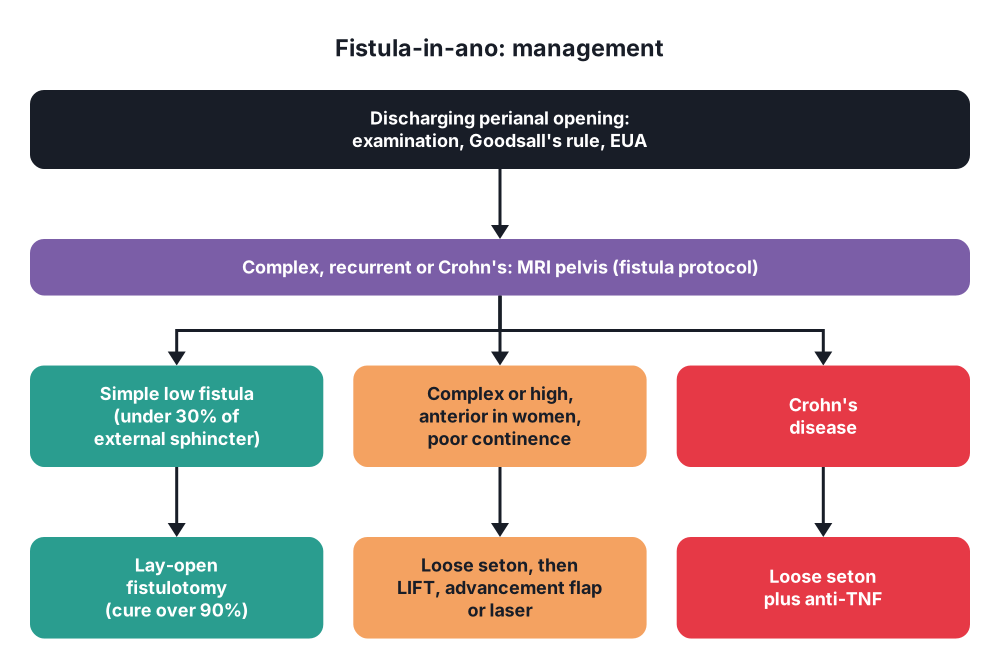
- Simple fistula → low (intersphincteric or low transsphincteric, under 30% of the external sphincter), single tract, not anterior in a woman, no Crohn's, radiation or previous incontinence
- Complex fistula → high (over 30% of the external sphincter), suprasphincteric or extrasphincteric, anterior in a woman, multiple tracts, horseshoe, recurrent, Crohn's, radiation, cancer, pre-existing incontinence
2. Epidemiology
- About 1–2 per 10 000 people a year
- Men about twice as often as women
- Peak at 30–50 years
- Follows about 30–50% of anorectal abscesses
- Crohn's disease → perianal fistula in up to a third of patients
3. Aetiology and risk factors
- Cryptoglandular (about 90%) → persisting infection of an anal gland
- Crohn's disease → complex, multiple, recurrent
- Tuberculosis, actinomycosis, lymphogranuloma venereum
- Malignancy (rectal, anal cancer; cancer can also arise in a long-standing fistula)
- Trauma → obstetric injury, surgery, foreign body
- Radiotherapy
- HIV and immunosuppression
- Risk factors for fistula after abscess → recurrent abscess, gut organisms in the pus, intersphincteric pus at drainage
4. Pathogenesis
- Anal gland infection → abscess in the intersphincteric space → spreads and bursts or is drained through the skin
- The infected gland and its track epithelialise and stay open → chronic fistula
- Repeated blockage of the external opening → recurrent abscesses (cycle of swelling, pain, discharge, relief)
- Goodsall's rule describes the path of the track:
- External opening in front of a transverse line through the anus → straight radial track to the nearest crypt
- External opening behind the line → curved track to the posterior midline (6 o'clock)
- Exception → anterior openings more than 3 cm from the anus often curve back to the posterior midline (anterior extension of a horseshoe)
5. Classification
Parks classification (by relation to the sphincters)
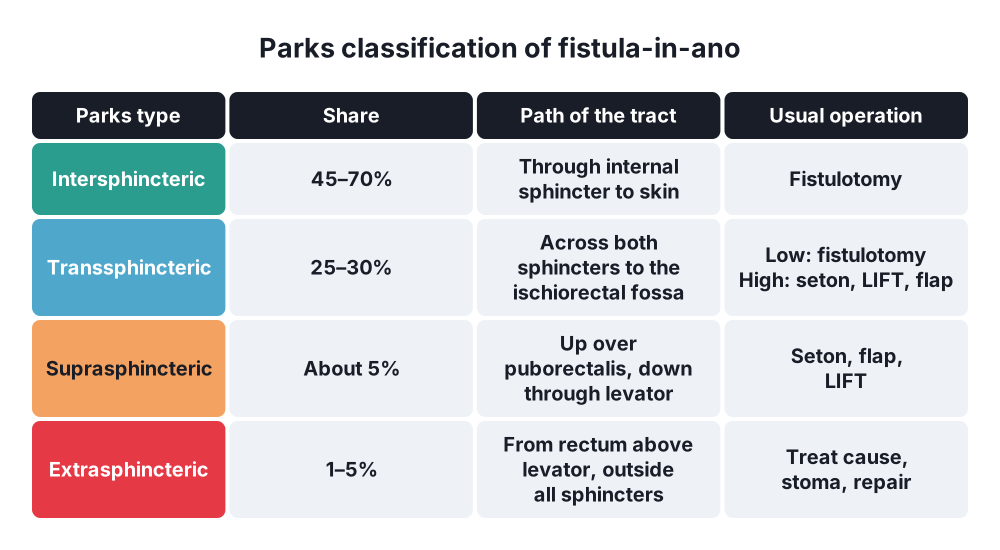
- Intersphincteric (about 45–70%) → passes through the internal sphincter and the intersphincteric space to the skin
- Transsphincteric (about 25–30%) → crosses both sphincters into the ischiorectal fossa; low or high depending on how much external sphincter it crosses
- Suprasphincteric (about 5%) → goes up in the intersphincteric space above the puborectalis, then down through the levator and ischiorectal fossa
- Extrasphincteric (about 1–5%) → from the rectum above the levator, outside all the sphincters, to the skin; usually from trauma, Crohn's, pelvic sepsis or wrong surgery
- Superficial (subcutaneous) → under the anoderm only, often from a fissure; not part of the original four types
Other descriptions
- Simple or complex; low or high
- Horseshoe → tracks extend around the anus on both sides
- St James's University Hospital (MRI) grades 1–5 → used to describe MRI findings
6. Clinical picture
- Persistent or intermittent discharge of pus, blood or mucus from a perianal opening; staining of underwear
- Cycles of swelling and pain that settle when it discharges
- Perianal itching and skin irritation
- History of an anorectal abscess drained or burst
- Diarrhoea, weight loss, abdominal pain → think of Crohn's disease
Examination
- External opening → small red papule of granulation tissue; may be at a distance from the anus
- A cord-like track may be felt under the skin running to the anus
- Several openings ("watering-can perineum") → Crohn's or tuberculosis
- DRE → induration at the internal opening, usually at the dentate line; assess sphincter tone and squeeze
- Proctoscopy → red crypt or pus at the internal opening when the track is pressed
7. Diagnosis
- Clinical examination with Goodsall's rule
- Examination under anaesthesia (EUA) → the key step:
- Gentle probing from both openings (never force a probe → false passage)
- Injection of dilute hydrogen peroxide, methylene blue or milk through the external opening shows the internal opening
- MRI pelvis (fistula protocol) → gold standard imaging for complex, recurrent or Crohn's fistulas; shows secondary tracks and hidden abscesses
- Endoanal ultrasound (with hydrogen peroxide) → good for the internal opening and sphincter defects; operator dependent
- Anorectal manometry → baseline sphincter function before surgery that may weaken it
- Colonoscopy → when Crohn's disease is suspected
- Biopsy → atypical tracks, long-standing fistula (cancer), tuberculosis
- Fistulography and CT are used less now
8. Differential diagnosis
- Pilonidal sinus → natal cleft, midline pits, no link with the anus
- Hidradenitis suppurativa → many superficial tracks, axillae and groins also affected
- Infected sebaceous cyst, furuncle
- Crohn's disease, tuberculosis
- Rectovaginal or anovaginal fistula (stool or gas through the vagina)
- Presacral (tail-gut) cyst, sacrococcygeal teratoma, Bartholin's gland infection
- Anal or rectal cancer
9. Treatment
Conservative
- A fistula does not heal on its own; conservative care is for those unfit or unwilling to have surgery
- Loose (draining) seton → long-term control of sepsis without cutting muscle (complex fistulas, Crohn's)
- Crohn's fistula → drain sepsis, loose seton, then anti-TNF therapy (infliximab, adalimumab), with metronidazole or ciprofloxacin and an immunomodulator
- Goals of treatment (in this order):
- Drain any sepsis
- Define the anatomy
- Remove or close the track and the internal opening
- Keep continence
- Prevent recurrence
Surgical
- Lay-open fistulotomy → treatment of choice for simple low fistulas (intersphincteric and low transsphincteric)
- A probe is passed through the track, which is laid open and curetted; the wound heals from the base
- Heals 92–98%; recurrence 2–8%; significant incontinence under 5% with normal sphincters beforehand
- Marsupialisation of the edges speeds healing
- Seton:
- Loose (draining) seton → silicone sling through the track; drains sepsis, lets the track mature, protects the sphincter; first stage of many complex repairs
- Cutting seton → tightened in stages to cut slowly through the muscle; risk of incontinence is close to that of fistulotomy; used less now
- Sphincter-saving operations (complex or high fistulas, anterior fistulas in women, poor continence):
- LIFT (ligation of the intersphincteric fistula tract) → the track is divided and tied in the intersphincteric space; heals about 60–80%; failure often leaves a simpler intersphincteric fistula
- Endorectal advancement flap → excise the internal opening and cover it with a flap of mucosa, submucosa and some internal sphincter; heals about 65–85%
- Fistula laser closure (FiLaC) and VAAFT (video-assisted anal fistula treatment) → ablate the track from the inside; heal about 65–85% in short-term studies
- Fibrin glue and fistula plugs → no muscle division, but lower and less durable healing rates
- Stem cell injection (darvadstrocel) → for complex Crohn's fistulas in selected centres
- Extrasphincteric fistula → treat the cause (Crohn's, pelvic abscess), often a defunctioning stoma, then repair
- Crohn's fistula → loose setons and anti-TNF; fistulotomy only for simple low tracks with quiet rectal disease; advancement flap when the rectum is healthy; proctectomy for severe refractory disease
- Rectovaginal fistula → wait 3–6 months if obstetric (half may heal); then advancement flap, sphincteroplasty, Martius or gracilis flap interposition; transabdominal repair for high fistulas
- After surgery → sitz baths, fibre, analgesia, wound care until healed
10. Complications
Of the disease
- Recurrent abscesses and sepsis
- Perianal skin irritation
- Cancer (adenocarcinoma or squamous) in a long-standing fistula, rare
Of surgery
- Faecal incontinence → risk grows with the amount of sphincter divided, in women with anterior fistulas, in the elderly and after previous surgery
- Recurrence → missed internal opening or secondary track, wrong classification, Crohn's
- Bleeding, urinary retention, slow wound healing
- False passage from forceful probing
- Keyhole deformity (groove at the anal margin causing soiling)
Prognosis
- Simple fistulas → over 90% cure with fistulotomy
- Complex fistulas → often several operations; sphincter-saving procedures cure about 60–80%
Show as a list
Fistula-in-ano
- Cause
- Cryptoglandular 90%
- Crohn's, TB, cancer
- Parks types
- Intersphincteric
- Transsphincteric
- Suprasphincteric
- Extrasphincteric
- Goodsall's rule
- Anterior: straight
- Posterior: to 6 o'clock
- Tests
- EUA, gentle probe
- MRI fistula protocol
- Endoanal US
- Treatment
- Low simple: fistulotomy
- Complex: loose seton
- LIFT, advancement flap
- Laser, VAAFT
- Crohn's: anti-TNF
- Risks
- Incontinence
- Recurrence