5. Electrical injury
High yield
Current through the body causes heat damage along its path, arrhythmias and rhabdomyolysis; the skin hides deep injury.
Exam Prep · State examSurgery · Emergency and trauma
1. Definition
- Electrical injury (electric shock) → local and systemic damage from electric current passing through the body
- Sources → technical (domestic, industrial) current and lightning (atmospheric electricity)
- Children → domestic sockets, cables; adults → occupational injury
2. Mechanism of injury
Factors that decide severity
- Current strength (amperage) → main determinant of damage
- Voltage:
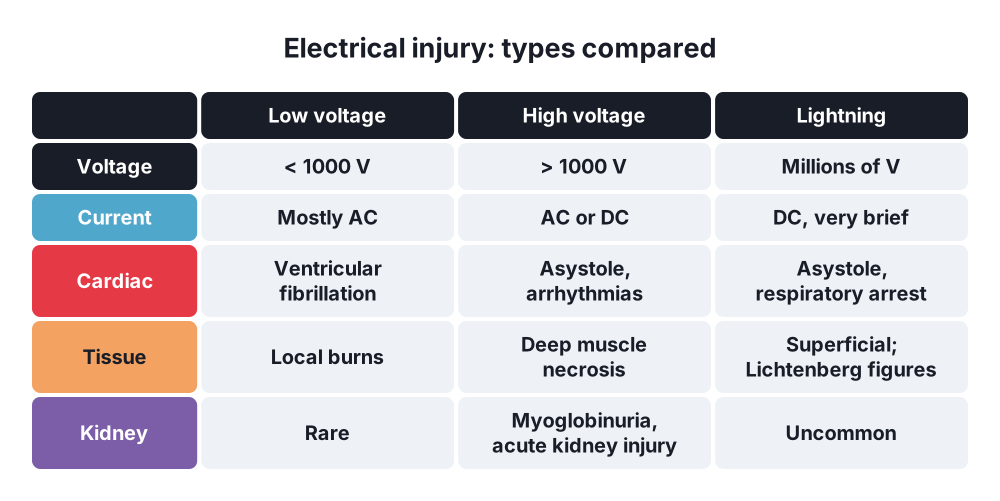
- Low voltage → < 1000 V (domestic 220–240 V)
- High voltage → > 1000 V
- Type of current:
- Alternating current (AC) → more dangerous at 50–60 Hz; tetanic muscle contraction prevents release (no let-go)
- Direct current (DC) → single muscle spasm, often throws the victim away
- Tissue resistance → highest in bone, then fat, tendon, skin; lowest in nerve, blood, muscle
- Skin resistance → falls sharply when skin is wet
- Path of current:
- Hand to hand, hand to foot → crosses the heart, most dangerous
- Head → brain, respiratory centre
- Duration of contact
Current thresholds (AC, 50–60 Hz)
- 1 mA → perception
- 10–20 mA → tetany, cannot let go
- 50–100 mA → ventricular fibrillation
- > 2 A → asystole, burns
3. Pathophysiology
- Thermal effect → heat by Joule's law (Q = I² × R × t); deep burns along the current path
- Electrolytic effect → ion shifts, cell membrane damage (electroporation)
- Mechanical effect → violent muscle contraction, falls, fractures, dislocations
- Biological effect → disturbed excitable tissue: heart, nerves, muscle
- Iceberg effect → small skin wounds over extensive deep muscle necrosis
- Deep tissue near bone heats most → periosseous muscle necrosis
4. Local changes
- Current marks (electric marks) → entry and exit wounds
- Round, grey-white or yellow, firm, depressed centre, raised edge
- Painless, no surrounding inflammation
- Contact burns, arc burns (up to 4000 °C), flame burns from burning clothes
- Deep muscle necrosis → oedema, compartment syndrome
- Vessel thrombosis → delayed limb gangrene
- Lightning → Lichtenberg figures (fern-like skin marks, not burns), tympanic membrane rupture
5. Systemic changes
- Heart:
- Ventricular fibrillation → low-voltage AC
- Asystole → high-voltage current, lightning
- Arrhythmias, myocardial injury
- Respiration → respiratory arrest (brainstem or muscle tetany)
- Nervous system → loss of consciousness, seizures, peripheral nerve damage, spinal cord injury, keraunoparalysis (transient limb paralysis after lightning)
- Muscle → rhabdomyolysis, myoglobinuria, hyperkalaemia
- Kidney → myoglobinuric acute kidney injury
- Skeleton → fractures, posterior shoulder dislocation
- Late → cataracts, neuropathy, psychological symptoms
6. Clinical picture
- Mild → fright, pain, brief loss of consciousness, palpitations
- Moderate → loss of consciousness, arrhythmias, burns
- Severe → apparent death (clinical death): no pulse, no breathing
- Lightning victims in apparent death → resuscitate first, even with several victims (reverse triage)
7. Diagnosis
Laboratory
- Creatine kinase (CK) → marker of muscle damage
- Urine myoglobin → red-brown urine
- Urea, creatinine, potassium
- Troponin, arterial blood gas
Imaging and monitoring
- Electrocardiogram (ECG) in every patient
- Cardiac monitoring 24 h → high voltage, loss of consciousness, abnormal ECG, current across the chest
- X-ray → fractures, dislocations
- Compartment pressure measurement
8. Treatment
First aid
- Switch off the current before touching the victim; use a dry non-conducting object
- High-voltage lines → wait for the power company; keep 10 m away
- Cardiopulmonary resuscitation (CPR); defibrillate ventricular fibrillation
- Prolonged CPR → good outcomes possible
- Spinal immobilisation if a fall or throw occurred
General treatment
- Intravenous fluids:
- Burn formula underestimates needs → start at 4 mL × kg × % TBSA (total body surface area)
- Myoglobinuria → target urine output 1–1.5 mL/kg/h until urine clears
- Correct hyperkalaemia and acidosis
- Analgesia, tetanus prophylaxis
- Low-voltage injury, normal ECG, no symptoms → discharge
Surgical treatment
- Fasciotomy → compartment syndrome
- Early debridement of necrotic muscle, repeated every 48–72 h (second look)
- Escharotomy for circumferential burns
- Skin grafts and flaps for cover
- Amputation → non-viable limb
9. Complications
- Cardiac arrest, arrhythmias
- Acute kidney injury
- Sepsis from necrotic muscle
- Secondary haemorrhage from damaged vessels
- Limb loss
- Cataracts → months later
Show as a list
Electrical injury
- Severity factors
- Amperage
- Voltage
- AC or DC
- Resistance
- Current path
- Effects
- Thermal
- Electrolytic
- Mechanical
- Biological
- Local
- Current marks
- Deep muscle necrosis
- Compartment syndrome
- Systemic
- Ventricular fibrillation
- Respiratory arrest
- Rhabdomyolysis
- Acute kidney injury
- Treatment
- Switch off current
- CPR
- Fluids, urine output
- Fasciotomy, debridement