76. Chronic pancreatitis, pancreatic cysts and fistulas
High yield
Progressive fibrosis causing pain and gland failure; pseudocysts, cystic neoplasms and fistulas each need their own plan.
Exam Prep · State examSurgery · HPB
1. Definition
- Chronic pancreatitis → progressive inflammation and fibrosis of the pancreas with permanent loss of exocrine and endocrine function, and pain
- Pancreatic cysts:
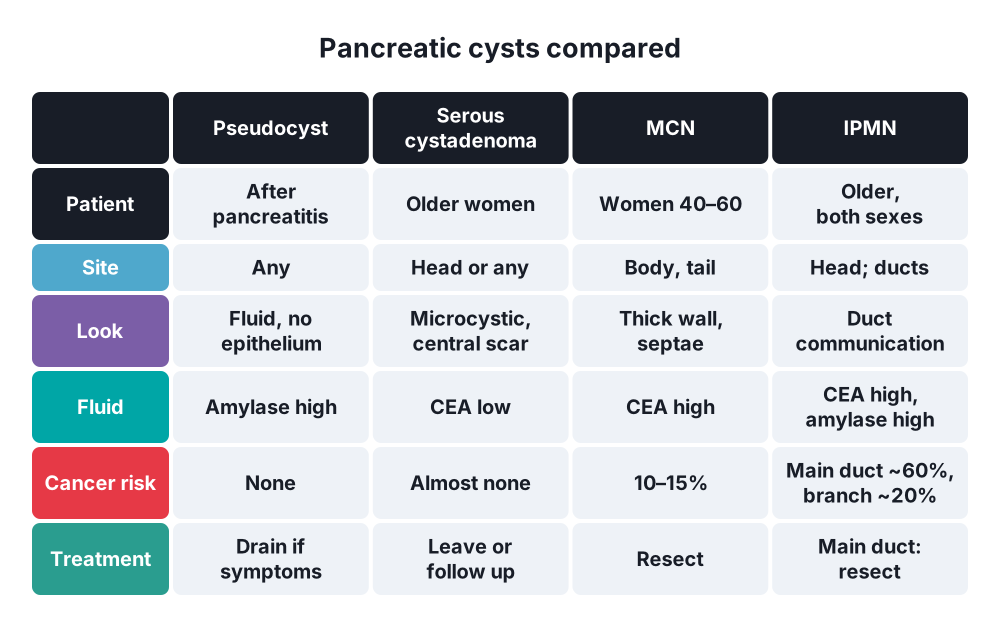
- Pseudocyst → collection of pancreatic fluid with a fibrous wall without epithelium, more than 4 weeks after pancreatitis
- Cystic neoplasms → cysts lined by epithelium: serous cystadenoma, mucinous cystic neoplasm (MCN), intraductal papillary mucinous neoplasm (IPMN), solid pseudopapillary neoplasm (SPN)
- True congenital cysts, retention cysts (rare)
- Pancreatic fistula → abnormal communication between the pancreatic duct and another surface:
- External → to the skin (after surgery, drains, trauma)
- Internal → to the peritoneum (pancreatic ascites), pleura (pancreatic pleural effusion), or bowel
2. Epidemiology
- Chronic pancreatitis → about 5–12 per 100,000 a year; men, age 40–50
- Alcohol → cause in about 50–70% in the West; smoking an independent and additive risk
- Pseudocysts → 10–20% of acute and 20–40% of chronic pancreatitis
- Pancreatic cystic lesions → found on 2–3% of CT and up to 20–45% of MRI scans (incidental, more with age)
- IPMN → most common cystic neoplasm (resected), older men and women
- MCN → almost always women (over 95%), body and tail, 40–60 years
- Serous cystadenoma → older women ("grandmother"), benign
- SPN → young women ("daughter"), low-grade malignant
- Postoperative pancreatic fistula → 10–30% after pancreaticoduodenectomy and distal pancreatectomy
3. Aetiology and risk factors
Chronic pancreatitis (TIGAR-O)
- Toxic-metabolic → alcohol, smoking, hypercalcaemia, hypertriglyceridaemia, chronic kidney disease
- Idiopathic → early or late onset, tropical pancreatitis (India, Africa)
- Genetic → PRSS1 (hereditary pancreatitis), SPINK1, CFTR (cystic fibrosis), CTRC
- Autoimmune → IgG4-related (type 1) and type 2 autoimmune pancreatitis
- Recurrent and severe acute pancreatitis
- Obstructive → pancreas divisum (debated), duct stricture after trauma or necrosis, tumours (IPMN, cancer), sphincter of Oddi stenosis
Pseudocyst
- Acute pancreatitis (interstitial), chronic pancreatitis, trauma, duct obstruction
Fistula
- After pancreatic surgery (soft gland, small duct)
- Drainage of necrosis or pseudocyst
- Trauma, duct disruption in pancreatitis
4. Pathogenesis
Chronic pancreatitis
- Repeated injury (alcohol, smoking) → acinar damage, protein plugs in ducts
- Plugs calcify → duct stones, strictures, duct dilatation ("chain of lakes")
- Pancreatic stellate cells activated → fibrosis
- Loss of acinar tissue → exocrine insufficiency (when over 90% is lost) → steatorrhoea
- Loss of islets → diabetes (type 3c; brittle, both insulin and glucagon lost)
- Pain → raised duct and tissue pressure, perineural inflammation, central sensitisation
- Inflammatory mass in the head (groove pancreatitis or head mass) → compresses the CBD, duodenum, portal and splenic veins
Pseudocyst
- Duct disruption → leak of pancreatic juice → walled off by granulation tissue and fibrosis over 4 weeks
- Many resolve when the duct heals; persist if the duct stays disrupted or blocked
Cystic neoplasms
- IPMN → mucin-producing papillary growth in the ducts; main duct type has high cancer risk (about 60%); branch duct type lower (about 20–25%)
- MCN → ovarian-type stroma; cancer risk 10–15%
- Serous cystadenoma → glycogen-rich cells, VHL-associated; almost never malignant
Fistula
- Disrupted duct + downstream obstruction → juice follows the path of least resistance
- Disconnected pancreatic duct syndrome → viable tail cut off from the head after necrosis → recurrent collections and fistulas
5. Classification
Chronic pancreatitis
- By cause → TIGAR-O
- By duct (Cambridge classification on imaging) → normal, equivocal, mild, moderate, marked (large cavities, stones, strictures, dilated duct)
- Large-duct (dilated over 7 mm; drainage operations help) or small-duct disease
- Calcifying, obstructive, autoimmune
Pseudocysts (D'Egidio)
- Type I → after acute pancreatitis, normal duct
- Type II → acute on chronic, abnormal duct, no stricture
- Type III → chronic pancreatitis with duct stricture (needs duct treatment)
Pancreatic cystic neoplasms
- IPMN → main duct, branch duct, mixed
- MCN, serous cystadenoma, SPN, cystic neuroendocrine tumour
Postoperative pancreatic fistula (ISGPS 2016)
- Definition → drain amylase over 3 times the serum upper limit on or after day 3, with a clinical effect
- Biochemical leak → no clinical effect (no longer called a fistula)
- Grade B → changes management: drain over 3 weeks, new drains, antibiotics, angioembolisation
- Grade C → reoperation, organ failure or death
6. Clinical picture
Symptoms
- Chronic pancreatitis:
- Pain (80–90%) → epigastric, radiating to the back, worse after food and alcohol; relieved by sitting forward; constant or in attacks
- Weight loss (fear of eating, malabsorption)
- Steatorrhoea → pale, bulky, oily, foul, floating stools
- Diabetes → thirst, polyuria
- Opioid dependence
- "Burnt-out" pancreas → pain may lessen as the gland fails
- Pseudocyst → persistent pain, early satiety, nausea and vomiting (gastric compression), epigastric mass, jaundice
- Cystic neoplasms → mostly incidental; pain, pancreatitis (IPMN), jaundice, weight loss and new diabetes suggest malignancy
- Fistula → clear watery, high-amylase drain fluid; skin excoriation; pancreatic ascites (painless swelling); breathlessness from a pleural effusion
Signs
- Thin, malnourished; erythema ab igne (from hot water bottles)
- Epigastric tenderness or mass (pseudocyst, inflammatory mass)
- Jaundice (CBD stricture)
- Ascites, pleural effusion (internal fistula)
- Splenomegaly, gastric varices (splenic vein thrombosis)
7. Diagnosis
Chronic pancreatitis
- Amylase and lipase → often normal
- Faecal elastase-1 → low (under 200 µg/g; severe under 100) → exocrine insufficiency
- HbA1c, glucose
- LFT (biliary stricture), fat-soluble vitamins (A, D, E, K), magnesium, bone density (osteoporosis)
- IgG4, calcium, triglycerides; genetic tests in young patients
- CT → calcification, duct dilatation, atrophy, pseudocysts, mass, vascular complications; first imaging test
- MRCP (secretin) → duct changes, strictures, "chain of lakes", side branch dilatation
- EUS → early disease (Rosemont criteria), biopsy of a mass
- Plain X-ray → pancreatic calcification (in 30%)
- Exclude cancer in any mass or stricture → CT, EUS-FNA, CA 19-9
Cysts
- CT or MRI with MRCP → size, wall, septa, communication with the duct, solid parts, duct dilatation
- EUS with FNA of cyst fluid:
- CEA over 192 ng/mL → mucinous (IPMN, MCN)
- Glucose low (under 50 mg/dL) → mucinous
- Amylase high → pseudocyst or IPMN (duct communication)
- Cytology, DNA (KRAS, GNAS for IPMN; VHL for serous)
- Worrying features and high-risk stigmata (Fukuoka 2017, European 2018):
- High-risk → obstructive jaundice with a cyst in the head, enhancing solid component ≥ 5 mm, main duct ≥ 10 mm, positive cytology
- Worrying → cyst ≥ 3 cm, thick enhancing wall, main duct 5–9 mm, enhancing mural nodule < 5 mm, duct calibre change with distal atrophy, lymph nodes, raised CA 19-9, growth ≥ 5 mm in 2 years, pancreatitis
Fistula
- Drain fluid amylase
- CT → collections; MRCP or ERCP → site of duct leak, disconnected duct, downstream stricture
- Ascitic or pleural fluid → amylase very high (often over 1,000 IU/L), protein over 30 g/L
8. Differential diagnosis
- Pancreatic cancer (mass-forming chronic pancreatitis looks the same; check CA 19-9, EUS biopsy)
- Peptic ulcer disease, biliary colic, mesenteric ischaemia
- Other malabsorption → coeliac disease, small bowel bacterial overgrowth
- Cysts → pseudocyst versus cystic neoplasm (no history of pancreatitis, septa, solid parts, duct communication suggest a neoplasm)
- Ascites of other causes (cirrhosis, malignancy)
9. Treatment
Conservative: chronic pancreatitis
- Stop alcohol and smoking (slows progression, helps pain)
- Pain → stepwise analgesia (paracetamol, NSAIDs, weak opioids; avoid strong opioids long term); pregabalin, tricyclics; pain clinic
- Exocrine insufficiency → pancreatic enzyme replacement (Creon) with meals, 25,000–50,000 lipase units with each meal; PPI if response is poor
- Diet → normal fat, small frequent meals; fat-soluble vitamins, calcium, vitamin D
- Diabetes → metformin, insulin (care with hypoglycaemia)
- Coeliac plexus block (EUS-guided) → short-term pain relief
- Endoscopic therapy:
- ERCP with stone extraction and duct stent for strictures
- ESWL (extracorporeal shock wave lithotripsy) for large duct stones in the head
- Biliary stent for CBD stricture (temporary; surgery often better long term)
- Autoimmune pancreatitis → steroids
- Surveillance → higher pancreatic cancer risk (especially hereditary pancreatitis)
Conservative: cysts and fistulas
- Pseudocyst → watch if asymptomatic, regardless of size; many resolve
- Cystic neoplasms:
- Serous cystadenoma → follow up or leave; resect only if symptomatic or large and growing
- Branch duct IPMN without worrying features → surveillance by MRI (6 months, then yearly depending on size); stop when unfit for surgery
- Fistula:
- Controlled external drainage; protect the skin (stoma bags)
- Nutrition → enteral preferred (nasojejunal), parenteral if needed
- Octreotide → may reduce output; no clear effect on closure
- Most low-output fistulas close in weeks if there is no downstream obstruction
- ERCP with sphincterotomy and stent across the leak or stricture
- Pancreatic ascites or pleural effusion → paracentesis or chest drain, nil by mouth, octreotide, ERCP stent
Surgical: chronic pancreatitis
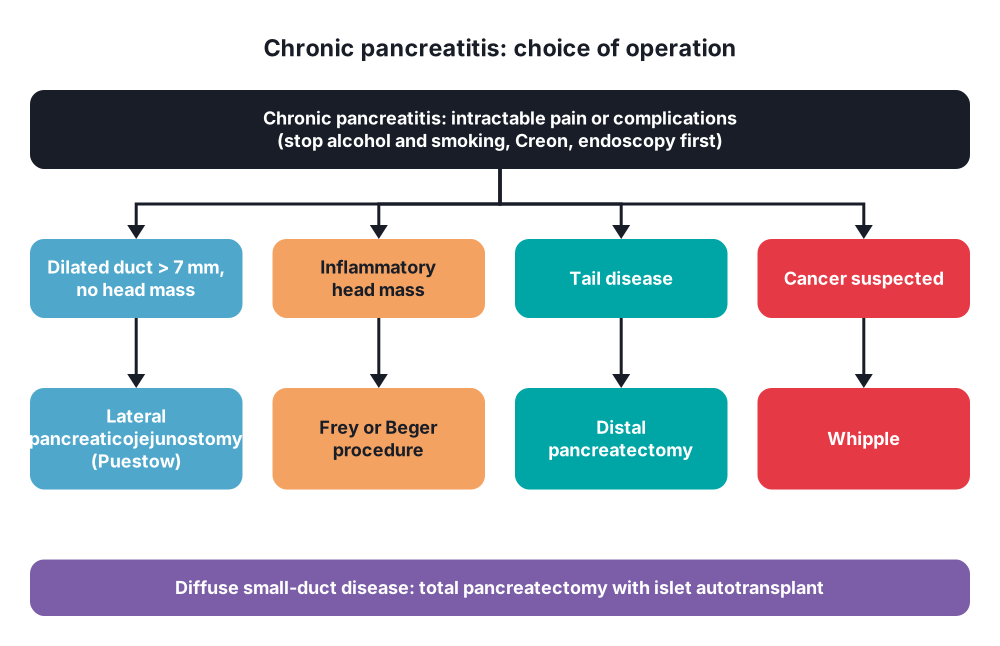
- Indications → intractable pain, suspicion of cancer, complications (CBD or duodenal obstruction, pseudocyst, bleeding)
- Earlier surgery gives better pain relief than prolonged endoscopy (ESCAPE trial)
- Drainage operation (dilated duct over 7 mm, no head mass):
- Lateral pancreaticojejunostomy (Partington-Rochelle modification of the Puestow procedure) → open the duct along its length, side-to-side Roux-en-Y pancreaticojejunostomy
- Resection (inflammatory head mass):
- Frey procedure → local coring of the head + lateral pancreaticojejunostomy
- Beger procedure → duodenum-preserving pancreatic head resection
- Berne modification → simpler head excavation
- Pancreaticoduodenectomy (Whipple) → if cancer is suspected
- Distal pancreatectomy → disease confined to the tail
- Total pancreatectomy with islet autotransplantation → diffuse small-duct disease, hereditary pancreatitis, failed other operations
- Thoracoscopic splanchnicectomy → pain relief in selected patients
- Biliary bypass (hepaticojejunostomy) for CBD stricture; gastrojejunostomy for duodenal obstruction
Surgical: cysts and fistulas
- Pseudocyst drainage → when symptomatic, infected, growing, bleeding or obstructing; wait at least 4–6 weeks for a mature wall:
- Endoscopic cystgastrostomy (EUS-guided, lumen-apposing metal stent) → first choice
- Endoscopic transpapillary stent if the cyst communicates with the duct
- Surgical internal drainage (laparoscopic or open) → cystgastrostomy (cyst behind the stomach), cystojejunostomy (Roux-en-Y), cystoduodenostomy
- Percutaneous drainage → infected cyst in an unfit patient (risk of external fistula)
- Biopsy the cyst wall at surgery to exclude a cystic neoplasm
- Never drain a cystic neoplasm as a pseudocyst
- Bleeding pseudoaneurysm → angioembolisation first
- Cystic neoplasms:
- MCN → resect (distal pancreatectomy, often laparoscopic) if over 4 cm or with worrying features; small ones may be watched
- Main duct IPMN (duct ≥ 10 mm) and high-risk stigmata → resection (Whipple, distal or total pancreatectomy); oncological resection with lymphadenectomy
- Branch duct IPMN with worrying features → EUS; resect in fit patients
- SPN → resect (curative in most)
- Fistula → surgery for failed conservative care, disconnected duct with recurrent collections (distal pancreatectomy or Roux-en-Y fistulojejunostomy), or uncontrolled sepsis; completion pancreatectomy rarely for grade C fistula after a Whipple
10. Complications
Chronic pancreatitis
- Pseudocyst, duct stricture and stones
- CBD stricture (obstructive jaundice), duodenal obstruction
- Splenic vein thrombosis → sinistral portal hypertension, gastric varices
- Pseudoaneurysm → bleeding into the duct (haemosuccus pancreaticus)
- Pancreatic ascites, pleural effusion, fistulas
- Exocrine insufficiency, diabetes, osteoporosis
- Pancreatic cancer (risk 13 times higher; up to 40% in hereditary pancreatitis)
- Opioid addiction, depression
Pseudocyst
- Infection (abscess), rupture (ascites, peritonitis)
- Bleeding (pseudoaneurysm into the cyst), obstruction (stomach, duodenum, CBD)
Treatment
- Drainage → bleeding, perforation, stent migration, infection, recurrence
- Resection → pancreatic fistula, delayed gastric emptying, diabetes, exocrine insufficiency
Show as a list
Chronic pancreatitis and cysts
- Causes
- Alcohol, smoking
- Genetic: PRSS1
- Autoimmune: IgG4
- Features
- Pain to back
- Steatorrhoea
- Diabetes
- Calcification
- Tests
- Faecal elastase
- CT, MRCP, EUS
- Exclude cancer
- Treatment
- Stop alcohol, smoking
- Creon
- ERCP, ESWL
- Puestow: dilated duct
- Frey, Beger: head mass
- Whipple if cancer
- Pseudocyst
- No epithelium
- > 4 weeks
- Watch if silent
- Endoscopic cystgastrostomy
- Cystic neoplasms
- Serous: benign
- MCN: women, resect
- IPMN: main duct resect
- SPN: young women
- Fistula
- Drain, nutrition
- ERCP stent
- Disconnected duct