47. Buerger's disease and Raynaud's disease
High yield
Smoking-linked inflammatory occlusion of small vessels in young men; cold-induced white, blue, red vasospasm of the fingers.
Exam Prep · State examSurgery · General surgery
1. Definition
- Buerger's disease (thromboangiitis obliterans) → non-atherosclerotic, segmental, inflammatory occlusive disease of small and medium arteries, veins and nerves of the limbs, strongly linked to tobacco
- Raynaud's phenomenon → episodic vasospasm of the digital arteries, provoked by cold or emotion, with colour changes of the fingers or toes
- Raynaud's disease (primary) → no underlying cause
- Raynaud's syndrome (secondary) → due to another disease (connective tissue disease, drugs, vibration)
2. Epidemiology
Buerger's disease
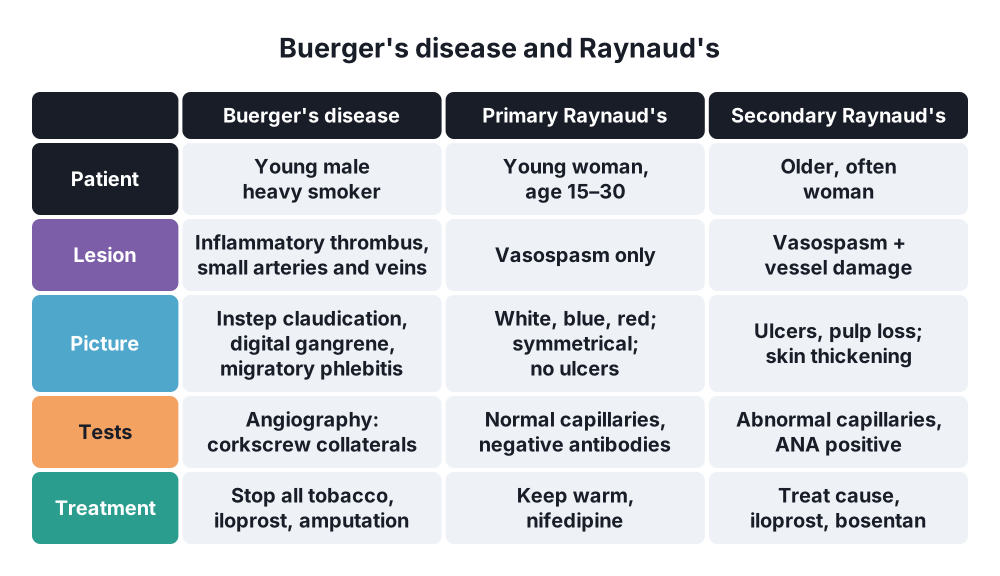
- Young men, age 20–45 years, heavy smokers; women more often now
- More common in the Middle East, Asia and Eastern Europe
Raynaud's
- Primary → 3–5% of the population; young women (female:male about 9:1); onset age 15–30; often family history
- Secondary → older; systemic sclerosis (> 90% have Raynaud's), SLE
3. Aetiology and risk factors
Buerger's disease
- Tobacco → essential; all forms (cigarettes, cigars, chewing tobacco, cannabis)
- Genetic susceptibility (HLA types)
- Immune reaction against vessel wall collagen
Raynaud's
- Primary → abnormal sympathetic control, raised α2-adrenergic sensitivity, low vasodilators (calcitonin gene-related peptide), high endothelin
- Secondary causes:
- Connective tissue disease → systemic sclerosis, SLE, rheumatoid arthritis, Sjögren's, dermatomyositis
- Vibration white finger → vibrating tools
- Drugs → β-blockers, ergotamine, chemotherapy, cocaine
- Arterial disease → Buerger's, atherosclerosis, thoracic outlet syndrome
- Blood → cryoglobulins, cold agglutinins, polycythaemia
- Hypothyroidism
4. Pathogenesis
Buerger's disease
- Acute phase → inflammatory thrombus with microabscesses and giant cells; vessel wall structure kept (unlike vasculitis)
- Subacute phase → thrombus organises, partial recanalisation
- Chronic phase → fibrosis around artery, vein and nerve together
- Starts distally (digital, plantar, tibial, radial and ulnar arteries) → spreads upwards
- Migratory superficial thrombophlebitis in about 40%
Raynaud's phenomenon
- Cold or stress → digital arteries spasm → white (pallor, ischaemia)
- Slow flow, deoxygenated blood → blue (cyanosis)
- Spasm relaxes → reactive hyperaemia → red (rubor), with pain and tingling
- Secondary → structural damage in the vessels → ulcers, pulp atrophy, gangrene
5. Classification
Buerger's disease: Shionoya criteria
- Smoking history
- Onset before age 50
- Infrapopliteal arterial occlusion
- Upper limb involvement or superficial migratory phlebitis
- No atherosclerotic risk factors other than smoking
- Stages → like PAD (Fontaine): claudication, rest pain, ulcers, gangrene
Raynaud's
- Primary (Raynaud's disease) → symmetrical, no ulcers, normal nailfold capillaries, negative antibodies, normal ESR
- Secondary (Raynaud's syndrome) → asymmetrical, older onset, ulcers, abnormal capillaries, positive antibodies
6. Clinical picture
Symptoms
- Buerger's:
- Instep (foot) claudication → arch of the foot, typical
- Rest pain in fingers and toes
- Cold sensitivity, Raynaud's phenomenon (about 40%)
- Painful ulcers and gangrene of the digits
- Painful red cords → migratory thrombophlebitis
- Raynaud's:
- Attacks of white, then blue, then red fingers on cold exposure
- Numbness, pain, tingling on rewarming
- Thumb often spared in primary disease
- Secondary → digital ulcers, skin thickening, joint pain, dry eyes
Signs
- Buerger's:
- Absent foot and wrist pulses with normal femoral and popliteal pulses
- Positive Allen's test → ulnar or radial artery occluded
- Ulcers, gangrene of fingertips and toes
- Raynaud's:
- Between attacks often normal
- Sclerodactyly, calcinosis, telangiectasia (systemic sclerosis)
- Pitted scars, pulp atrophy
7. Diagnosis
Buerger's disease
- Diagnosis of exclusion → no diabetes, hyperlipidaemia, embolic source or autoimmune disease
- Tests → glucose, lipids, autoantibodies, thrombophilia screen, echocardiography
- Angiography of all four limbs:
- Segmental occlusion of small and medium distal arteries
- "Corkscrew" collaterals
- Normal proximal arteries, no atheroma
- Biopsy → rarely; acute lesion shows inflammatory thrombus
Raynaud's
- Clinical → Allen and Brown criteria for primary disease: attacks by cold or emotion, both hands, no gangrene, no other cause, for at least 2 years
- Nailfold capillaroscopy → dilated, lost capillaries in secondary disease
- Bloods → FBC, ESR, CRP, antinuclear antibodies (ANA), anti-centromere, anti-Scl-70, rheumatoid factor, thyroid function, cryoglobulins
- Digital pressures after cooling, cold provocation test
- Duplex or CT angiography → thoracic outlet, proximal disease
8. Differential diagnosis
- Atherosclerosis (older, risk factors)
- Embolism (heart, thoracic outlet, aneurysm)
- Vasculitis → Takayasu's, polyarteritis nodosa, scleroderma
- Diabetic microangiopathy
- Ergotism
- Acrocyanosis, chilblains (perniosis)
- Thoracic outlet syndrome
9. Treatment
Conservative
- Buerger's:
- Complete stop of all tobacco → the only treatment proven to halt the disease; amputation risk falls sharply if they stop
- Nicotine replacement must also stop
- Foot care, protect from cold and injury
- Iloprost (prostacyclin) infusion → ulcer healing, rest pain
- Analgesia, antiplatelet, calcium-channel blockers
- Treat ulcer infection
- Raynaud's:
- Keep warm → gloves, heated gloves and socks
- Stop smoking; avoid β-blockers and vibrating tools
- Calcium-channel blockers → nifedipine first-line; amlodipine, diltiazem
- Others → losartan, fluoxetine, sildenafil, topical nitrates
- Severe or ulcers → IV iloprost; bosentan to prevent new ulcers in systemic sclerosis
- Treat the underlying disease
Surgical
- Buerger's:
- Bypass rarely possible (distal disease, no target); poor patency
- Sympathectomy → lumbar for feet, thoracoscopic for hands; may help ulcer healing and pain
- Omentoplasty, spinal cord stimulation → selected patients
- Amputation → digits, minor first; major amputation if they keep smoking
- Raynaud's:
- Thoracoscopic (T2–T3) sympathectomy → short-term relief; recurrence common
- Digital (periarterial) sympathectomy, botulinum toxin injection
- Debridement or digit amputation for gangrene
10. Complications
- Buerger's → digital gangrene, amputation (about 25% of those who keep smoking), chronic pain, disability
- Raynaud's → digital ulcers, infection, pulp loss, gangrene (secondary form)
- Sympathectomy → Horner's syndrome, compensatory sweating, pneumothorax, neuralgia
Show as a list
Buerger's and Raynaud's
- Buerger's
- Young male smoker
- Small arteries, veins, nerves
- Inflammatory thrombus
- Instep claudication
- Corkscrew collaterals
- Stop tobacco
- Iloprost, sympathectomy
- Amputation
- Raynaud's
- Primary: young women
- Secondary: scleroderma
- White, blue, red
- Capillaroscopy
- Keep warm
- Nifedipine
- Iloprost
- Sympathectomy