10. Blood transfusion and blood groups
High yield
ABO and Rh groups decide compatibility; group, screen, crossmatch and bedside checks before transfusion; haemolysis is the worst complication.
Exam Prep · State examSurgery · General surgery
1. Definition
- Blood transfusion → transfer of blood or blood components from a donor to a recipient
- Modern practice → component therapy, not whole blood
- Autologous transfusion → patient's own blood (predeposit, cell salvage)
2. Blood group doctrine
ABO system
- Discovered by Landsteiner (1901)
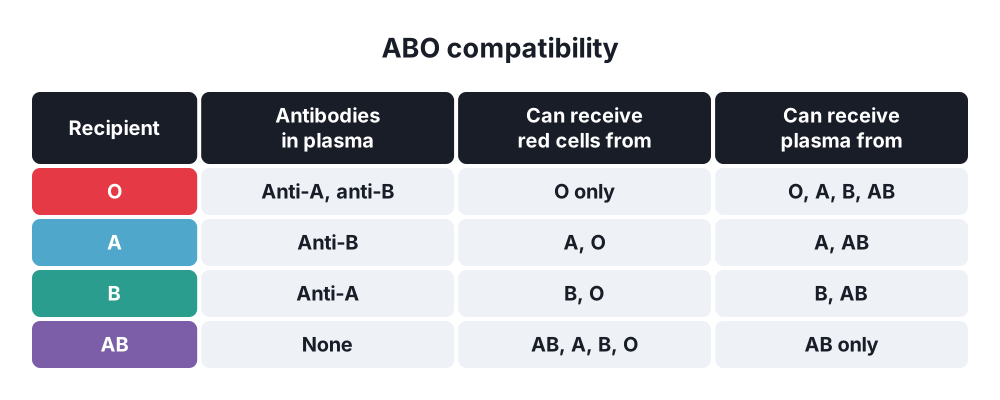
- Antigens (A, B) on red cells; antibodies (anti-A, anti-B, IgM) in plasma
- Antibodies are naturally occurring → present without prior exposure
- Groups:
- O → no antigens; anti-A and anti-B; universal red cell donor
- A → A antigen; anti-B
- B → B antigen; anti-A
- AB → A and B antigens; no antibodies; universal plasma donor, universal red cell recipient
- Plasma compatibility is the reverse of red cell compatibility
Rhesus (Rh) system
- Main antigen → D
- Rh positive → 85% of people
- No natural anti-D → formed after exposure (transfusion, pregnancy)
- Rh-negative woman with Rh-positive fetus → haemolytic disease of the newborn; prevented by anti-D immunoglobulin
Other systems
- Kell, Duffy, Kidd, MNS → irregular antibodies after previous transfusion or pregnancy
3. Indications
- Acute blood loss → class III–IV haemorrhage
- Anaemia → restrictive threshold:
- Haemoglobin < 70 g/L in most patients
- < 80 g/L with cardiovascular disease
- Massive transfusion → trauma, obstetric, surgical bleeding
- Components:
- Red cells → anaemia, blood loss
- Platelets → thrombocytopenia with bleeding or before surgery
- Fresh frozen plasma (FFP) → coagulation factor deficiency
- Cryoprecipitate → fibrinogen < 1.5 g/L
4. Compatibility tests
- ABO and Rh grouping of recipient and donor
- Forward grouping → patient's red cells with anti-A, anti-B, anti-D reagents
- Reverse grouping → patient's plasma with known A and B cells
- Antibody screen → irregular antibodies in recipient plasma
- Crossmatch → recipient serum with donor red cells
- Saline (immediate spin) at room temperature → ABO incompatibility
- Indirect antiglobulin (Coombs) test at 37 °C → IgG antibodies
- Electronic crossmatch → when grouping and screen are valid
- Bedside ABO check → recipient's blood with anti-A and anti-B at the bedside
- Biological test → 3 × 10–20 mL given with 3-minute pauses, watching for reaction (traditional in Eastern European practice)
- Emergency without time for crossmatch → O negative red cells (O positive in men and older women)
5. Rules and technique of transfusion
- Written consent where possible
- Pre-transfusion sample → labelled at the bedside
- Positive patient identification at every step → name, date of birth, hospital number
- Check the bag:
- Group and number match the compatibility label
- Expiry date
- Integrity, no clots or discolouration
- Giving set with a 170–200 µm filter
- Red cells → start within 30 min of leaving storage, complete within 4 h
- Platelets → stored at 22 °C; do not refrigerate
- No drugs or solutions other than 0.9% saline in the same line
- Observations → before start, at 15 min, at the end
- Watch the patient closely in the first 15 min
- Document the transfusion
6. Complications
Acute (< 24 h)
- Acute haemolytic reaction → ABO incompatibility, mostly identification error
- Fever, rigors, loin and chest pain, hypotension, haemoglobinuria
- Disseminated intravascular coagulation (DIC), acute kidney injury
- Febrile non-haemolytic reaction → most common; cytokines, leucocyte antibodies
- Allergic reaction → urticaria, itch
- Anaphylaxis → IgA deficiency with anti-IgA antibodies
- Transfusion-related acute lung injury (TRALI) → non-cardiogenic pulmonary oedema within 6 h
- Transfusion-associated circulatory overload (TACO) → elderly, heart failure
- Bacterial contamination → platelets most often; septic shock
- Air embolism
Delayed (> 24 h)
- Delayed haemolytic reaction → 5–10 days, irregular antibodies (Kidd)
- Transfusion-associated graft-versus-host disease → prevented by irradiated products
- Post-transfusion purpura
- Iron overload → repeated transfusions
- Infections → hepatitis B and C, human immunodeficiency virus (HIV), syphilis, cytomegalovirus
Massive transfusion
- Definition → > 10 units of red cells in 24 h, or replacement of 1 blood volume
- Complications:
- Hypothermia
- Hypocalcaemia → citrate binds calcium
- Hyperkalaemia
- Dilutional coagulopathy, thrombocytopenia
- Acidosis
Management of a reaction
- Stop the transfusion immediately; keep the line open with saline
- Check patient identity and the bag label
- ABCDE assessment, oxygen, fluids
- Adrenaline for anaphylaxis
- Return the bag; send blood for direct antiglobulin test, repeat group, full blood count, clotting, urine for haemoglobin
- Inform the blood bank
Show as a list
Blood transfusion
- ABO system
- O, A, B, AB
- Natural antibodies
- Rh system
- D antigen
- Anti-D after exposure
- Compatibility tests
- Grouping
- Antibody screen
- Crossmatch
- Bedside check
- Biological test
- Technique
- Identity check
- Filter giving set
- Within 4 h
- Complications
- Haemolytic
- Febrile, allergic
- TRALI, TACO
- Infections
- Massive transfusion