
11. Blood products and blood substitutes
High yield
Red cells, platelets, plasma and cryoprecipitate replace specific deficits; crystalloids and colloids restore volume.
Exam Prep · State examSurgery · General surgery
1. Definition
- Blood components → parts of donated whole blood separated by centrifugation
- Blood products (plasma derivatives) → industrially fractionated from pooled plasma
- Blood substitutes → solutions that replace volume or carry oxygen without donor blood
- Principle → give only the component the patient lacks
2. Classification
A. Cellular components
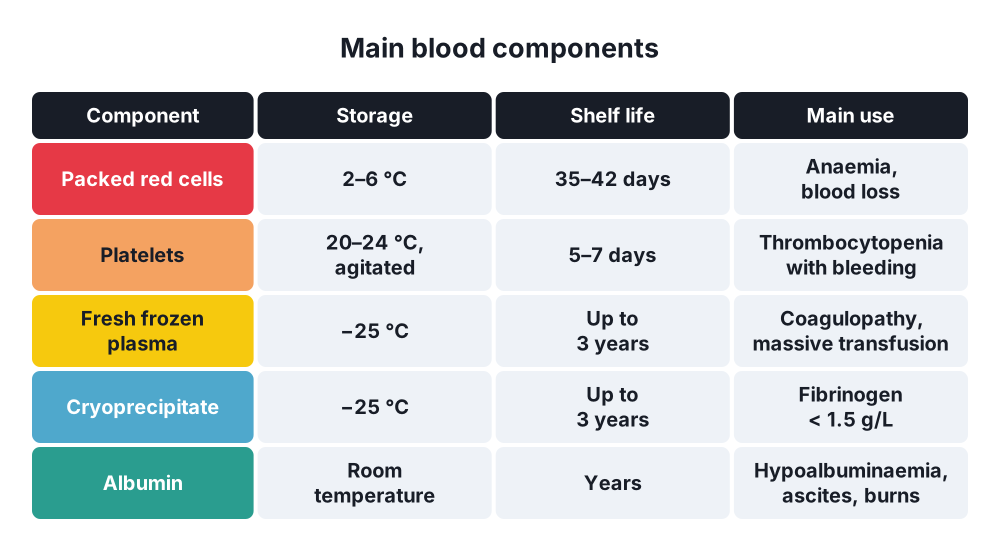
- Packed red cells → anaemia, acute blood loss
- Volume about 280 mL; haematocrit 0.55–0.65
- Stored at 2–6 °C for up to 35–42 days
- 1 unit → raises haemoglobin by about 10 g/L in an adult
- Leucocyte-depleted red cells → fewer febrile reactions, less cytomegalovirus transmission
- Washed red cells → IgA deficiency, recurrent allergic reactions
- Irradiated components → prevent transfusion-associated graft-versus-host disease (immunosuppressed, Hodgkin's lymphoma, intrauterine transfusion)
- Platelets → thrombocytopenia, platelet dysfunction
- Stored at 20–24 °C with agitation for 5–7 days
- Highest risk of bacterial contamination
- Thresholds: bleeding < 50 × 10^9/L; prophylaxis < 10 × 10^9/L; neurosurgery < 100 × 10^9/L
- Granulocytes → rarely; neutropenic sepsis
B. Plasma components
- Fresh frozen plasma (FFP) → all coagulation factors
- Frozen within hours of donation, stored at −25 °C
- Dose → 12–15 mL/kg
- Indications → coagulopathy with bleeding, massive transfusion, disseminated intravascular coagulation (DIC)
- Must be ABO compatible
- Cryoprecipitate → fibrinogen, factor VIII, von Willebrand factor, factor XIII
- Indication → fibrinogen < 1.5 g/L with bleeding
C. Plasma derivatives
- Albumin 4.5% and 20% → hypoalbuminaemia, paracentesis of ascites, burns
- Prothrombin complex concentrate (PCC) → factors II, VII, IX, X; urgent warfarin reversal
- Factor VIII and IX concentrates → haemophilia A and B
- Fibrinogen concentrate
- Recombinant factor VIIa → life-threatening bleeding resistant to other treatment
- Immunoglobulins → anti-D, hepatitis B, tetanus, rabies, intravenous immunoglobulin
D. Blood substitutes: volume replacement
- Crystalloids → first choice for resuscitation
- 0.9% sodium chloride → hyperchloraemic acidosis in large volumes
- Balanced solutions → Hartmann's (Ringer's lactate), Plasma-Lyte
- 5% glucose → maintenance water; not for resuscitation
- Only about 25% stays in the circulation
- Colloids → stay longer in the circulation
- Albumin
- Gelatins (Gelofusine) → anaphylaxis risk
- Dextrans → impair platelets, anaphylaxis
- Hydroxyethyl starch → kidney injury, coagulopathy; avoided in sepsis and critical illness
- Hypertonic saline → head injury, small volume resuscitation
E. Oxygen-carrying substitutes
- Haemoglobin-based oxygen carriers
- Perfluorocarbons
- Experimental, not in routine use
3. Alternatives to donor blood
- Preoperative anaemia correction → oral or intravenous iron
- Intraoperative cell salvage → shed blood washed and returned; not in bowel contamination or malignancy (relative)
- Acute normovolaemic haemodilution
- Preoperative autologous donation
- Tranexamic acid
- Erythropoietin
- Patient blood management → restrictive transfusion thresholds
4. Clinical and surgical significance
- Massive haemorrhage protocol → red cells, FFP and platelets in ratio about 1:1:1
- Add cryoprecipitate when fibrinogen < 1.5 g/L
- Give calcium → citrate in products binds calcium
- Jehovah's Witnesses → refuse whole blood and main components; may accept cell salvage, albumin, some factor concentrates
Show as a list
Blood products and substitutes
- Cellular
- Packed red cells
- Platelets
- Irradiated, washed
- Plasma
- Fresh frozen plasma
- Cryoprecipitate
- Derivatives
- Albumin
- PCC
- Factor concentrates
- Immunoglobulins
- Volume substitutes
- Crystalloids
- Colloids
- Alternatives
- Cell salvage
- Iron, tranexamic acid