81. Appendicitis in children, the elderly and pregnancy
High yield
Young children and older patients present late and perforate more; in pregnancy the appendix moves up and MRI helps.
Exam Prep · State examSurgery · General surgerySurgery · Emergency and trauma
1. Definition
- Atypical appendicitis → acute appendicitis whose picture differs from the classic adult case because of age, pregnancy, position of the appendix or other disease
- Groups that need special care:
- Infants and young children (under 5 years)
- Older children and adolescents
- Older adults (over 65)
- Pregnant women
- Others → immunosuppressed (HIV, transplant, chemotherapy), obese, diabetic, patients on steroids
- Classic adult appendicitis → see question 80
2. Epidemiology
Children
- Most common surgical emergency in childhood
- Peak 10–15 years; rare under 2 years (under 2% of cases)
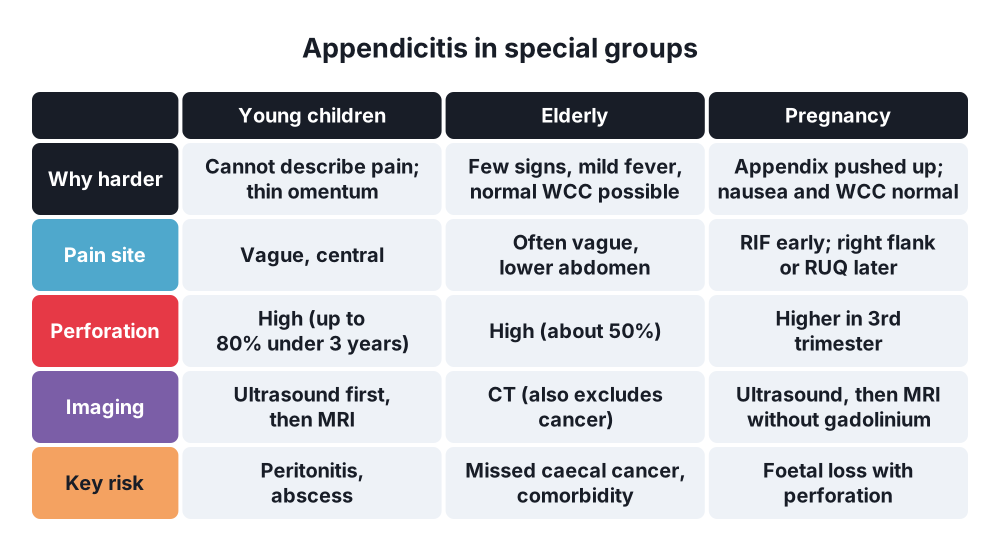
- Perforation → about 30% in children; 80–100% under 2 years, 50–70% under 5 years (late diagnosis, thin omentum)
- Negative appendicectomy → higher in girls approaching puberty
Older adults
- About 5–10% of cases are over 60–65 years; rising with an ageing population
- Perforation in 50–70% (vs 20–30% in younger adults)
- Mortality up to 4–8% (under 0.5% in young adults); appendicitis is the third commonest cause of emergency abdominal surgery in the elderly
- Appendiceal tumours found in up to 3–5% of specimens over 40–50
Pregnancy
- Most common non-obstetric surgical emergency in pregnancy → about 1 in 800–1,500 pregnancies
- Equal in all trimesters; slightly more in the second trimester
- Typical presentation in only 50–60%
- Foetal loss → about 2–3% uncomplicated, up to 20–35% with perforation; preterm labour 5–15%
3. Aetiology and risk factors
- Same basic cause → obstruction of the lumen (lymphoid hyperplasia in children, faecolith in adults, tumour or faecolith in the elderly)
Why children perforate early
- Thin appendix wall, small lumen
- Omentum is short and thin → cannot wall off the inflammation → generalised peritonitis rather than a mass
- Cannot describe symptoms; non-specific signs (vomiting, irritability)
- Wide differential (gastroenteritis, mesenteric adenitis, pneumonia) → delay
- Lymphoid hyperplasia after viral infections
Why older patients perforate
- Atherosclerosis → poor blood supply → early gangrene and perforation
- Blunted immune and fever response; fewer symptoms
- Late presentation, delayed diagnosis, comorbidities, drugs (steroids, NSAIDs, beta-blockers mask tachycardia)
- Narrowed lumen (fibrosis), tumours (adenocarcinoma, mucinous neoplasm) as the obstructing cause
Why pregnancy is difficult
- Enlarging uterus pushes the appendix and caecum upwards and outwards → pain higher, in the right flank or right upper quadrant in late pregnancy (Baer's shift; seen on imaging in some, debated)
- Abdominal wall is stretched and lifted off the appendix → less guarding and rebound
- Normal pregnancy causes nausea, vomiting, anorexia, leucocytosis (up to 15–16 × 10⁹/L) → signs lose value
- Uterus keeps the omentum away → peritonitis spreads more easily
- Fear of radiation and anaesthesia → delay
4. Pathogenesis
- Same sequence → obstruction, raised pressure, bacterial overgrowth, ischaemia, gangrene, perforation
- Faster in children and the elderly (thin wall, poor blood supply)
- Perforation leads to:
- Children → diffuse peritonitis (no omental wall), dehydration, sepsis
- Elderly → appendix mass or abscess, sepsis, mimicking caecal cancer
- Pregnancy → peritonitis, uterine irritability, preterm labour, foetal hypoxia and loss
- Pylephlebitis and liver abscess more likely after delayed diagnosis
5. Classification
- By group → infant, child, adolescent, adult, elderly, pregnant (by trimester), immunocompromised
- By pathology → uncomplicated or complicated (gangrene, perforation, abscess, mass, peritonitis)
- By position → retrocaecal, pelvic, subcaecal, pre-ileal, post-ileal; in pregnancy, shifted cranially
Scores used in special groups
- Paediatric Appendicitis Score (PAS) (out of 10):
- Cough, percussion or hopping tenderness (2)
- Anorexia (1)
- Fever over 38 °C (1)
- Nausea or vomiting (1)
- Tenderness in the RIF (2)
- WCC over 10 × 10⁹/L (1)
- Neutrophilia (1)
- Migration of pain (1)
- ≤ 3 low risk; 4–6 imaging; ≥ 7 high risk
- Alvarado → less accurate in children, the elderly and pregnancy
- AIR score and Adult Appendicitis Score → better at ruling out in adults and older patients
6. Clinical picture
Infants and young children (under 5)
- Symptoms vague → irritability, lethargy, poor feeding, vomiting (often the first sign), fever
- Diarrhoea (pelvic appendix, or peritonitis) → misdiagnosed as gastroenteritis
- Child lies still, hip flexed; limping or refusing to walk
- Abdominal distension, diffuse tenderness and guarding → often already perforated
- Grunting, tachypnoea (looks like pneumonia)
Older children and adolescents
- Classic picture in most → periumbilical pain moving to the RIF, anorexia, vomiting
- Hop test → pain on hopping on the right leg; pain on jumping or coughing
- Fever higher than in adults; examine gently, distract the child, examine on the parent's lap
- Girls → ovarian torsion and cysts are important differentials
Older adults
- Pain milder and less localised; may present late with abdominal distension, obstruction, confusion or a mass
- Fever and leucocytosis may be absent (in up to 30%)
- Anorexia often absent
- Signs reduced; RIF mass (abscess or tumour)
- May present as small bowel obstruction (inflamed appendix stuck to ileum)
- Falls, confusion, sepsis of unknown cause
Pregnancy
- First trimester → like non-pregnant; RIF pain, McBurney tenderness
- Second and third trimesters → pain and tenderness higher: right flank, right upper quadrant, near the umbilicus or in the back
- Nausea and vomiting (confused with pregnancy sickness or hyperemesis)
- Tenderness less marked; guarding and rebound often absent
- Alder's sign → tenderness that stays the same when the patient rolls onto her left side suggests appendicitis (extra-uterine); tenderness that moves with the uterus suggests a uterine cause
- Uterine contractions, preterm labour signs
- Fever, tachycardia (note normal pregnancy raises heart rate by 10–15/min)
Immunosuppressed
- Few signs; may present with sepsis or neutropenic enterocolitis (typhlitis)
7. Diagnosis
Blood and urine tests
- WCC and CRP → normal values make appendicitis less likely in children; less reliable in pregnancy (physiological leucocytosis) and in the elderly
- Urinalysis (urine infection is a common mimic, but pyuria occurs in appendicitis)
- Pregnancy test in every girl after menarche and every woman of childbearing age
- U&E (dehydration in children), lactate, blood cultures if septic
Imaging
- Children:
- Ultrasound first (no radiation): non-compressible appendix over 6 mm, appendicolith, free fluid, hyperaemia; ovaries in girls
- MRI (fast, no contrast) where available if ultrasound is not diagnostic
- CT only if needed (low-dose protocol; radiation and cancer risk)
- Low-risk PAS → observe and re-examine (active observation reduces negative appendicectomies)
- Older adults:
- CT with IV contrast in almost all → confirms appendicitis, perforation, abscess; excludes caecal cancer, diverticulitis, mesenteric ischaemia, AAA
- Check renal function (contrast)
- Pregnancy:
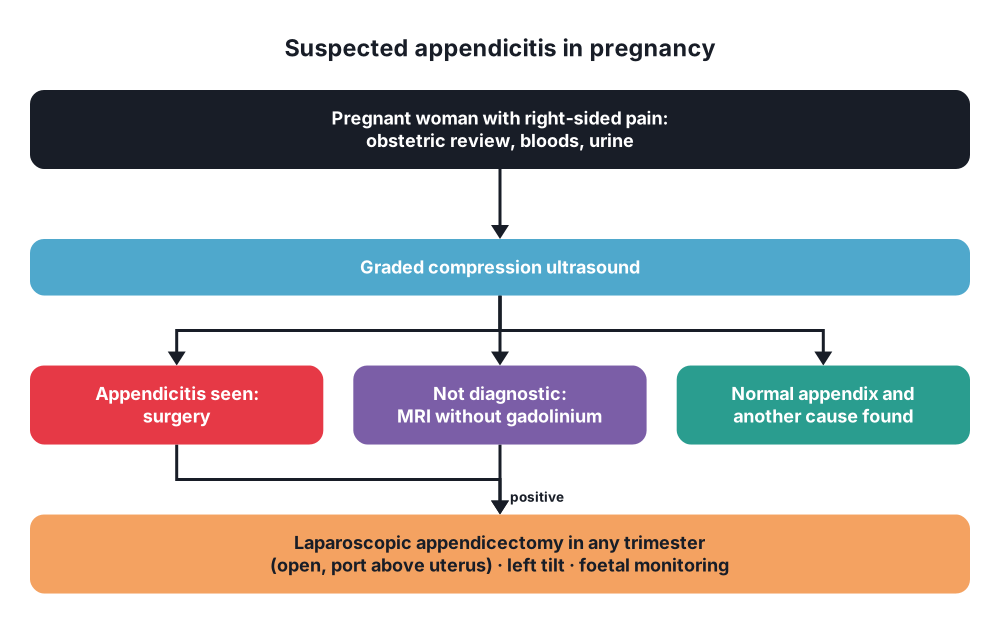
- Graded compression ultrasound first (appendix seen in only 50% in later pregnancy; also checks the foetus, placenta, ovaries)
- MRI without gadolinium → second line when ultrasound is not diagnostic; sensitivity and specificity over 90%; safe in all trimesters
- Low-dose CT → if MRI is not available and the diagnosis is still uncertain (foetal dose under 50 mGy carries no proven harm; benefit outweighs risk)
- Cardiotocography (CTG) and obstetric review → foetal wellbeing
- Diagnostic laparoscopy → when doubt remains in any group (including pregnancy)
8. Differential diagnosis
Children
- Gastroenteritis (diarrhoea and vomiting before pain)
- Mesenteric adenitis (recent upper respiratory infection, high fever, enlarged nodes)
- Intussusception (6 months to 2 years; colicky pain, redcurrant jelly stool)
- Meckel's diverticulitis
- Constipation, urinary infection, right lower lobe pneumonia
- Henoch-Schönlein purpura, diabetic ketoacidosis, sickle cell crisis
- Testicular torsion (examine the testes); in girls ovarian torsion and cysts
Older adults
- Caecal or right colon cancer (perforated or obstructing)
- Diverticulitis (right-sided or redundant sigmoid in the right iliac fossa)
- Mesenteric ischaemia
- Leaking abdominal aortic aneurysm
- Bowel obstruction, perforated peptic ulcer, cholecystitis
- Ureteric colic, pyelonephritis, urinary retention
Pregnancy
- Obstetric → ectopic pregnancy (first trimester), placental abruption, preterm labour, chorioamnionitis, round ligament pain, HELLP syndrome
- Gynaecological → ovarian torsion or cyst rupture, degenerating fibroid (red degeneration)
- Urological → pyelonephritis (common in pregnancy), ureteric stone
- Surgical → cholecystitis (RUQ pain in late pregnancy), pancreatitis, bowel obstruction
9. Treatment
Conservative
- All groups → IV fluids, analgesia, antiemetics, nil by mouth, antibiotics (preoperative single dose; continue 3–5 days if complicated)
- Children:
- Correct dehydration first (weight-based fluids), check glucose
- Uncomplicated appendicitis → antibiotics alone is possible in selected children (about 70% avoid surgery at 1 year; failure higher with appendicolith); surgery remains standard in most centres
- Appendix mass or abscess → antibiotics ± percutaneous drainage; interval appendicectomy is debated in children (recurrence 10–20%)
- Low-risk → active observation with repeat examination after 6–12 hours
- Older adults:
- Antibiotics alone → not advised (higher rate of complicated disease and hidden tumours); possible in the very frail with uncomplicated disease
- Appendix mass → conservative care, then colonoscopy and CT to exclude cancer (about 10–17% of masses over 40 hide a neoplasm); interval appendicectomy in selected patients
- Optimise comorbidities; careful fluid balance; VTE prophylaxis
- Pregnancy:
- Non-operative management is not recommended (higher failure, peritonitis and foetal loss)
- Left lateral tilt (relieves IVC compression after 20 weeks)
- Obstetric team involved; foetal monitoring before and after surgery
- Tocolytics only if preterm labour starts (not routinely)
- Corticosteroids for foetal lung maturity if 24–34 weeks and early delivery is possible
- Antibiotics safe in pregnancy → cefuroxime with metronidazole, or co-amoxiclav (avoid tetracyclines, quinolones)
- VTE prophylaxis (pregnancy is prothrombotic)
Surgical
- Children:
- Laparoscopic appendicectomy → standard; small ports (3–5 mm); single-incision options
- Open → Lanz incision
- Perforated → washout of pus, consider drain for abscess; no routine drain
- Older adults:
- Early laparoscopic appendicectomy → safe, less pain, faster mobilisation
- Look at the caecum; if a tumour is suspected → right hemicolectomy (oncological)
- Histology of every specimen (neuroendocrine tumour, adenocarcinoma, mucinous neoplasm)
- Pregnancy:
- Surgery without delay once the diagnosis is likely → negative appendicectomy is safer than perforation
- Laparoscopic appendicectomy → safe in all trimesters (SAGES, WSES guidelines):
- Left lateral tilt (15–30°)
- Open (Hasson) entry, or Veress/optical entry well above the uterus; first port placed above the fundus (subcostal or Palmer's point in late pregnancy)
- Low pressure pneumoperitoneum → 10–15 mmHg
- Monitor end-tidal CO₂ (avoid foetal acidosis)
- Minimal handling of the uterus
- Ports placed according to fundal height
- Open appendicectomy → incision over the point of maximum tenderness (shifted upward in late pregnancy), or a lower midline for diffuse peritonitis
- Caesarean section at the same time → only for obstetric reasons (term, foetal distress)
- Foetal heart monitoring before and after surgery
- Immunosuppressed → early surgery; broader antibiotics
10. Complications
Children
- Perforation and peritonitis, intra-abdominal (pelvic) abscess
- Wound infection, adhesive obstruction
- Later tubal infertility in girls after perforation (debated; small effect)
Older adults
- Perforation, abscess, sepsis, high mortality
- Cardiopulmonary complications (pneumonia, myocardial infarction), delirium, VTE
- Missed caecal cancer
Pregnancy
- Foetal loss (higher with perforation and with surgery in the first trimester)
- Preterm labour and delivery (most in the first week after surgery)
- Maternal sepsis, peritonitis, wound infection
- Uterine injury (laparoscopic ports)
- Maternal death (rare, mostly after delayed diagnosis)
Show as a list
Appendicitis: special groups
- Children
- Under 5: perforation 50-100%
- Short omentum
- Vomiting, irritable
- PAS score
- Ultrasound first
- Laparoscopy
- Elderly
- Mild signs
- No fever in 30%
- Perforation 50-70%
- CT with contrast
- Caecal cancer
- Colonoscopy after mass
- Pregnancy
- Commonest non-obstetric emergency
- Appendix moves up
- Alder's sign
- Ultrasound, then MRI
- Operate early
- Laparoscopy all trimesters
- Left tilt, 10-15 mmHg
- Risks
- Foetal loss with perforation
- Preterm labour
- High elderly mortality