44. Achalasia
High yield
Lower sphincter fails to relax; manometry confirms it; dilatation, Heller myotomy or POEM relieve it.
Exam Prep · State examSurgery · Upper GISurgery · General surgeryAnatomy · Thorax
1. Definition
- Achalasia → primary oesophageal motility disorder with failure of the lower oesophageal sphincter (LOS) to relax on swallowing and loss of peristalsis in the oesophageal body
- Pseudoachalasia → same picture caused by a tumour at the cardia
2. Epidemiology
- Incidence about 1 per 100,000 a year
- Men and women equally
- Mean age at diagnosis about 50 years; peaks at 30 and 60 years
- Chagas disease → common cause in South America
3. Aetiology and risk factors
- Primary → cause unknown:
- Autoimmune reaction, possibly after a viral infection (herpes, varicella-zoster)
- Genetic susceptibility (HLA types), Down's syndrome, Allgrove syndrome
- Secondary:
- Chagas disease → Trypanosoma cruzi destroys ganglion cells (also megacolon, cardiomyopathy)
- Pseudoachalasia → cancer of the cardia, lymphoma, paraneoplastic (small cell lung cancer)
- After fundoplication or gastric banding
4. Pathogenesis
- Inflammation and loss of inhibitory neurons in the myenteric (Auerbach's) plexus
- These neurons release nitric oxide and vasoactive intestinal peptide → needed for LOS relaxation and peristalsis
- Excitatory (acetylcholine) neurons are spared → LOS stays closed, often hypertensive
- No peristalsis → food and fluid stay in the oesophagus
- Oesophagus dilates and lengthens → megaoesophagus, sigmoid oesophagus
- Stasis → oesophagitis → higher risk of squamous cell carcinoma
5. Classification
High-resolution manometry (Chicago classification v4.0)
- Diagnosis → raised integrated relaxation pressure (IRP) plus absent peristalsis
- Type I (classic) → no pressure in the oesophageal body; dilated oesophagus
- Type II → pan-oesophageal pressurisation; best response to any treatment
- Type III (spastic) → premature spastic contractions; best treated by a long myotomy (POEM)
Radiological stage (by oesophageal diameter)
- I < 4 cm, II 4–6 cm, III > 6 cm, IV sigmoid oesophagus
Related motility disorders
- Diffuse oesophageal spasm → premature (simultaneous) contractions; chest pain and dysphagia; "corkscrew" oesophagus on barium
- Hypercontractile ("jackhammer") oesophagus
- Oesophagogastric junction outflow obstruction
6. Clinical picture
Symptoms
- Dysphagia to both solids and liquids from the start (fluids can be worse early) → typical of a motility disorder
- Regurgitation of undigested food, often at night
- Chest pain (more in type III)
- Weight loss
- Heartburn → from fermenting food, not reflux; many are wrongly treated with PPIs first
- Nocturnal cough, aspiration pneumonia
- Patients eat slowly, drink to wash food down, stretch or stand to swallow
Signs
- Often normal
- Weight loss, malnutrition
- Signs of aspiration in the chest
- Eckardt score → dysphagia, regurgitation, chest pain, weight loss (0–12); used to judge response
7. Diagnosis
Imaging
- Barium swallow (timed):
- Dilated oesophagus with an air-fluid level
- "Bird's beak" or "rat's tail" smooth narrowing at the cardia
- Slow emptying; absent gastric air bubble on chest X-ray
- Sigmoid shape in late disease
- CT → if pseudoachalasia is suspected (age > 60, short history, rapid weight loss)
Endoscopy
- Upper GI endoscopy in every patient → exclude cancer of the cardia (pseudoachalasia) and stricture
- Food residue, dilated oesophagus; scope "pops" through the tight LOS
Physiology
- High-resolution manometry → gold standard; gives the type
- pH monitoring → to separate achalasia from GORD; also after treatment
8. Differential diagnosis
- Pseudoachalasia → cancer of the cardia
- Peptic stricture, eosinophilic oesophagitis
- Diffuse oesophageal spasm, jackhammer oesophagus
- Scleroderma → weak LOS, reflux, absent peristalsis
- Oesophageal cancer
- Chagas disease
9. Treatment
- Aim → relieve the obstruction at the LOS; none restores peristalsis
- Choice depends on type, age, fitness and local skill
Conservative
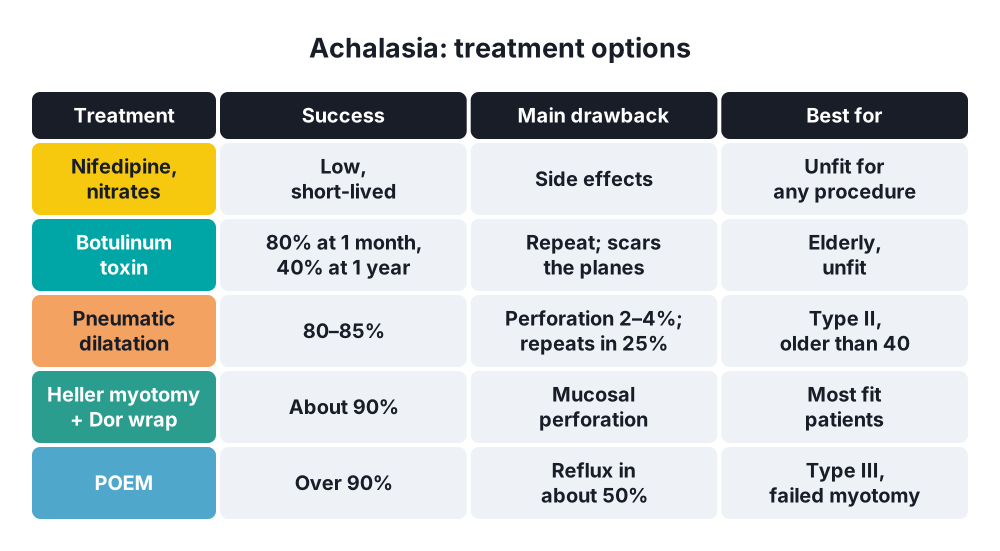
- Drugs → nifedipine or nitrates before meals; short effect, side effects; for patients unfit for anything else
- Botulinum toxin → 100 units injected into the LOS at endoscopy:
- Blocks acetylcholine release
- Relief in about 80% at 1 month, 40% at 1 year
- For the elderly or unfit; scars the planes and makes later myotomy harder
- Pneumatic dilatation:
- Graded balloons (30 → 35 → 40 mm) under X-ray
- Success about 80–85%; about 25% need repeat dilatation
- Perforation in about 2–4%
- Poorer results → age < 40, men, type I and III
Surgical
- Laparoscopic Heller myotomy + partial fundoplication → standard operation:
- Divide the muscle layers (longitudinal and circular) down to the mucosa
- Length → about 6 cm on the oesophagus and 2–3 cm onto the stomach
- Add an anterior (Dor) or posterior (Toupet) partial fundoplication → reflux falls from about 48% to 9%
- Success about 90%
- Complications → mucosal perforation (repaired at once), reflux, recurrent dysphagia
- Peroral endoscopic myotomy (POEM):
- Submucosal tunnel from inside the oesophagus; circular muscle divided
- Success > 90%; best for type III (long myotomy)
- Main drawback → reflux in about 50% (no fundoplication)
- End-stage sigmoid oesophagus or failed treatments → oesophagectomy
- Follow-up → endoscopy surveillance is debated; cancer risk stays raised
10. Complications
Of disease
- Aspiration pneumonia, lung abscess
- Malnutrition, weight loss
- Squamous cell carcinoma → about 10–50 times more risk; late
- Megaoesophagus
Of treatment
- Perforation → dilatation (2–4%), myotomy, POEM
- GORD, peptic stricture, Barrett's oesophagus
- Recurrent dysphagia → incomplete myotomy, scar, tight wrap
Show as a list
Achalasia
- Cause
- Loss of inhibitory neurons
- Chagas disease
- Pseudoachalasia
- Clinical
- Dysphagia solids and liquids
- Regurgitation
- Weight loss
- Diagnosis
- Barium: bird's beak
- Endoscopy
- Manometry: types I-III
- Treatment
- Botulinum toxin
- Pneumatic dilatation
- Heller myotomy + Dor
- POEM
- Complications
- Aspiration
- Squamous carcinoma
- Perforation