Popliteal fossa
The diamond-shaped space behind the knee, home of Baker’s cysts. Key to safe access to the knee joint.
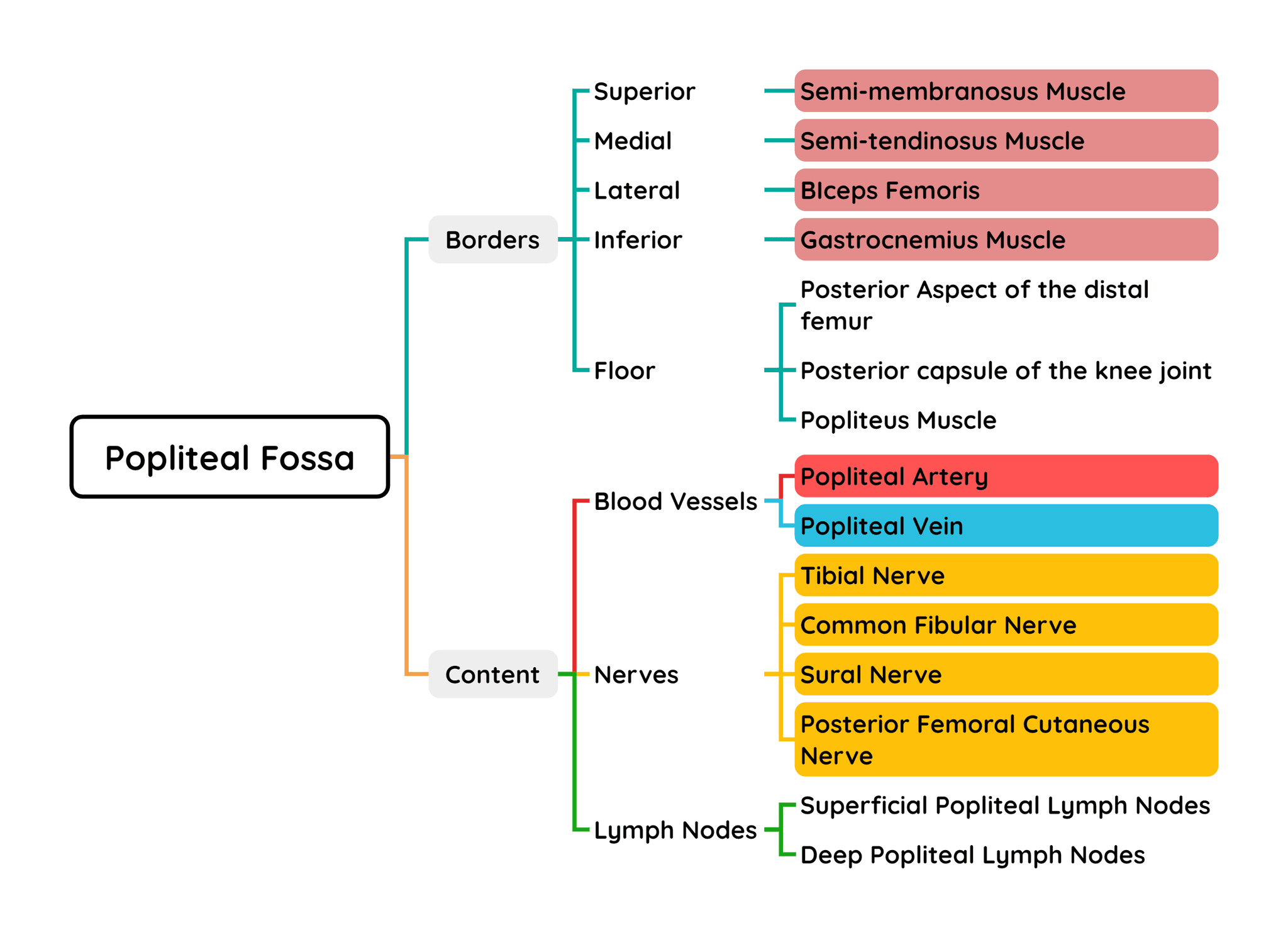
Popliteal Fossa
Borders
- Superior:
- Semi-membranosus
- Medial:
- Semi-Tendinosus
- Lateral:
- Biceps Femoris
- Inferior:
- The two heads of the gastrocnemius muscle
- Floor:
- Posterior Aspect of the distal femur
- Posterior capsule of the knee joint
- Popliteus Muscle
Contents
- Blood Vessels:
- Popliteal Artery and Vein
- The Popliteal Artery is the deepest structure within the Popliteal Fossa
- Short Saphenous Vein
- Popliteal Artery and Vein
- Nerves:
- Tibial Nerve (L4-S3)
- Common Fibular Nerve (L4-S2)
- Sural Nerve (S1,S2)
- Posterior Femoral Cutaneous Nerve (S2,S3)
- Lymph Nodes:
- Superficial Popliteal Lymph Nodes
- Deep Popliteal Lymph Nose
Surgical Anatomy And Surgical Considerations
- Access to the popliteal fossa is achieved via an S-shaped incision. This incision is centered in an oblique manner over the joint line.
- Surgical access to the popliteal fossa, and surgery of the popliteal fossa predisposes the Tibial Nerve (L4-S3) artery to risk of transection.
Chart